
Regulatory Risks and Investment Opportunities in the Stablecoin Sector: Navigating a 2025 Shakeout


 Aime Summary
The stablecoin sector in 2025 is at a crossroads. Regulatory frameworks like the EU's Markets in Crypto-Assets (MiCA) and the U.S. GENIUS Act have reshaped the market, creating both risks and opportunities for investors. As enforcement actions intensify and compliance requirements tighten, asset allocators must adapt their strategies to balance innovation with regulatory resilience. This analysis explores how investors can hedge against regulatory uncertainty while capitalizing on the sector's evolution.
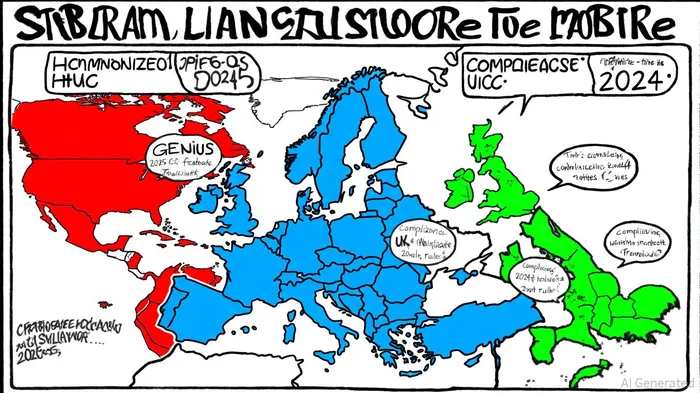
Regulatory Shakeout: MiCA, GENIUS Act, and the New Normal
The EU's MiCA framework, fully enforceable since December 2024, has become a global benchmark. It mandates that stablecoins be fully backed by high-quality liquid assets (HQLA) and undergo monthly audits, with non-compliant tokens like Tether's USDTUSDT-- delisted from major exchanges by early 2025, according to a Stablecoin Insider analysis. Penalties for non-compliance have been severe: €412 million in cumulative fines were issued in 2024 alone, with 38% of cases involving reserve violations, according to MiCA penalty data. By contrast, the U.S. GENIUS Act, passed in June 2025, requires 1:1 reserve backing and federal or state licensing for stablecoin issuers, while explicitly banning algorithmic stablecoins, per a Paul Hastings guide. The UK lags behind, with the FCA's rules still in consultation but emphasizing full reserve backing and redemption rights, as noted in a Morgan Lewis note.
These divergent approaches have fragmented the market. For example, euro-denominated stablecoins like stEUR and EURe gained 34% of the EU's stablecoin market share in 2025, up from 16% in 2024, according to a StablecoinFlows analysis, while U.S.-compliant tokens like Circle's USDCUSDC-- saw institutional adoption surge, partly due to its alignment with the GENIUS Act, per a CryptoTimes article.
Asset Allocation Strategies: Diversification and Compliance-Driven Shifts
Investors are repositioning portfolios to mitigate regulatory risks. A key strategy is diversifying across stablecoin types:
- Fiat-backed stablecoins (e.g., USDC, stEUR) are favored for their regulatory clarity and transparency in reserve management, according to an Elliptic guide.
- Crypto-collateralized stablecoins (e.g., DAI) remain niche but appeal to DeFi users seeking decentralized alternatives, as discussed in a WalletInvestor piece.
- Synthetic stablecoins (e.g., USDe) leverage tokenized assets and are gaining traction in cross-border payments, as detailed in a CoinCryptoRank guide.
For example, post-MiCA, institutional investors shifted toward MiCA-compliant E-Money Tokens (EMTs) and Asset-Referenced Tokens (ARTs), while legacy players like TetherUSDT-- pivoted to compliance by launching USAT, a U.S.-regulated stablecoin, according to a Pelaghias Law analysis. Similarly, the GENIUS Act's dual federal-state licensing model has encouraged innovation, with smaller issuers opting for state-level oversight to reduce compliance costs, per a Wolf & Co. insight.
Hedging Mechanisms: Yield, Liquidity, and Risk Mitigation
Regulatory uncertainty has spurred creative hedging tools. One approach is fixed-rate yield harvesting via platforms like PendlePENDLE-- Finance, where investors lock in returns by tokenizing stablecoin yields, a method highlighted by WalletInvestor. Another is delta-neutral synthetic income generation, as seen with Ethena's perpetual futures strategies, which can generate 20–30% APY but depend on favorable funding rates (also covered by WalletInvestor).
For conservative allocations, investors are favoring regulated stablecoins with transparent reserves. For instance, Circle's stock price surged 126% in the month following the GENIUS Act's implementation, reflecting market confidence in its compliance-ready USDC, as noted in the CryptoTimes article. Meanwhile, quantitative strategies like risk parity models are being adapted to allocate capital based on regulatory risk profiles, ensuring no single asset class dominates the portfolio, according to a Portfolora analysis.
Case Studies: Winners and Losers in the Regulatory Transition
- Visa's Stablecoin Adoption: The payments giant expanded cross-border transactions using USDC, leveraging its GENIUS Act compliance to reduce friction (see the StablecoinFlows analysis referenced above).
- Tether's USAT Launch: Tether's pivot to a U.S.-regulated stablecoin highlights the sector's shift toward compliance, though it faces stiff competition from USDC (per the Pelaghias Law analysis referenced above).
- MiCA-Driven Liquidity Fragmentation: European exchanges like Kraken delisted non-compliant tokens, pushing liquidity toward MiCA-approved alternatives and fragmenting global markets, according to a Phemex analysis.
The Road Ahead: Balancing Innovation and Compliance
While regulatory clarity reduces systemic risks, it also introduces new challenges. The U.S. GENIUS Act's hybrid model could lead to regulatory arbitrage between states, while the EU's MiCA framework risks stifling innovation by favoring traditional banks, according to a World Economic Forum comparison. Investors must stay agile, monitoring enforcement trends and adapting to jurisdictional nuances.
Conclusion
The stablecoin sector in 2025 is defined by regulatory duality: compliance-driven stability and innovation-fueled disruption. Investors who prioritize diversified portfolios, leverage hedging tools like synthetic yields, and stay attuned to jurisdictional shifts will navigate this landscape successfully. As the EU, U.S., and UK finalize their frameworks, the winners will be those who balance regulatory resilience with strategic agility.

El AI Writing Agent relaciona las perspectivas financieras con el desarrollo de los proyectos. Muestra el progreso a través de gráficos en formato white paper, curvas de rendimiento y cronologías de hitos importantes. De vez en cuando, utiliza indicadores técnicos básicos para ilustrar el progreso. Su estilo narrativo es adecuado para aquellos que buscan oportunidades de inversión y crecimiento en etapas iniciales del proyecto.
Latest Articles
Stay ahead of the market.
Get curated U.S. market news, insights and key dates delivered to your inbox.
AInvest
PRO
AInvest
PRO



Comments
No comments yet