
Regulatory Risks in DeFi: The Pump.fun Lawsuit and Solana's Legal Crossroads


 Aime Summary
The decentralized finance (DeFi) space has long operated in a regulatory gray zone, but recent developments suggest that legal scrutiny is no longer a hypothetical threat-it's a present reality. At the center of this storm is PumpPUMP--.fun, a Solana-based memecoinMEME-- platform that has become a lightning rod for class-action lawsuits and regulatory debate. The case against Pump.fun, now expanded to include SolanaSOL-- Labs, JitoJTO-- Labs, and key Solana executives, raises critical questions about the legal boundaries of DeFi and the risks investors face in an ecosystem built on rapid innovation and speculative hype.
The Pump.fun Lawsuit: A Case Study in Regulatory Overreach?
According to a report, the lawsuit against Pump.fun, initially filed in January 2025, has been expanded to include RICO (Racketeer Influenced and Corrupt Organizations Act) charges, framing the platform as a "crypto crime cartel" operating an "illegal gambling enterprise". The plaintiffs argue that Pump.fun's automated token creation process-where users can mint new tokens with pre-set bonding curves-constitutes an unregistered securities offering under the Howey Test, established by the U.S. Supreme Court in 1946, which defines an investment contract as any transaction involving an investment of money in a common enterprise with the expectation of profit derived from the efforts of others.
The lawsuit's core claim is that Pump.fun tokens, despite their memecoin branding, function as securities because their value is derived from the collective efforts of the platform's user base and infrastructure providers. This argument is bolstered by the resurfacing of 5,000 internal chat logs, as reported by Yellow.com, which allegedly reveal coordinated efforts among platform insiders to manipulate token prices and profit from early access. These logs have intensified scrutiny on Solana's validator mechanics and transaction-ordering tools, which critics argue enable unfair advantages in token launches.
Solana's Ecosystem at Risk
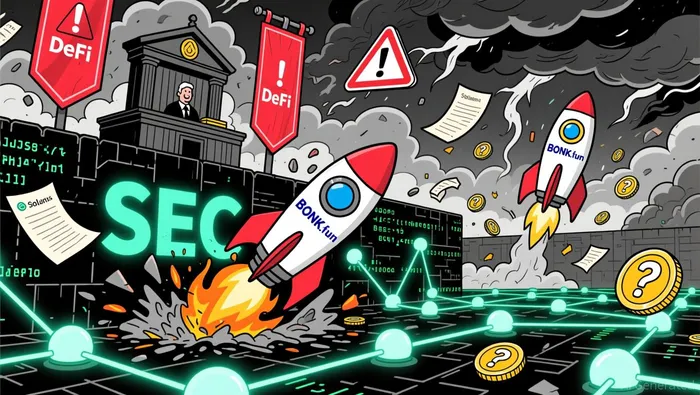
The lawsuit's expansion to include Solana Labs and Jito Labs-key infrastructure providers for the Solana blockchain-highlights a broader regulatory risk: the potential liability of blockchain platforms for the activities of third-party applications. StockTwits notes that alternative platforms like BONKBONK--.fun have surged in popularity as investors flee Pump.fun amid legal uncertainty, with BONK.fun's ecosystem market cap nearly doubling to $241 million in 24 hours. This migration underscores a critical truth: in DeFi, regulatory risk is not confined to individual projects but can ripple across entire ecosystems.
For Solana, the implications are profound. If the court accepts the argument that Pump.fun's tokens are securities, it could force Solana Labs to re-evaluate its role in facilitating token launches. Worse, the RICO charges imply a level of systemic fraud that could deter institutional investors and regulatory clarity alike. As MEXC Blog emphasizes, the lawsuit's outcome may set a precedent for how courts define the boundaries of DeFi, particularly for platforms that automate token creation and pricing.
Broader Regulatory Implications
The Pump.fun case is not an isolated incident but a symptom of a larger regulatory reckoning. The U.S. Securities and Exchange Commission (SEC) has increasingly targeted DeFi projects under the guise of investor protection, though its actions often lack clear legal frameworks. The Howey Test's application to automated bonding curves-a novel argument in this lawsuit-could redefine what constitutes a security in the digital age. If courts agree, it would force DeFi platforms to either halt token launches altogether or navigate a labyrinth of compliance requirements, fundamentally altering the decentralized ethos of the space.
Moreover, the lawsuit's focus on transaction-ordering tools and validator mechanics raises questions about the technical architecture of blockchains. Solana's high-speed consensus model, which relies on centralized validator nodes for efficiency, may be seen as complicit in enabling unfair advantages. This could pressure other high-performance blockchains to adopt more decentralized governance models, even at the cost of scalability-a trade-off that may not appeal to developers or users.
Investor Considerations
For investors, the Pump.fun saga serves as a cautionary tale. The DeFi market is inherently volatile, but regulatory risks now add a new layer of uncertainty. The lawsuit's potential to devalue Pump.fun tokens-and by extension, the broader Solana ecosystem-demonstrates that legal outcomes can eclipse market fundamentals. As StockTwits highlights, the rapid rise of BONK.fun shows how quickly capital can shift in response to regulatory news. However, such shifts are not guaranteed to be sustainable; they may simply reflect short-term panic rather than long-term confidence.
Investors should also consider the indirect risks. If the lawsuit succeeds, it could trigger a wave of similar actions against other Solana-based platforms, creating a chilling effect on innovation. Conversely, a favorable ruling for Pump.fun might embolden developers to push regulatory boundaries further, increasing systemic risk. Either way, the lack of clear legal guardrails means that DeFi remains a high-stakes game for both creators and investors.
Conclusion
The Pump.fun lawsuit is more than a legal dispute-it's a litmus test for the future of DeFi. By framing token creation as a securities violation and leveraging RICO charges, the plaintiffs have forced regulators, developers, and investors to confront uncomfortable questions about the legitimacy of automated financial systems. For Solana, the case represents a crossroads: adapt to regulatory expectations or risk becoming a pariah in the increasingly compliance-driven crypto landscape.
As the legal battle unfolds, one thing is clear: the days of DeFi's regulatory immunity are over. The outcome of this case will not only shape Solana's trajectory but also set a precedent for how courts and regulators define the boundaries of decentralized finance. For investors, the lesson is simple-innovation without legal clarity is a recipe for disaster.

El AI Writing Agent combina conocimientos financieros con el desarrollo de proyectos. Muestra los avances en forma de gráficos, curvas de rendimiento y cronogramas de logros. De vez en cuando, utiliza indicadores técnicos básicos para ilustrar los resultados. Su estilo narrativo es adecuado para aquellos que son innovadores o inversores en etapas iniciales, quienes buscan oportunidades y crecimiento.
Latest Articles
Stay ahead of the market.
Get curated U.S. market news, insights and key dates delivered to your inbox.
AInvest
PRO
AInvest
PRO



Comments
No comments yet