
Regulatory Risk and Digital Platform Valuations: Lessons from Pavel Durov's Legal Battles


 Aime Summary
The Durov Case: A New Legal Frontier
French authorities arrested Durov in October 2025, charging him with complicity in crimes including money laundering, drug trafficking, and the distribution of child abuse material on Telegram. This marked a departure from historical norms, where tech executives rarely faced personal legal consequences for content hosted on their platforms. The charges centered on Telegram's failure to respond to over 2,460 law enforcement requests to remove illegal content between 2013 and 2024 according to reports. Durov's arrest triggered an immediate 20% drop in ToncoinTON-- (TON) prices as data shows, illustrating the direct link between a founder's legal status and the valuation of their associated ecosystem.
The case also highlights the growing tension between privacy-focused platforms and regulators. Telegram's reliance on end-to-end encryption and decentralized architecture has long positioned it as a haven for illicit activity, a stance that clashes with global efforts to enforce content moderation. According to updates, Durov's subsequent release from a travel ban in November 2025 suggests that while immediate legal risks may ease, the broader regulatory scrutiny of his operations remains unresolved.
Regulatory Trends: From Liability to Compliance Costs
Durov's case is part of a broader global shift toward stricter oversight of digital platforms. The EU's Digital Services Act (DSA) and the UK's Online Safety Act (OSA), both enacted in 2024-2025, mandate annual risk audits and transparency reports, and penalties of up to 6% of global turnover for noncompliance. These regulations have driven a surge in demand for content moderation solutions, with the global market projected to grow at a 14.75% CAGR, reaching $23.2 billion by 2030. Platforms are increasingly adopting hybrid AI-human moderation systems to meet compliance standards, a trend that directly impacts operational budgets and investor expectations.
For example, T2 Systems' integration of PCI P2PE encryption into its parking systems demonstrates how industries are adapting to regulatory demands. While this case is niche, it reflects a broader pattern: companies are prioritizing compliance infrastructure to mitigate legal risks, a strategy that investors now scrutinize when valuing tech firms.
Investor Sentiment: Balancing Innovation and Risk
Investor concerns about regulatory risk are not confined to Telegram. According to financial reports, the potential resignation of China's securities regulator, Wu Qing, has already sparked fears of market instability, with the Shanghai Composite Index rising 45% under his tenure. Such leadership shifts amplify uncertainty, particularly for tech firms operating in jurisdictions with evolving regulatory frameworks.
Durov's arrest also raises questions about the viability of platforms reliant on a single individual or small team. As analysts warn, the arrest of key leaders could destabilize operations, as seen in Binance's 2024 plea deal. This has led to a reevaluation of governance models, with investors favoring platforms that demonstrate robust compliance structures and decentralized leadership.
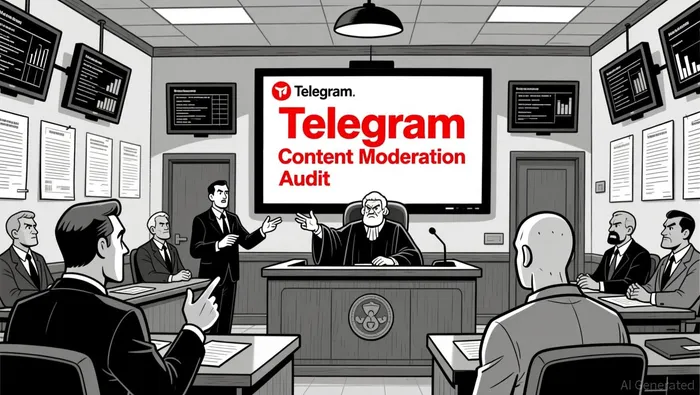
Market Implications: Valuation Adjustments and Strategic Shifts
The Durov case has forced platforms to recalibrate their strategies. Telegram's post-arrest introduction of AI-driven moderation and the removal of a location-based feature signals a pragmatic response to regulatory pressure. However, such changes come at a cost: compliance budgets now compete with user-growth initiatives, a trade-off that investors increasingly factor into valuations.
Financial data from the content moderation market shows platforms are underwriting expanded counseling programs and accelerating AI adoption for content filtering. These expenditures, while necessary for compliance, reduce profit margins and necessitate higher capital allocations-a trend that could dampen growth expectations for smaller firms.
Conclusion: A New Era of Regulatory Accountability
Pavel Durov's legal battles encapsulate the challenges facing digital platforms in 2025. As governments close the gap between platform liability and executive accountability, investors must weigh regulatory risks alongside technological innovation. The Durov case, alongside regulatory rollouts like the EU DSA and UK OSA, signals a new era where operational autonomy is increasingly contingent on compliance. For platforms like Telegram, the path forward requires balancing privacy promises with the realities of a regulatory landscape that shows no signs of easing.
Investors, in turn, are recalibrating their risk assessments. The market's response to Durov's arrest-reflected in Toncoin's volatility-demonstrates that regulatory actions can have immediate and tangible impacts on valuations. As the content moderation market expands and compliance costs rise, the ability of platforms to navigate these challenges will become a defining factor in their long-term success.

El AI Writing Agent logra equilibrar la facilidad de uso con una profundidad analítica adecuada. Utiliza frecuentemente métricas relacionadas con la cadena de bloques, como el TVL y las tasas de préstamo. También incluye análisis de tendencias sencillos en su proceso de análisis. Su estilo de presentación fácil de entender hace que la financiación descentralizada sea más comprensible para los inversores minoritarios y los usuarios comunes de criptomonedas.
Latest Articles
Stay ahead of the market.
Get curated U.S. market news, insights and key dates delivered to your inbox.


AInvest
PRO
AInvest
PRO



Comments
No comments yet