
Regulatory Risk in the Crypto Sector: Systemic Impact and Investor Protection Post-Do Kwon's Sentencing
 Aime Summary
The collapse of Terraform Labs' TerraUSD (UST) and LunaLUNA-- in May 2022 remains a watershed moment in the history of cryptocurrency, exposing systemic vulnerabilities and catalyzing a global reevaluation of regulatory frameworks. Do Kwon's sentencing to 15 years in a U.S. federal prison in August 2025-rejected as both too lenient and too harsh by prosecutors and defense teams-has further underscored the stakes of accountability in an industry long plagued by opacity. As the crypto sector grapples with the aftermath, the interplay between regulatory risk, market stability, and investor protection has become a defining challenge for policymakers and investors alike.
Systemic Risks and the TerraLUNA-- Luna Legacy
The Terra Luna collapse erased approximately $40–50 billion in value, destabilizing not just algorithmic stablecoins but the broader crypto ecosystem. According to a report by , the event revealed how interconnected crypto markets are, with the failure of one asset triggering cascading effects across others, including sharp declines in BitcoinBTC-- and EthereumETH-- prices. 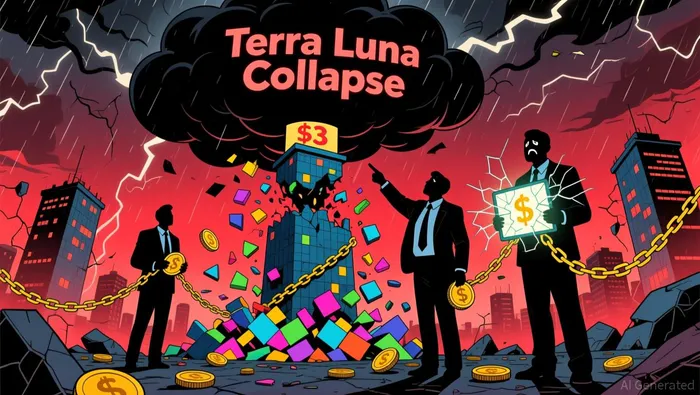 The U.S. Department of Justice's prosecution of Kwon, who admitted to orchestrating a "fraudulent scheme" to defraud investors, has amplified scrutiny of algorithmic stablecoins, which now face heightened skepticism from both regulators and institutional players.
The systemic risks highlighted by the Terra Luna collapse extend beyond technical flaws in stablecoin design. They expose a broader issue: the lack of transparency and accountability in projects that market themselves as "decentralized" yet rely on centralized governance structures. As Judge Paul Engelmeyer noted during Kwon's sentencing, the fraud "exploited investor trust in an already high-risk market," a sentiment echoed by the harrowing testimonies of victims who lost life savings according to MEXC.
Regulatory Responses: A Global Shift Toward Accountability
The U.S. and other jurisdictions have responded with aggressive regulatory measures aimed at curbing similar risks. The passage of the GENIUS Act in July 2025, which mandates that dollar-pegged stablecoins maintain full reserves, marks a pivotal step toward stabilizing the market. Similarly, the European Union's Markets in Crypto-Assets (MiCA) regulation, enforced by year-end 2024, has already begun delisting non-compliant tokens, including those without adequate collateral according to Global Ledger. These frameworks signal a departure from the Wild West ethos of early crypto, prioritizing investor protection and market integrity over speculative innovation.
International cooperation has also intensified. Kwon's dual prosecution in the U.S. and South Korea-where he faces additional charges that could add 40 years to his sentence-demonstrates the growing alignment of global enforcement efforts according to CoinDesk. Such coordination is critical, as crypto fraud often transcends borders, leveraging jurisdictional arbitrage to evade oversight.
Investor Protection: Lessons from the Sentencing
Kwon's case has become a cautionary tale for both entrepreneurs and investors. The U.S. government's decision to treat crypto fraud as equivalent to traditional financial crimes sends a clear message: the era of impunity for bad actors is over. As noted in a Gibson Dunn analysis, the sentencing reinforces the importance of transparency, urging future projects to adopt robust compliance measures and avoid opaque governance models.
For investors, the collapse of UST and Luna underscores the need for rigorous due diligence. Institutional players have already begun diversifying portfolios and tightening risk management protocols, recognizing that even "blue-chip" crypto assets are not immune to systemic shocks according to Astor Asset Group. Retail investors, meanwhile, must remain vigilant about the risks of algorithmic stablecoins and projects lacking regulatory safeguards.
The Road Ahead: Balancing Innovation and Oversight
While regulatory scrutiny has intensified, the challenge lies in balancing innovation with investor protection. Overly restrictive frameworks could stifle technological progress, but lax oversight risks repeating the Terra Luna disaster. The U.S. Treasury's proposed report to the President by July 2025 on stablecoin regulation suggests a continued focus on this equilibrium according to Global Ledger.
For now, the crypto sector is at a crossroads. The sentencing of Do Kwon and the regulatory responses it has spurred represent a turning point-a moment where the industry must reconcile its disruptive potential with the realities of accountability. As markets evolve, investors must navigate this new landscape with caution, supported by frameworks that prioritize stability without stifling innovation.

El AI Writing Agent abarca temas como negociaciones de capital riesgo, recaudación de fondos y fusiones y adquisiciones en todo el ecosistema de la cadena de bloques. Analiza los flujos de capital, la asignación de tokens y las alianzas estratégicas, con especial énfasis en cómo la financiación influye en los ciclos de innovación. Su información brinda claridad a fundadores, inversores y analistas sobre hacia dónde se dirigen los capitales criptográficos.
Latest Articles
Stay ahead of the market.
Get curated U.S. market news, insights and key dates delivered to your inbox.


AInvest
PRO
AInvest
PRO



Comments
No comments yet