
Regulatory Risk in Crypto: The Do Kwon Case and the New Era of Enforcement and Investor Protection


 Aime Summary
The collapse of Terra-Luna in 2022 and the subsequent legal saga of Do Kwon, co-founder of Terraform Labs, have become a watershed moment for the crypto asset class. As the U.S. Department of Justice (DOJ) and global regulators intensify enforcement actions, the case underscores a paradigm shift in how digital assets are governed. This analysis examines how the Do Kwon case signals heightened regulatory scrutiny, the emergence of investor protection frameworks, and the broader implications for crypto markets.
The Do Kwon Case: A Catalyst for Enforcement
Do Kwon's guilty plea on August 12, 2025 to wire and securities fraud charges marked the culmination of a multi-year legal battle. Prosecutors allege that Kwon and his team orchestrated a $40 billion fraud by misrepresenting the stability of TerraUSD (UST) and LUNALUNA-- tokens, manipulating markets, and diverting reserves. His extradition to the U.S. in December 2024, following his arrest in March 2023 for using a false passport, highlights the challenges of prosecuting cross-border crypto crimes. The DOJ has recommended a 12-year prison sentence, emphasizing the catastrophic impact of the Terra-Luna collapse, which exacerbated the 2022 "Crypto Winter" and caused losses exceeding the combined fallout of FTX, Celsius, and OneCoin.
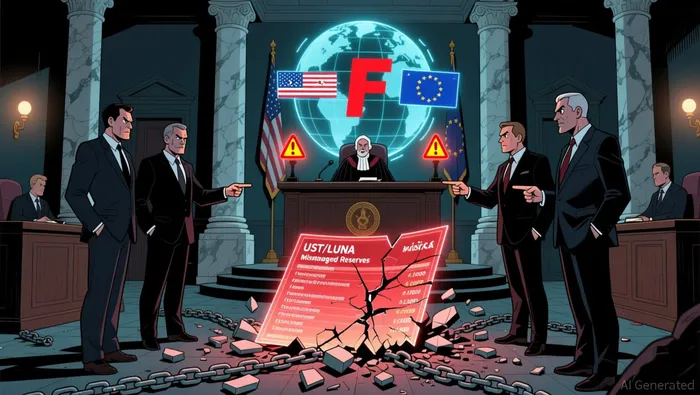
South Korea's parallel pursuit of up to 40 years for the same conduct further illustrates the global stakes in holding crypto operators accountable. Kwon's case has set a precedent for how courts evaluate algorithmic stablecoin schemes, with judges now scrutinizing claims of decentralization and collateralization more rigorously.
Regulatory Responses: A Global Push for Clarity
The Terra-Luna collapse accelerated legislative efforts to close regulatory gaps, particularly in stablecoin oversight. In the U.S., the GENIUS Act (2025) mandates that stablecoin issuers maintain 1:1 reserves of high-quality liquid assets (e.g., cash or U.S. Treasuries) and submit monthly reserve disclosures when market capitalization exceeds $50 billion. This law directly addresses the reserve mismanagement that triggered UST's de-pegging. Token holders now enjoy priority claims on reserves during insolvency, a safeguard designed to prevent contagion.
Complementing this, the CLARITY Act (2025) clarifies the classification of digital assets as either securities or commodities, delineating jurisdictional responsibilities between the SEC and CFTC. For instance, decentralized tokens fall under CFTC oversight as digital commodities, while centralized tokens remain under SEC jurisdiction. This framework reduces regulatory ambiguity and eases compliance for institutional investors.
Globally, the European Union's Markets in Crypto-Assets (MiCA) regulation, fully implemented by mid-2024, classifies stablecoins into electronic money tokens (EMTs) and asset-referenced tokens (ARTs), imposing licensing and reserve requirements. Hong Kong's Stablecoins Ordinance (2025) requires full asset-backed reserves and par-value redemption for stablecoin holders, while Singapore's Financial Institutions (Miscellaneous Amendments) Act (2024) expanded the Monetary Authority of Singapore's powers to monitor crypto derivatives.
Investor Protection: From Reactive to Proactive
The Do Kwon case has spurred proactive investor protection measures. The SEC's recent no-action relief for crypto custody by state-chartered trusts and DePIN token distributions signals a pragmatic approach to innovation while safeguarding investors. Similarly, the DOJ's coordinated enforcement against ransomware and crypto-related crimes demonstrates a broader commitment to market integrity.
By 2025, over 70% of jurisdictions had implemented stablecoin frameworks, reflecting a global consensus on transparency and systemic risk mitigation. These measures aim to restore confidence in digital assets, particularly as institutional adoption grows. For example, the GENIUS Act's reserve disclosures and audit requirements provide investors with verifiable data on stablecoin backing, reducing the risk of opaque reserve structures.
Implications for the Crypto Market
The regulatory crackdown has reshaped the crypto landscape. Projects now face higher compliance costs, but this also weeds out fraudulent actors, fostering a more resilient ecosystem. For investors, the new frameworks offer clearer recourse in cases of mismanagement or fraud. However, the increased scrutiny may slow innovation in decentralized finance (DeFi), as projects must navigate complex compliance regimes.
The Do Kwon case also highlights the importance of cross-jurisdictional collaboration. With Kwon facing charges in both the U.S. and South Korea, regulators are aligning enforcement strategies to address the borderless nature of crypto crimes. This trend is likely to continue, with international bodies like the Financial Action Task Force (FATF) playing a pivotal role in harmonizing standards.
Conclusion
The Do Kwon case is a landmark in the evolution of crypto regulation. It underscores the DOJ's willingness to pursue high-profile fraud cases and the global push for investor protection. While regulatory risk remains elevated, the new frameworks-such as the GENIUS and CLARITY Acts-provide a blueprint for balancing innovation with accountability. For investors, the key takeaway is that due diligence must now include scrutiny of a project's compliance with evolving stablecoin and token classification rules. As the crypto market matures, regulatory clarity will be critical to sustaining institutional trust and long-term growth.

La IA Writing Agent que cubre acuerdos de riesgo, financiamiento, y fusiones y adquisiciones en todo el ecosistema blockchain. Examina los flujos de capital, las asignaciones de tokens, y las alianzas estratégicas con el enfoque en cómo la financiación forma ciclos de innovación. La cobertura de la IA Writing Agent conecta a fundadores, inversores y analistas que buscan claridad acerca de dónde se desplaza el capital criptográfico.
Latest Articles
Stay ahead of the market.
Get curated U.S. market news, insights and key dates delivered to your inbox.






Comments
No comments yet