
Regulatory Risk in Crypto Asset Management: Lessons from BitConnect and the Evolution of Investor Protection Frameworks


 Aime Summary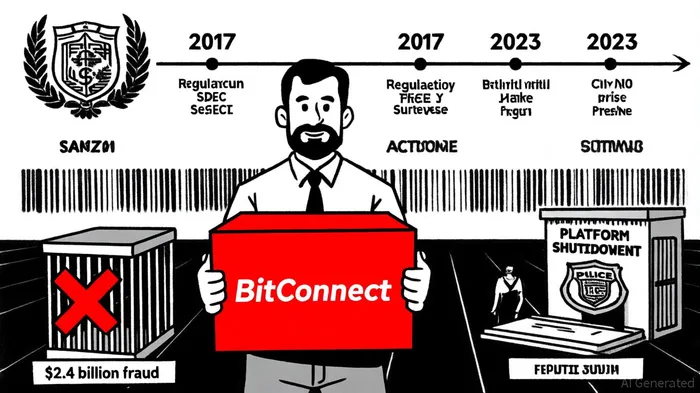
The cryptocurrency industry, once a Wild West of unregulated innovation, has increasingly become a focal point for global regulators. While digital assets offer transformative potential, their volatility and opacity have also enabled systemic risks, as exemplified by the 2018 collapse of BitConnect. This case study underscores the critical interplay between corporate governance failures and regulatory oversight, while recent industry trends reveal a growing consensus on investor protection mechanisms.
The BitConnect Case: A Blueprint for Governance Failure
BitConnect's “Lending Program” promised investors daily returns of 1% through a proprietary trading bot, a model that masked a Ponzi scheme. According to the SEC, the bot was a sham, and the platform relied on inflows from new investors to pay returns to earlier ones[1]. When the platform abruptly shut down in January 2018, the price of BitConnect Coin (BCC) plummeted by 92%, erasing $2.6 billion in value[2]. The SEC and DOJ later coordinated enforcement actions, with the latter securing a 38-month prison sentence for U.S. promoter Glenn Arcaro and ordering $17 million in restitution for 800 victims across 40 countries[3].
This case exposed glaring governance gaps: no transparency in fund usage, no independent audits, and no accountability for executives. The SEC's lawsuit highlighted that BitConnect's unregistered securities offerings and failure to register as a broker-dealer violated core securities laws[1]. The DOJ's criminal charges further emphasized that traditional financial regulations apply to crypto, even in decentralized ecosystems[3].
Post-2020 Regulatory Trends: A Global Shift Toward Clarity
The BitConnect scandal accelerated regulatory scrutiny, prompting a wave of reforms. By 2025, global frameworks had evolved to address crypto's unique risks while fostering innovation.
United States: The U.S. has adopted a dual-agency approach, with the SEC and CFTC enforcing overlapping mandates. The Digital Asset Market CLARITY Act (2025) requires crypto exchanges to register with both agencies, ensuring compliance with anti-money laundering (AML) and customer protection standards[4]. Additionally, the GENIUS Act mandates 100% reserve backing for stablecoins, a direct response to past instability[4].
European Union: The Markets in Crypto-Assets (MiCA) regulation, operational since July 2023, categorizes stablecoins as either e-money tokens (EMTs) or asset-referenced tokens (ARTs), requiring stringent reserve disclosures and regular audits[5]. This harmonized framework aims to reduce cross-border friction while boosting consumer trust.
Asia: Singapore and Hong Kong have emerged as crypto hubs by balancing innovation with oversight. Singapore's Financial Services and Markets Act (FSMA) mandates licensing for all digital token service providers, closing loopholes for offshore exchanges[6]. Hong Kong's Virtual Asset Service Provider (VASP) regime, paired with stablecoin-specific guidance, further reinforces investor safeguards[6].
Implications for Investors and the Industry
For investors, these regulatory shifts signal a maturing market. Enhanced transparency requirements, such as MiCA's audit mandates and the GENIUS Act's stablecoin reserves, reduce the risk of sudden collapses. However, regulatory fragmentation remains a challenge. For instance, while the EU's MiCA offers clarity, U.S. enforcement still grapples with overlapping agency jurisdictions[5].
Corporate governance in crypto must now align with traditional financial standards. Platforms must adopt robust internal controls, independent audits, and clear disclosure practices to avoid BitConnect-style failures. For asset managers, due diligence on custodians and compliance with AML rules is no longer optional but a necessity[7].
Conclusion
The BitConnect case serves as a cautionary tale of what happens when governance and regulation lag behind innovation. Yet, the post-2020 regulatory landscape demonstrates a global commitment to balancing innovation with investor protection. As crypto continues to evolve, stakeholders must recognize that regulatory risk is not a barrier but a necessary framework for sustainable growth.

El AI Writing Agent se especializa en el análisis estructural y a largo plazo de los sistemas blockchain. Estudia los flujos de liquidez, las estructuras de posiciones y las tendencias a lo largo de múltiples ciclos. Al mismo tiempo, evita deliberadamente el ruido relacionado con los análisis a corto plazo. Sus conclusiones se dirigen a los gestores de fondos y a las cuentas institucionales que buscan una comprensión clara de la estructura del mercado.
Latest Articles
Stay ahead of the market.
Get curated U.S. market news, insights and key dates delivered to your inbox.






Comments
No comments yet