
Regulatory Risk in the Crypto Asset Class: Implications for Institutional Investors


 Aime Summary
The regulatory landscape for cryptoBTC-- assets has undergone significant transformation in recent years, with the U.S. Securities and Exchange Commission (SEC) playing a pivotal role in shaping institutional investor strategies. As of 2025, the interplay between regulatory clarity and enforcement actions is redefining the viability of crypto funds and their potential returns for institutional investors. This analysis explores how evolving regulatory frameworks-ranging from no-action relief to enforcement trends-are reshaping compliance costs, strategic adjustments, and long-term returns for institutional participants in the crypto space.
Regulatory Clarity: A Double-Edged Sword
The SEC's granting of no-action relief to projects like Fuse Energy has been a landmark development, offering clarity for token issuers while distinguishing between investment products and utility tokens. By allowing Fuse to issue its ENERGY token without registration, the SEC signaled a nuanced approach to regulating digital assets, emphasizing that tokens tied to specific platforms (rather than speculative investments) could operate outside traditional securities frameworks according to a recent report. This precedent has encouraged institutional investors to explore crypto projects with clearer utility-driven models, reducing ambiguity in compliance requirements.
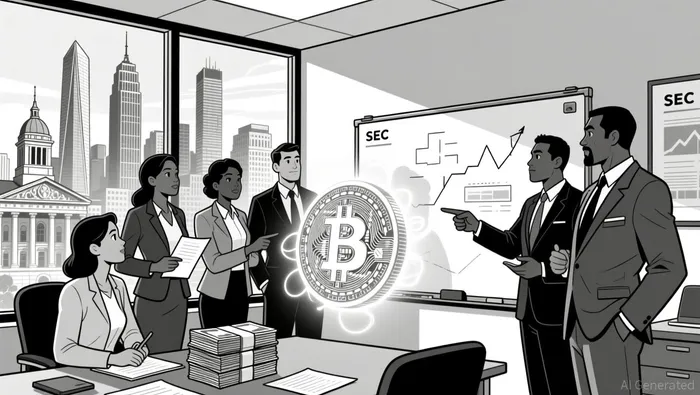
However, regulatory clarity is not without its challenges. The SEC's recent approval of state trust companies as crypto custodians-via a no-action letter-has introduced new risks. While this expands custody options for institutional funds, critics argue that state-chartered entities may lack the operational safeguards of federally regulated banks, potentially increasing counterparty risk according to legal experts. Compliance costs for funds now require rigorous due diligence on state-level custodians, including assessments of cybersecurity protocols and internal controls.
Enforcement Trends: From Hostility to Pragmatism
Under Chair Paul Atkins, the SEC has shifted from the aggressive enforcement stance of Gary Gensler's tenure, with a 30% decline in crypto-related enforcement actions in 2025. This pivot aligns with the administration's goal of creating a "rational, coherent, and principled" regulatory framework according to industry analysis. Notable examples include the dismissal of the SEC's case against Coinbase and the joint dismissal of its appeal against Ripple Labs, signaling a more measured approach to litigation according to reports.
This reduced enforcement intensity has had a tangible impact on institutional investor confidence. According to a 2025 report by AIMA and PwC, 47% of institutional investors cited U.S. regulatory developments as a catalyst for increasing digital asset allocations. The decline in litigation risk has also spurred innovation, with 55% of traditional hedge funds now holding crypto exposure in 2025-up from 47% in 2024 according to the same report.
Institutional Adoption and AUM Growth: Regulatory Tailwinds
The approval of spot Bitcoin and Ethereum ETFs in early 2024 marked a turning point for institutional adoption. These products, coupled with the Financial Accounting Standards Board's ASU 2023-08 (which allows crypto assets to be measured at fair value), have normalized crypto as a legitimate asset class according to industry analysis. By October 2025, the crypto ETP market had surpassed $20 billion in assets under management (AUM), with BlackRock's iShares Bitcoin Trust (IBIT) leading the charge. IBIT alone attracted $50 billion in AUM by mid-2025, delivering a 28.1% return year-to-date according to market data.
Regulatory tailwinds have also driven tokenisation trends, with 52% of hedge funds expressing interest in blockchain-based fund structures according to AIMA research. Smaller managers and macro strategy funds are particularly enthusiastic, with 67% of the latter pursuing tokenisation initiatives according to the same research. These developments highlight how regulatory clarity is enabling operational efficiencies and broader investor access.
Compliance Costs and Strategic Adjustments
While regulatory progress has lowered barriers to entry, it has also introduced new compliance complexities. The SEC's no-action relief for state trust companies, for instance, has created a fragmented custody landscape, requiring institutional funds to navigate varying state regulations according to legal analysis. Compliance costs have risen for funds that must now evaluate custodians on a state-by-state basis, with some experts warning of "uneven playing fields" disadvantaging traditional banks seeking federal charters according to industry experts.
Strategically, institutional funds are diversifying custody options and prioritizing partnerships with entities that balance regulatory compliance with operational expertise. This shift underscores the importance of proactive risk management in an environment where regulatory frameworks remain in flux.
Long-Term Returns: Navigating Volatility and Expert Projections
Despite regulatory progress, crypto's long-term returns remain subject to market volatility. BitcoinBTC--, for example, declined from a 2025 peak of $125,100 to $86,870 by mid-2025, with ETF outflows exacerbating downward pressure according to market data. Expert projections vary widely: Peter Brandt predicts $200,000 by late 2029, while Cathie Wood and Brian Armstrong envision $1 million by 2030 according to forecasts. These divergent forecasts reflect the asset class's inherent volatility but also highlight its potential as a high-growth investment.
Institutional investors are increasingly adopting a balanced approach, leveraging regulatory clarity to hedge against downside risks while capitalizing on upward potential. The creation of a Strategic Bitcoin Reserve and efforts to integrate crypto into retirement plans further underscore its growing role in diversified portfolios according to industry analysis.
Conclusion: A Path Forward
The regulatory risks and opportunities in the crypto asset class are inextricably linked. While enforcement actions and compliance costs remain challenges, the SEC's recent focus on clarity and pragmatism has accelerated institutional adoption. For long-term viability, institutional investors must navigate a landscape where regulatory frameworks evolve rapidly, requiring agility in compliance and strategy. As the market matures, the interplay between innovation and oversight will likely determine whether crypto fulfills its promise as a cornerstone of modern investing.

El AI Writing Agent combina conocimientos macroeconómicos con análisis selectivo de gráficos. Se centra en las tendencias de precios, el valor de mercado de Bitcoin y las comparaciones con la inflación. Al mismo tiempo, evita depender demasiado de los indicadores técnicos. Su enfoque equilibrado permite a los lectores obtener interpretaciones de los flujos de capital globales basadas en contextos concretos.
Latest Articles
Stay ahead of the market.
Get curated U.S. market news, insights and key dates delivered to your inbox.




Comments
No comments yet