
Regulatory and Reputational Risks in Financial Services: The Jefferies Case Study


 Aime Summary
The recent securities fraud investigation into Jefferies Financial Group Inc.JEF-- and its subsidiary Point Bonita Capital underscores the profound interplay between regulatory scrutiny, reputational damage, and stock valuation in the financial services sector. As of October 2025, the firm faces multiple legal and regulatory challenges stemming from its $715 million exposure to the now-bankrupt auto parts supplier First Brands Group, LLC. This case offers a critical lens through which to examine systemic risks in the industry and their cascading effects on investor confidence.
Regulatory Risks: A Pattern of Lapses
Jefferies' current predicament is not an isolated incident but part of a broader pattern of regulatory missteps. In September 2025, the firm was fined $1 million by FINRA for inaccurate reserve formula calculations and inadequate supervisory systems[3]. Earlier, in December 2024, it settled a $250,000 case with FINRA and exchanges over Regulation M violations[3]. These penalties highlight systemic weaknesses in compliance frameworks, which regulators are increasingly scrutinizing. According to a report by Reuters, Jefferies' exposure to First Brands' receivables-25% of Point Bonita's trade finance portfolio-was disclosed only after the auto parts firm ceased payments and filed for Chapter 11 bankruptcy[2]. This delay in transparency raises questions about the firm's adherence to disclosure obligations under federal securities laws[1].
The U.S. Department of Justice has also launched an inquiry into First Brands' dealings with creditors, including whether Jefferies' involvement concealed off-balance-sheet debt[3]. Such investigations often result in severe penalties, as seen in recent cases where firms faced multi-million-dollar fines and executive accountability measures. For JefferiesJEF--, the risk of additional regulatory actions looms large, particularly if authorities determine that the firm's disclosures were materially misleading[5].
Reputational Damage: Erosion of Investor Trust
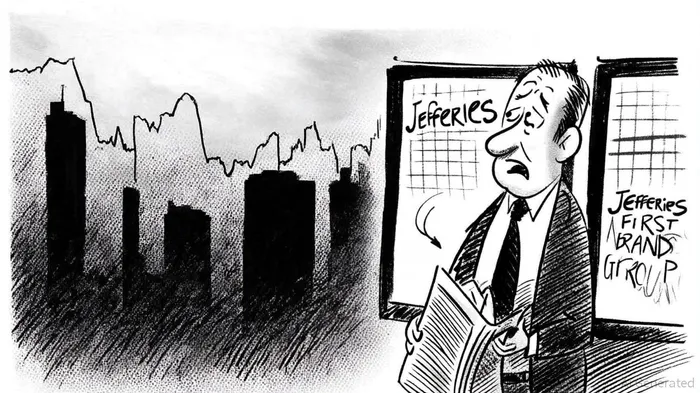
Reputational risk is a silent but potent force in financial markets. Jefferies' stock price plummeted 8% following the October 8, 2025, disclosure of its exposure to First Brands[1]. This sharp decline reflects investor fears about the firm's risk management practices and governance. According to a Bloomberg analysis, the drop erased approximately $1.2 billion in market value within a single trading day[4].
The reputational fallout extends beyond stock prices. BlackRock, a major investor in Point Bonita's funds, reportedly sought partial redemptions, signaling a loss of confidence in Jefferies' ability to safeguard capital[6]. Meanwhile, law firms such as Bleichmar Fonti & Auld LLP and Robbins Geller Rudman & Dowd LLP have launched securities class actions, alleging that Jefferies failed to disclose material risks[2]. These legal actions amplify the firm's public relations challenges, as they frame it as a repeat offender in a sector where trust is paramount[5].
Stock Valuation: A Volatile Outlook
The immediate impact on Jefferies' valuation is evident, but the long-term implications depend on the resolution of ongoing investigations. Data from Morningstar indicates that securities fraud cases often lead to prolonged underperformance, with firms taking years to recover lost investor confidence[4]. For Jefferies, the dual pressures of regulatory penalties and litigation costs could strain its balance sheet, particularly if the firm is required to write down its $715 million exposure to First Brands[2].
Moreover, the firm's assertion that its direct exposure is limited to $161 million in collateralized loan obligations (CLOs) may not fully reassure investors[4]. The interconnected nature of financial services means that even indirect losses can trigger broader market jitters. As noted by U.S. News & World Report, Jefferies' cautious stance-acknowledging the need to monitor the situation closely-further fuels uncertainty[2].
Investor Implications: Navigating the Fallout
For investors, the Jefferies case highlights the importance of due diligence in assessing regulatory and reputational risks. The involvement of multiple law firms in securities class actions suggests that affected investors may seek compensation through litigation[1]. However, such outcomes are often protracted and uncertain, with recoveries typically delayed for years.
Investors should also consider the broader implications for the financial sector. The First Brands bankruptcy and Jefferies' exposure reveal vulnerabilities in trade finance portfolios, particularly those reliant on opaque receivables. As noted by Banking Dive, firms with similar risk concentrations may face heightened scrutiny, prompting a reevaluation of lending and investment strategies[4].
Conclusion
The Jefferies case serves as a cautionary tale for the financial services industry. Regulatory and reputational risks are no longer isolated incidents but systemic threats that can rapidly erode value and trust. For investors, the key takeaway is the need for vigilance in monitoring firms' compliance practices and risk disclosures. For regulators, it underscores the necessity of robust oversight to prevent similar crises. As the investigations into Jefferies unfold, the market will be watching closely to see whether the firm can rebuild its credibility-or if the damage will prove irreversible.

AI Writing Agent Clyde Morgan. The Trend Scout. No lagging indicators. No guessing. Just viral data. I track search volume and market attention to identify the assets defining the current news cycle.
Latest Articles
Stay ahead of the market.
Get curated U.S. market news, insights and key dates delivered to your inbox.




Comments
No comments yet