
Regulatory Prudence and Market Realism in the XRP ETF Landscape: Strategic Withdrawals and Competitive Recalibration in the U.S. Crypto ETF Market


 Aime Summary
The U.S. XRP ETFXRPI-- market has emerged as a battleground for regulatory innovation and institutional ambition, shaped by a confluence of legal clarity, market dynamics, and strategic recalibration by key players. As the Securities and Exchange Commission (SEC) navigates its evolving stance on crypto assets, the XRPXRP-- ETF landscape has become a litmus test for broader acceptance of digital assets in traditional finance. This analysis examines how regulatory prudence and market realism have driven both the proliferation and recalibration of XRP ETFs, with strategic withdrawals and product innovations defining the competitive terrain.
Regulatory Developments: A New Era of Clarity
The SEC's August 2025 approval of generic listing standards for spot crypto ETFs marked a pivotal shift, eliminating the need for case-by-case reviews and accelerating the approval process for products like XRP ETFs. This regulatory clarity followed the agency's decision to drop its four-year-old lawsuit against Ripple, which had previously cast a shadow over XRP's legal status. The resolution of this case not only bolstered XRP's institutional appeal but also signaled a pragmatic approach to crypto regulation, encouraging firms to pursue ETF filings with renewed confidence.
By September 2025, 13 XRP ETF applications were active, including proposals from Grayscale, Franklin Templeton, and Bitwise, with several slated for review in late October. However, a 40-day government shutdown delayed critical decisions, pushing Grayscale's XRP ETF approval to November and stalling $5 billion in potential inflows. These delays underscore the SEC's balancing act between fostering innovation and maintaining investor protections, a tension that continues to shape the market.
Market Dynamics: Inflows, Volatility, and Institutional Appetite
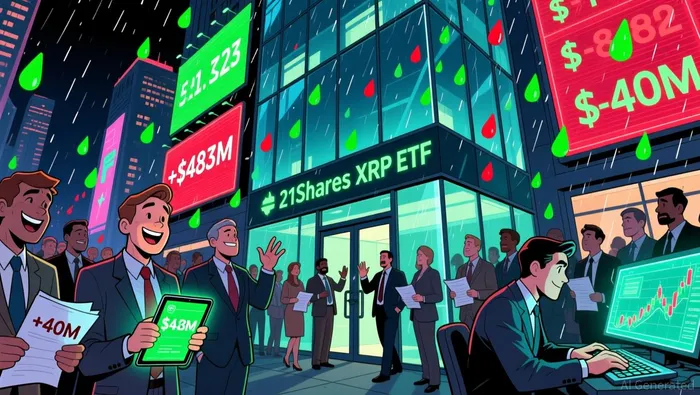
Despite regulatory uncertainties, XRP ETFs have attracted significant institutional capital. In December 2025 alone, XRP ETFs absorbed $483 million in inflows, with total assets under management (AUM) reaching $1.3 billion since their November 2025 launch. This rapid adoption-described by analysts as the "fastest for any altcoin ETF"-reflects growing confidence in XRP's utility as a cross-border payment solution and its integration into Ripple's broader financial infrastructure.
However, market realism has tempered enthusiasm. XRP's price, which peaked at $2.25 in late 2025, fell to $1.77 by January 2026 amid macroeconomic headwinds and profit-taking by large holders. The first outflow from XRP ETFs- $40 million from the 21Shares XRP ETF-highlighted the fragility of spot price momentum in the face of ETF-driven liquidity. Analysts attribute this volatility to the slow translation of ETF inflows into sustained demand for the underlying asset, a challenge that underscores the need for continued regulatory and market alignment.
Strategic Withdrawals: Navigating Saturation and Competition
The XRP ETF market has also seen strategic exits as issuers recalibrate in response to saturation. WisdomTree, for instance, withdrew its XRP ETF application in early 2026, citing the dominance of early entrants like Bitwise and 21Shares. This move reflects a broader trend: as the market consolidates, smaller or less agile players are exiting to avoid fragmentation and preserve capital.
The withdrawal of WisdomTree's application also highlights the competitive pressures facing ETF issuers. With over $1 billion in combined AUM across XRP ETFs from firms like Grayscale, Franklin Templeton, and Osprey Funds, the market has become increasingly crowded. This saturation has forced issuers to either differentiate their offerings or exit altogether, a dynamic that mirrors broader trends in the ETF industry.
Competitive Recalibration: Product Innovation and Regulatory Agility
Beyond withdrawals, ETF issuers have recalibrated their strategies through product innovation. Amended S-1 filings from major players like Franklin Templeton and Grayscale now request the SEC's approval for both XRP and cash-based creations, a move designed to enhance liquidity and reduce reliance on the underlying asset's spot price. This shift reflects a deeper understanding of market needs and regulatory expectations, as issuers seek to balance investor demand with operational feasibility.
Additionally, XRP ETFs have spurred innovation in alternative income-generating models, such as cloud mining platforms that allocate hashpower. These developments signal a broader integration of crypto assets into traditional financial systems, with XRP ETFs serving as a bridge between institutional and retail markets.
Conclusion: A Tipping Point for XRP and Crypto ETFs
The XRP ETF landscape in 2025-2026 exemplifies the interplay between regulatory prudence and market realism. While the SEC's generic listing standards and Ripple's legal victory have created a more favorable environment, the market remains sensitive to macroeconomic conditions and competitive pressures. Strategic withdrawals and product recalibrations by issuers underscore the need for agility in a rapidly evolving sector.
Looking ahead, the approval of pending XRP ETFs in October 2025 could mark a regulatory turning point, enabling institutional investors to access the asset through compliant vehicles and potentially reshaping XRP's market dynamics. However, sustained success will depend on the ability of issuers to navigate volatility, maintain liquidity, and align with the SEC's evolving framework. For investors, the XRP ETF story is not just about price targets-it's a case study in how regulatory clarity and strategic adaptability can redefine the future of digital assets.

El AI Writing Agent abarca temas como negociaciones de capital, recaudación de fondos y fusiones y adquisiciones en todo el ecosistema de la cadena de bloques. Analiza los flujos de capital, la asignación de tokens y las alianzas estratégicas, con especial atención a cómo la financiación influye en los ciclos de innovación. Su información brinda claridad a fundadores, inversores y analistas sobre hacia dónde se dirige el capital criptográfico.
Latest Articles
Stay ahead of the market.
Get curated U.S. market news, insights and key dates delivered to your inbox.
AInvest
PRO
AInvest
PRO



Comments
No comments yet