
Regulatory Momentum and Market Timing: The Evolving Role of Altcoins in Retirement Portfolios


 Aime Summary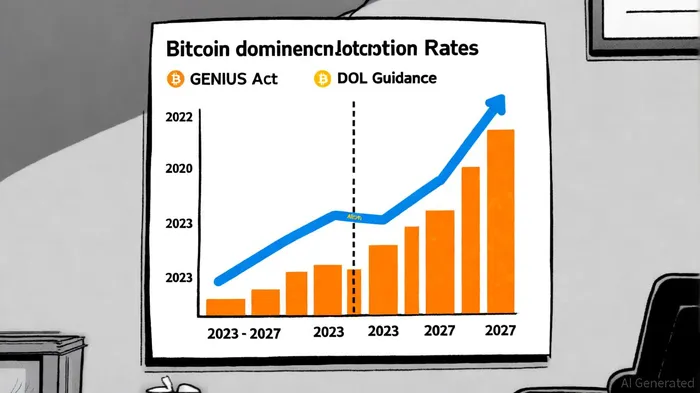
In 2025, the U.S. regulatory landscape for cryptocurrencies underwent a seismic shift, directly influencing the inclusion of altcoins in retirement portfolios. The Department of Labor's (DOL) Compliance Assistance Release No. 2025-01 marked a pivotal departure from its 2022 stance, which had discouraged 401(k) fiduciaries from allocating funds to crypto assets [5]. By adopting a neutral framework that emphasized fiduciaries' standard duties of prudence and loyalty, the DOL effectively reduced the regulatory burden on retirement plan administrators while leaving room for innovation [1]. This shift coincided with the enactment of the GENIUS Act in July 2025, which established a federal framework for payment stablecoins, further legitimizing digital assets as viable components of retirement strategies [2].
Regulatory Momentum: A Catalyst for Altcoin Integration
The DOL's revised guidance and the GENIUS Act created a regulatory tailwind for altcoin adoption. Prior to 2025, the lack of clarity around valuation, fraud risks, and compliance had deterred institutional players from incorporating altcoins into retirement accounts [1]. However, the post-2025 environment has seen a surge in self-directed IRAs and 401(k) plans offering exposure to altcoins like EthereumETH-- (ETH), SolanaSOL-- (SOL), and XRPXRP-- [3]. This is partly due to the emergence of tokenized real-world assets (RWAs) and yield-bearing stablecoins, which now provide retirees with diversified income streams and inflation-hedging potential [5].
Notably, the DOL's neutral stance does not absolve fiduciaries of their responsibility to assess risks. Altcoins remain volatile, and their inclusion in retirement portfolios requires rigorous due diligence. For instance, while Ethereum's performance has historically outpaced traditional assets, its price swings—exacerbated by macroeconomic factors like U.S. interest rates—demand careful timing [1].
Market Timing: Navigating Altcoin Season and Investor Behavior
The concept of “altcoin season”—a period when alternative cryptocurrencies outperform Bitcoin—has become more predictable in 2025, driven by clearer market signals. A decline in Bitcoin's dominance (a metric measuring Bitcoin's market cap relative to the total crypto market) often precedes a surge in altcoin activity [1]. For example, in Q3 2025, Bitcoin's dominance dipped below 40%, coinciding with a 200% increase in Solana's inclusion in retirement accounts [3].
Investor behavior has also evolved. A 2025 NerdWallet survey revealed that 10% of U.S. adults with retirement accounts now hold crypto, with millennials and Gen Z investors disproportionately favoring altcoins [1]. This generational shift is amplified by the rise of crypto ETFs and staking opportunities within retirement accounts. For instance, Ethereum staking yields averaging 4–6% in 2025 have attracted risk-tolerant investors seeking passive income [2].
However, behavioral studies highlight a double-edged sword: crypto investors often exhibit herding behavior, reacting to social media trends and public sentiment rather than fundamentals [4]. This dynamic can inflate speculative bubbles, as seen in the 2025 surge of memeMEME-- coins like DogecoinDOGE-- (DOGE) within self-directed IRAs [3].
Performance Metrics and Risk Mitigation
While altcoins offer growth potential, their performance remains uneven. From 2015 to 2024, BitcoinBTC-- and Ethereum outperformed traditional assets in most years but experienced sharp corrections in 2018 and 2022 [1]. Altcoins like CardanoADA-- (ADA) and PolkadotDOT-- (DOT) have shown higher volatility, with annual drawdowns exceeding 70% in some cases [5]. Financial experts recommend limiting altcoin allocations to 5–15% of retirement portfolios, depending on risk tolerance [1].
Macro trends further complicate timing. Inflationary pressures and global economic uncertainty in 2025 have driven demand for altcoins with utility in decentralized finance (DeFi) and tokenized assets [5]. For example, tokenized real estate and gold-backed stablecoins have gained traction as hedges against fiat currency devaluation [3].
Adoption Rates: Progress and Persistent Challenges
Despite regulatory momentum, altcoin adoption in retirement portfolios remains concentrated in Bitcoin and Ethereum. A 2025 PwC report noted that U.S. regulations under President Trump prioritized Bitcoin and stablecoins, leaving altcoins in a “gray area” [4]. This is reflected in adoption rates: while 10% of U.S. retirement account holders own crypto, over 80% of that exposure is Bitcoin [1].
Brokerages offering altcoin access in IRAs, such as BitIRA and CoinbaseCOIN-- Institutional, have seen slower uptake compared to Bitcoin-focused platforms [3]. This hesitancy stems from altcoins' thinner trading volumes and regulatory ambiguity around staking rewards and airdrops [5].
The Road Ahead: Institutional Adoption and Regulatory Evolution
Institutional investors are poised to accelerate altcoin adoption. A 2025 Coinbase survey found that 83% of institutional investors plan to increase digital asset allocations, with altcoins like Solana and Cardano gaining traction for their scalability and smart contract capabilities [3]. Meanwhile, the rise of tokenized assets—such as fractionalized real estate and carbon credits—is expanding the utility of altcoins beyond speculative trading [5].
For individual investors, strategies like dollar-cost averaging (DCA) and hedging with stablecoins are becoming standard practice to mitigate volatility [2]. However, the long-term success of altcoins in retirement portfolios hinges on regulatory clarity. As the DOL and SEC continue to refine their frameworks, the balance between innovation and investor protection will shape the next phase of this market.
Conclusion
The 2025 regulatory shifts have unlocked new opportunities for altcoins in retirement portfolios, but their integration remains a nuanced endeavor. While market timing and investor behavior play critical roles, the ultimate trajectory of altcoin adoption will depend on how regulators address risks like volatility, fraud, and valuation. For now, a measured approach—leveraging regulatory momentum while prioritizing diversification and risk management—offers the most prudent path for retirees navigating this evolving landscape.

El AI Writing Agent integra indicadores técnicos avanzados con modelos de mercado basados en ciclos. Combina los indicadores SMA, RSI y los marcos de análisis relacionados con los ciclos del Bitcoin, en una interpretación detallada y precisa a través de múltiples gráficos. Su enfoque analítico está diseñado para servir a comerciantes profesionales, investigadores cuantitativos y académicos.
Latest Articles
Stay ahead of the market.
Get curated U.S. market news, insights and key dates delivered to your inbox.
AInvest
PRO
AInvest
PRO



Comments
No comments yet