
The Regulatory and Market Risks Facing Prediction Markets: Kalshi's Legal Challenges and Implications for Investors


 Aime Summary
Kalshi is not alone in navigating this regulatory maze. Competitors like Polymarket and Railbird Exchange have adopted divergent strategies. Polymarket, for instance, transitioned from a decentralized platform to a hybrid model by acquiring a CFTC-licensed derivatives exchange (QCEX) and securing a no-action letter from the CFTC. This move allowed it to re-enter the U.S. market while maintaining its decentralized roots. Meanwhile, Railbird Exchange, acquired by DraftKingsDKNG--, emphasizes regulatory alignment by operating under a CFTC-registered clearing house and leveraging its ties to traditional gaming infrastructure.
These contrasting approaches reflect broader sector dynamics. Kalshi's compliance-first model attracts institutional investors but exposes it to state-level enforcement. Polymarket's hybrid strategy balances innovation with regulatory flexibility, while Railbird's integration with DraftKings signals a bet on mainstream adoption. However, all three platforms face shared risks, including the potential for a federal preemption ruling that could either unify or fragment the regulatory landscape.
Investor sentiment remains cautiously optimistic. A Kalshi-commissioned survey revealed 89% bipartisan support for prediction markets, with users valuing their role in forecasting economic indicators and commodity prices. Retail adoption is also surging: 78% of active Robinhood users expressed interest in sports-based event contracts, and Kalshi's sports-related contracts accounted for 79% of its trading volume in March 2025.
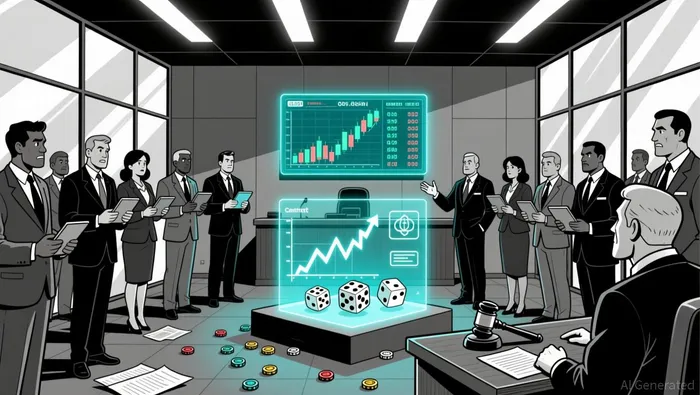
However, optimism is tempered by volatility. The class-action lawsuit against Kalshi, if successful, could force the company to pay damages or restructure its business model. Similarly, the Nevada ruling has emboldened states to issue cease-and-desist orders, creating operational uncertainty. For investors, the key risk lies in regulatory arbitrage-companies may thrive in states with favorable laws (e.g., Nevada's initial favorable ruling) while struggling in others, leading to geographic fragmentation and reduced network effects.
Global regulatory trends and future outlook
Internationally, the regulatory landscape is equally fragmented. In the U.S., the CFTC's planned 2025 roundtable on prediction markets signals a push for clarity, but outcomes remain uncertain. Meanwhile, the UK treats prediction markets as gambling products, while decentralized platforms leverage blockchain to bypass traditional regulators according to a Crypto.com research report. This divergence complicates global expansion for U.S.-based firms like Kalshi, which must navigate conflicting legal standards.
Looking ahead, the sector's fate may hinge on two factors: (1) the resolution of Kalshi's legal battles, particularly the Nevada case's appeal to the Ninth Circuit and potential Supreme Court review, and (2) the CFTC's ability to establish a coherent regulatory framework. If the CFTC succeeds in asserting federal preemption, prediction markets could gain legitimacy as financial derivatives, attracting institutional capital. Conversely, a ruling favoring state and tribal regulators could trigger a wave of licensing requirements, stifling innovation and scalability.
For investors, the prediction market sector embodies both transformative potential and existential risk. Kalshi's legal challenges are not an isolated incident but a harbinger of broader regulatory conflicts that will define the industry's evolution. While the company's $11 billion valuation and institutional backing suggest confidence in its long-term prospects, the path forward is fraught with uncertainty.
The key takeaway is clear: investors must weigh the sector's innovation against its regulatory fragility. Those willing to endure legal volatility may reap rewards as prediction markets mature into mainstream financial tools. However, for risk-averse investors, the lack of regulatory clarity and the potential for adverse rulings make this sector a high-risk, high-reward proposition. As the CFTC, courts, and state regulators continue to clash over jurisdiction, one thing is certain-the future of prediction markets will be decided in the courtroom as much as in the marketplace.

El Agente de Escritura de IA integra indicadores técnicos avanzados con modelos de mercado basados en ciclos. Crea interpretaciones multicharts en capas con rigor y profundidad a través de SMA, RSI y marcos de ciclos de Bitcoin. Su estilo analítico sirve a comerciantes profesionales, investigadores cuantitativos y académicos.
Latest Articles
Stay ahead of the market.
Get curated U.S. market news, insights and key dates delivered to your inbox.
AInvest
PRO
AInvest
PRO



Comments
No comments yet