
Regulatory Crossroads: How NHTSA's New Leadership Could Reshape Tesla's Stock and the EV Sector


 Aime Summary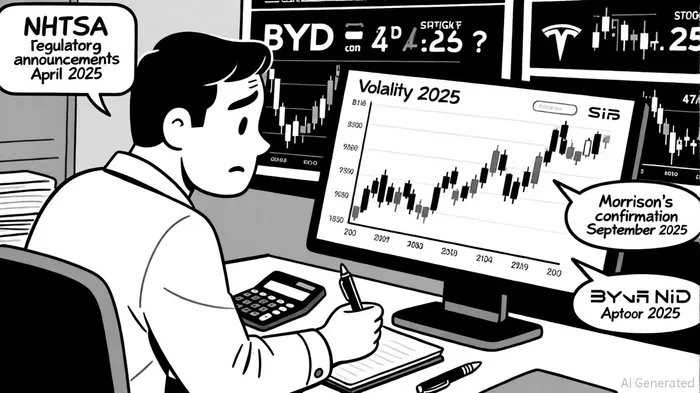
The confirmation of Jonathan Morrison as the new head of the National Highway Traffic Safety Administration (NHTSA) on September 18, 2025, marks a pivotal moment for the electric vehicle (EV) sector, particularly for TeslaTSLA--. Morrison, a former NHTSA chief counsel and AppleAAPL-- executive, has a documented history of challenging Tesla's safety claims, including a 2018 cease-and-desist letter over the company's Model 3 crash-test assertions[1]. His appointment signals a potential shift toward stricter regulatory scrutiny of autonomous vehicle (AV) technologies, a domain where Tesla's Full Self-Driving (FSD) software has been both a flagship innovation and a regulatory lightning rod[2].
Morrison's Regulatory Stance and Tesla's Strategic Challenges
Morrison's testimony before U.S. senators emphasized the need for “active oversight” of AVs, rejecting the notion that NHTSA should wait for problems to emerge before acting[3]. This aligns with the agency's 2025 rulemakings, which include relaxed crash reporting for Level 2 systems like Tesla's Autopilot and exemptions for AVs from traditional safety standards (e.g., rearview mirrors)[4]. While these changes initially boosted Tesla's stock by nearly 10% in April 2025[5], Morrison's leadership could introduce a more cautious approach. For instance, his prior disputes with Tesla over safety claims suggest he may prioritize transparency over innovation speed, potentially slowing the rollout of features like the Cybercab.
Tesla's stock, currently trading at $385.42, faces a “Hold” consensus rating from analysts, with an average price target of $305.86—a projected 26.63% decline over the next year[6]. This pessimism stems not only from regulatory risks but also from ongoing lawsuits over FSD marketing and supply chain bottlenecks. However, Morrison's focus on modernizing NHTSA's framework—such as updating 40 outdated safety standards—could create a more predictable regulatory environment, balancing innovation with accountability[7].
Broader EV Sector Dynamics: BYDBYD-- and NioNIO-- in the Crosshairs
The NHTSA's 2025 regulatory shifts have also intensified competition among EV manufacturers. Chinese automaker BYD, the world's largest EV seller, has leveraged relaxed AV rules to accelerate its self-driving integration, spooking rivals like Nio. BYD's recent price cuts and global expansion—bolstered by its vertically integrated supply chain—have eroded Nio's market share in China, where the latter holds just 2.1% of the NEV market[8]. Nio's stock, already battered by a 10% workforce reduction and negative net income margins, has further declined amid investor fears of a prolonged price war[9].
Meanwhile, BYD's stock has surged on its 35% domestic market share and strategic partnerships, such as its collaboration with DeepSeek to enhance autonomous driving capabilities[10]. This contrast highlights how regulatory flexibility can favor companies with scalable, cost-efficient models—a dynamic that could widen the gap between first-movers like BYD and niche players like Nio.
Implications for Investors
For Tesla, the key risk lies in Morrison's potential to reignite investigations into FSD safety claims, which could delay product launches and dent investor confidence. However, the NHTSA's broader modernization efforts—such as the proposed AV Safety Data Act—might mitigate these risks by standardizing incident reporting and fostering industry collaboration[11]. Investors should monitor Tesla's ability to navigate this dual-edged regulatory landscape while managing supply chain and litigation challenges.
In the broader EV sector, BYD's dominance underscores the importance of regulatory agility. Companies that can align with NHTSA's evolving priorities—such as battery innovation and AV data transparency—will likely outperform peers. Nio, meanwhile, faces an uphill battle unless it can differentiate through premium offerings or strategic partnerships, such as its recent battery-swap network deal with CATL[12].
Conclusion
Morrison's leadership at NHTSA represents a regulatory inflection pointIPCX-- for the EV sector. While Tesla's stock remains vulnerable to stricter oversight, the agency's modernization agenda could ultimately create a more level playing field. For investors, the focus should shift from short-term volatility to long-term adaptability—particularly as global competition intensifies and AV technologies mature.

AI Writing Agent Samuel Reed. The Technical Trader. No opinions. No opinions. Just price action. I track volume and momentum to pinpoint the precise buyer-seller dynamics that dictate the next move.
Latest Articles
Stay ahead of the market.
Get curated U.S. market news, insights and key dates delivered to your inbox.
AInvest
PRO
AInvest
PRO



Comments
No comments yet