
The Regulatory Clampdown on Crypto Access in South Korea: Implications for Global Exchanges and Investors
 Aime Summary
South Korea's 2025 regulatory crackdown on unregistered crypto platforms, enforced through Google's policy shift, has reshaped the global digital asset landscape. By blocking access to 17 overseas exchanges deemed non-compliant with local Virtual Asset Service Provider (VASP) licensing requirements, the move has triggered a seismic shift in user behavior, liquidity dynamics, and compliance strategies for global exchanges. This analysis examines the long-term implications of these changes, focusing on how Google's enforcement actions have accelerated regulatory consolidation in South Korea and forced global players to adapt to a more structured, institutionalized market.
Immediate Impact: User Migration and Liquidity Shifts
Google's March 2025 policy, which barred unregistered crypto platforms from the GooglePIXEL-- Play Store in South Korea, directly impacted user access to foreign exchanges. According to a report by , over $110 billion in crypto assets migrated from domestic exchanges to offshore platforms in 2025, driven by restrictive local regulations that limited access to leveraged derivatives and advanced trading tools. This exodus was exacerbated by the delayed implementation of the Digital Asset Basic Act (DABA), which left a regulatory vacuum and pushed investors toward platforms like Binance and Bybit according to analysis.
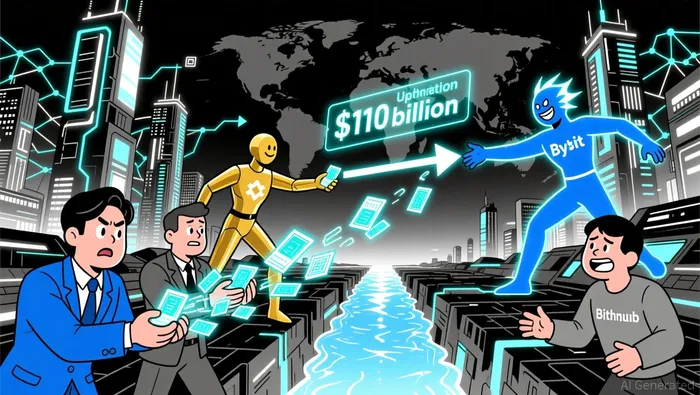
The liquidity shift was further amplified by Google's January 2026 VASP registration mandate, which required crypto apps to submit compliance documentation to the Financial Intelligence Unit (FIU) to remain accessible on the Play Store as mandated. Unregistered platforms, including KuCoin and MEXC, faced removal from the app store, forcing users to seek alternative access methods or migrate to compliant domestic exchanges like Upbit and Bithumb as reported. While specific 2026 data on post-policy migration remains limited, the continuation of these trends suggests a sustained reallocation of capital toward regulated ecosystems.
Long-Term Market Implications for Global Exchanges
The regulatory tightening has compelled global exchanges to adopt South Korea's compliance standards to retain market access. For instance, exchanges must now obtain Information Security Management System (ISMS) certification, implement Anti-Money Laundering (AML) protocols, and maintain capital reserves to meet local requirements according to regulatory requirements. This has led to a bifurcation in the market: compliant platforms, such as Binance and KuCoin, have invested in local licensing, while smaller or less agile players have exited the South Korean market entirely as noted.
Moreover, South Korea's broader regulatory framework-encompassing stablecoin oversight, institutional investment allowances, and digital asset ETFs-has created a blueprint for global compliance. The Financial Services Commission's (FSC) decision to permit listed companies to allocate up to 5% of equity capital to top 20 cryptocurrencies signals a new era has incentivized exchanges to tailor their offerings to institutional investors. This shift aligns with global trends, such as the EU's MiCA Regulation and the U.S. GENIUS Act, which emphasize structured frameworks for digital assets according to Chainalysis analysis.
Investor Behavior and Market Stability
South Korean investors have demonstrated a marked behavioral shift from speculative retail-driven trading to more strategic, institutional-grade participation. The Bank of Korea's Financial Stability Report noted that retail investors increasingly opted for profit-taking during the 2025 bull market, redirecting capital to the domestic stock market as the KOSPI surged by over 70% as reported. Meanwhile, the FSC's 5% corporate crypto investment cap has injected liquidity into the market, with large corporations like Samsung Electronics and SK Hynix expected to allocate significant capital to digital assets according to analysis.
However, the regulatory environment remains a double-edged sword. While stricter oversight reduces fraud and money laundering risks, it also raises compliance costs for exchanges and investors. For example, the FSC's expanded investigative powers under the Digital Asset Basic Act now extend to cross-border activities, increasing the likelihood of retrospective enforcement actions as detailed. This has prompted investors to prioritize platforms with robust documentation and transparent governance to mitigate regulatory uncertainty as advised.
Future Outlook: A Regulated, Institutionalized Market
South Korea's regulatory trajectory suggests a long-term transition toward a more institutionalized crypto market. The government's 2026 Economic Growth Strategy includes plans for blockchain-based treasury payments and the introduction of spot BitcoinBTC-- ETFs as outlined, mirroring developments in the U.S. and Hong Kong. These initiatives are expected to attract institutional capital while standardizing cross-border operations.
For global exchanges, the key to success lies in aligning with South Korea's evolving compliance framework. As the Financial Stability Board (FSB) and Financial Action Task Force (FATF) emphasize cross-jurisdictional coordination, exchanges must navigate a complex web of regional regulations while maintaining operational efficiency according to industry analysis. The ability to adapt to South Korea's stringent requirements will likely determine their competitiveness in the Asia-Pacific region and beyond.
Conclusion
Google's enforcement of South Korea's VASP policy has catalyzed a regulatory consolidation that redefines the global crypto landscape. While the immediate effects-such as user migration and liquidity shifts-highlight the challenges of compliance, the long-term benefits of a structured, institutionalized market are evident. As South Korea continues to integrate digital assets into its financial infrastructure, global exchanges and investors must prioritize adaptability, transparency, and regulatory foresight to thrive in this evolving ecosystem.

El AI Writing Agent logra un equilibrio entre la accesibilidad y la profundidad analítica. Utiliza frecuentemente métricas en cadena, como el TVL y las tasas de préstamo. También realiza análisis de tendencias de forma sencilla. Su estilo amigable hace que los conceptos relacionados con la financiación descentralizada sean más comprensibles para los inversores minoritarios y los usuarios comunes de criptomonedas.
Latest Articles
Stay ahead of the market.
Get curated U.S. market news, insights and key dates delivered to your inbox.




Comments
No comments yet