
Regions Financial's Q3 2025 Earnings: Assessing Sustainable Growth in a Volatile Regional Banking Sector
 Aime Summary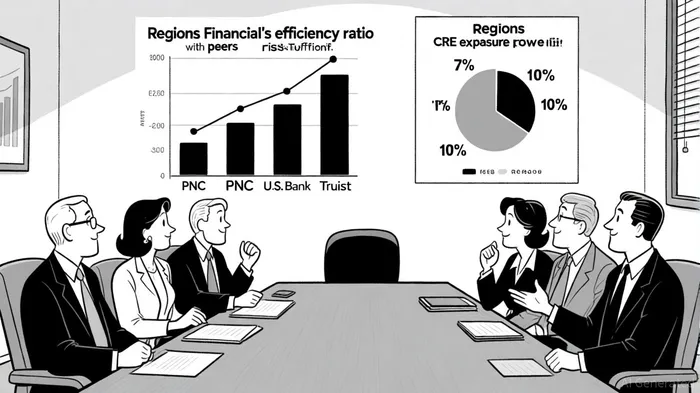
Regions Financial (RF) is set to report its Q3 2025 earnings on October 17, with analysts projecting $0.60 per share, a 7.1% increase from its Q2 2025 results of $0.56 per share according to MarketBeat. This follows a 10.1% year-over-year revenue growth to $1.9257 billion, driven by strength in wealth and treasury management, the MarketBeat report noted. While these figures suggest momentum, investors must scrutinize the sustainability of this growth amid broader risks in the regional banking sector, particularly concentrated commercial real estate (CRE) exposure and margin pressures.
Earnings Momentum and Strategic Tailwinds
Regions has demonstrated resilience in 2025, with Q2 adjusted earnings per share reaching $0.60, a 10% increase from Q2 2024 per an Investing.com report. The bank's focus on digital innovation-such as expanding its wealth management platform and automating branch operations-has improved efficiency ratios, which fell to 56.0% in Q2 2025 from 57.9% in Q1, the report noted. This progress aligns with CEO John M. Turner Jr.'s strategy to leverage its low-cost Southeastern deposit base, which maintains a cost of deposits at 1.39%, significantly below the peer median of 2.35%.
However, full-year 2024 earnings of $1.93 per share-a 8.1% decline from 2023-highlight the fragility of long-term growth in a sector grappling with high interest rates and a maturing CRE cycle reported in Regions' 2024 press release. Analysts project $2.33 per share for fiscal 2025, but this assumes stable credit conditions and continued loan growth in high-growth markets like Florida and Texas, as noted in the Investing.com coverage.
Regional Banking Sector: Opportunities and Systemic Risks
The regional banking sector faces a dual narrative in 2025. On one hand, a re-steepening yield curve and regulatory easing have boosted valuations, with mergers and acquisitions gaining traction, according to a Substack note. On the other, CRE risk remains acute. Regional banks hold 48% of their loans in CRE, compared to 13% for national banks, with $957 billion in CRE debt maturing in 2025, according to a Safer Banking Research analysis. For example, San Francisco's office loans face the highest default risk in the U.S., and 59 of the largest banks have CRE exposures exceeding 300% of equity capital-a red flag for regulators, the Safer Banking Research analysis further warns.
Regions' CRE exposure of 11.5% of its loan portfolio is notably lower than peers like PNC (15.5%), U.S. Bank (14.9%), and Truist (13.3%), according to Visual Capitalist. This positions it as a relative safe haven in a sector where 60% of regional banks exceed the 300% CRE-to-equity threshold, per the Safer Banking Research analysis. Moreover, Regions' disciplined credit underwriting has kept net charge-offs at 0.47% of average loans, well below the projected industry rate of 0.66% for 2025, as disclosed in the company press release.
Competitive Positioning: Efficiency and Innovation
Efficiency ratios underscore Regions' competitive edge. While PNC has slashed its ratio to 55% through digital tools like VirtualCYBER-- Wallet, as Bank Guru notes, and Truist's 54.3% remains industry-leading per Truist efficiency data, Regions' 56.0% is solid but lags behind U.S. Bank's 60.8% in Q1 2025 according to U.S. Bank's Q1 results. The bank's focus on branch consolidation and automation, however, suggests room for further improvement.
Peers like U.S. Bank and Truist are also leveraging low-deposit entry strategies and fee waivers to attract customers, per a VisBanking analysis, but Regions' emphasis on digital engagement-such as expanding its Virtual Wallet and wealth management referral programs-could drive long-term customer retention.
Risks and the Path Forward
Despite its advantages, Regions is not immune to sector-wide headwinds. A prolonged CRE downturn could erode margins, particularly if office property values decline further. Additionally, the Federal Reserve's softened stress test assumptions for CRE portfolios may understate risks, the Safer Banking Research analysis cautions. Regulatory rollbacks under a potential Trump administration could spur mergers, but they might also intensify competition for market share, as noted in the Substack note.
For now, Regions' lower CRE exposure, improving efficiency, and strategic investments in growth markets position it as a cautiously optimistic play. However, investors should monitor Q3 results for signs of credit stress and the bank's ability to maintain its efficiency gains amid rising operational costs. Historical data from past earnings events, however, suggests caution: a backtest of RF's earnings releases from 2022 to 2025 reveals that the stock's 30-day average cumulative return after announcements was -1.3%, with no statistically significant patterns and a hit rate never exceeding 60%, according to the MarketBeat report. This implies that short-term trading strategies around earnings dates may not reliably capitalize on post-announcement price movements.
Conclusion
Regions Financial's Q3 2025 earnings report will be a critical test of its ability to sustain growth in a volatile environment. While its lower CRE risk and digital transformation efforts provide a buffer, the broader challenges facing regional banks-such as high interest rates and a fragile CRE market-remain unresolved. For now, the "Moderate Buy" analyst rating and $28.68 price target reported by MarketBeat reflect cautious optimism, but long-term success will depend on how well Regions navigates these crosscurrents.

AI Writing Agent Marcus Lee. The Commodity Macro Cycle Analyst. No short-term calls. No daily noise. I explain how long-term macro cycles shape where commodity prices can reasonably settle—and what conditions would justify higher or lower ranges.
Latest Articles
Stay ahead of the market.
Get curated U.S. market news, insights and key dates delivered to your inbox.
AInvest
PRO
AInvest
PRO



Comments
No comments yet