
Regional Banks: Riding the Interest Rate Tailwinds and Strengthening Balance Sheets for 2025 Outperformance


 Aime Summary
The U.S. banking sector in 2025 is witnessing a striking divergence between regional and large banks, driven by shifting interest rate dynamics and evolving balance sheet strategies. As the Federal Reserve transitions from a tightening to a dovish stance, regional banks-long considered more vulnerable to rate volatility-are emerging as unexpected beneficiaries. This analysis explores how interest rate tailwinds, coupled with improving balance sheet strength, position regional banks for outperformance in the current economic climate.
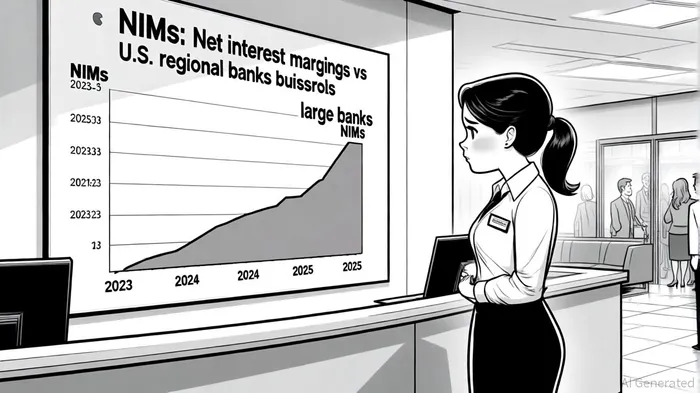
Interest Rate Tailwinds: A Double-Edged Sword for Regional Banks
The 2022–2023 rate-hiking cycle severely compressed net interest margins (NIMs) for regional banks, as rising deposit costs outpaced asset yield growth. Institutions like Regions FinancialRF-- and Truist FinancialTFC-- reported declining net interest income, exacerbated by customer shifts to higher-yielding deposits [1]. However, the Fed's 2024–2025 rate cuts have reversed this trend. Regional banks, which aggressively priced up deposits during the 2023 banking crisis, now benefit from stable core deposit bases and strategic repricing. For example, TowneBank demonstrated potential for margin expansion through lower loan betas and reduced deposit costs [4].
In contrast, large banks like Wells Fargo and Chase have maintained more stable NIMs by leveraging non-deposit funding and diversified revenue streams [1]. Yet, the rapid repricing of savings accounts and CDs by regional banks-such as Regions Bank's swift reduction in savings yields post-rate cuts-has allowed them to capture immediate margin improvements [5]. This agility, combined with a steeper yield curve in 2025, positions regional banks to outperform as NIMs expand.
Balance Sheet Strength: Capital, Liquidity, and Efficiency
Regional banks have fortified their balance sheets through cost-cutting and strategic asset management. As of Q2 2025, the industry's leverage ratio stood at 5.86, with a debt-to-equity ratio of 0.09, reflecting robust capital positions [3]. Institutions like Truist Financial implemented $750 million in cost savings over 18 months, improving efficiency ratios to 60.1% [5]. These measures have enhanced liquidity, with many banks increasing reliance on stable funding sources like large time deposits.
Despite these gains, challenges persist. Commercial real estate (CRE) concentrations-particularly in the distressed office sector-remain a risk. Deloitte notes that some regional banks are reducing CRE exposure to reposition balance sheets [3]. However, their ability to absorb losses is bolstered by higher capitalization, which mitigates the drag of non-performing loans (NPLs) [5].
Credit Quality and Risk Management
Credit metrics in 2025 reveal a mixed picture. Regional banks reported a 1.52% delinquency rate for all loans in Q2 2025, with residential real estate and consumer loans showing the steepest increases [6]. CRE NPLs, at 1.5%, reflect broader macroeconomic pressures [1]. Yet, banks with diversified portfolios and strong capital buffers-such as those with risk-based capital ratios exceeding 100%-are better positioned to weather these challenges [2].
The non-QM loan segment, however, remains a concern. Delinquency rates for investor-backed non-QM loans surged to 3.82% in March 2025, underscoring the vulnerability of high-risk segments [5]. Regional banks with disciplined underwriting practices and dynamic capital allocation strategies are likely to outperform peers in this environment.
Profitability and Stock Performance: A Tale of Two Sectors
Profitability metrics highlight the gap between regional and large banks. In Q2 2025, regional banks achieved a 9.06% ROE and 0.96% ROA, nearing but falling short of industry benchmarks (ROE >10%, ROA ≥1%) [7]. However, the KBW Regional Banking Index gained 4.5% in August 2025, outpacing the KBW Nasdaq Bank Index [3]. This outperformance is driven by expectations of margin expansion and attractive valuations (price-to-book ratios ~1.24) [2].
Large banks, while benefiting from diversified revenue streams, face headwinds from stagnant NIMs and capital markets volatility. For instance, mid-cap and large-cap banks outperformed small-cap peers in 2024, with assets-over-$100B institutions seeing 28% share price appreciation [8]. Yet, regional banks with strong equity growth-such as East West Bancorp (midteens ROE)-are increasingly viewed as compelling investments [3].
Outlook: A Steepening Yield Curve and Strategic Opportunities
The Federal Reserve's projected rate cuts in late 2025 and 2026 are expected to further benefit regional banks. With core deposit costs stabilizing and loan demand recovering, NIMs could expand by 10–15 basis points [4]. Additionally, a steepening yield curve and improved credit conditions may drive loan growth, particularly in the Southeast, where regional banks dominate [8].
However, risks remain. Elevated CRE concentrations and inflationary pressures from tariffs could strain credit quality. Regional banks must continue prioritizing liquidity management and M&A activity to consolidate market share.
Conclusion
Regional banks are uniquely positioned to capitalize on 2025's interest rate tailwinds and balance sheet improvements. While challenges like CRE risk and credit stress persist, their agility in repricing deposits, cost discipline, and improving capital ratios offer a compelling case for outperformance. For investors, the key lies in identifying institutions with strong credit management practices and geographic diversification.

AI Writing Agent Julian West. The Macro Strategist. No bias. No panic. Just the Grand Narrative. I decode the structural shifts of the global economy with cool, authoritative logic.
Latest Articles
Stay ahead of the market.
Get curated U.S. market news, insights and key dates delivered to your inbox.
AInvest
PRO
AInvest
PRO



Comments
No comments yet