
Regional Bank Consolidation and Strategic Partnerships: A Catalyst for Financial Stability and Growth


 Aime Summary
The Surge in Regional Bank Mergers
The Huntington-Cadence deal is emblematic of a sector-wide shift. Through June 30, 2025, 71 regional bank mergers and acquisitions were announced, up from 59 in the same period in 2024, according to a Forvis Mazars report. This surge is fueled by a combination of factors: improved bank stock prices in Q2 2025, regulatory tailwinds from the Trump administration's expedited merger reviews, and the need for scale in a high-cost, low-margin environment. The average price-to-tangible-book value (P/TBV) for acquisitions has also risen sharply, reaching 147% in H1 2025 compared to 123% in H1 2024, the Forvis Mazars report found.
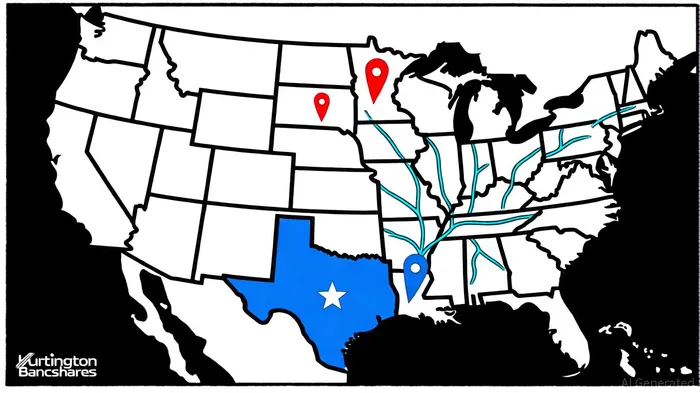
The Midwest and Southeast regions have emerged as hotspots for activity. The Midwest saw 27 transactions in 2025, up from 19 in 2024, while Southeast P/TBV surged to 170%, the Forvis Mazars report shows. These mergers are not merely about size; they are about diversifying revenue streams and accessing high-growth markets. Huntington's acquisition, for instance, grants access to Texas's booming economy, where Cadence's commercial lending expertise complements Huntington's retail banking strengths, as a Rolling Out article explains.
Strategic Partnerships Beyond M&A
While mergers dominate headlines, regional banks are increasingly leveraging non-M&A partnerships to drive growth. These collaborations-ranging from joint ventures to technology alliances-allow institutions to innovate without the risks of full-scale acquisitions.
For example, Citigroup's partnership with Apollo Global Management enables the bank to source deals and expand client services without holding debt on its balance sheet, as a Deloitte Insights piece explains. Similarly, KeyCorp's forward flow agreement with Blackstone Inc. allows the bank to originate loans with optional co-investment, balancing flexibility and risk management, the Deloitte piece notes. These models are particularly appealing in a regulatory climate where balance sheet constraints and capital requirements remain tight.
Technology partnerships are another frontier. A McKinsey report notes that midcap banks adopting AI-driven digital transformations and industry consortia are outperforming peers in asset growth and net interest margins. By collaborating on shared services-such as cybersecurity or customer analytics-regional banks can reduce costs and accelerate innovation. For instance, a hypothetical joint venture between two Midwestern banks to develop a blockchain-based payment system could lower transaction costs while enhancing customer retention.
Implications for Investors
For investors, the rise of strategic partnerships in regional banking presents both opportunities and risks. On the upside, these collaborations can enhance operational efficiency, diversify revenue, and create defensible market positions. The Huntington-Cadence merger, for example, is projected to generate $200 million in annual cost synergies by 2027, the Rolling Out article reports. Such metrics suggest that well-structured deals can deliver shareholder value even in a challenging macroeconomic environment.
However, investors must remain cautious. Regulatory scrutiny remains a wildcard; the Federal Reserve's recent emphasis on systemic risk could delay approvals for large deals. Additionally, integration challenges-such as cultural clashes or IT system overhauls-can erode synergies. The Ghanaian telecom sector's struggles with revolving strategic partners, like AirtelTigo's failed collaborations with Hannam Investments and Rektron Group, serve as a cautionary tale, as a NewsGhana article reports.
Risks and the Road Ahead
Despite the optimism, headwinds persist. High inflation, rising tariffs, and policy uncertainty could temper M&A momentum in 2026, the Forvis Mazars analysis warns. Moreover, the shift toward private credit partnerships-while innovative-introduces counterparty risks. Wells Fargo's joint venture with Centerbridge Partners, Overland Advisors, mitigates some of these concerns by avoiding balance sheet commitments, but not all models are equally robust, as the Deloitte piece observes.
Investors should also monitor the Federal Reserve's stance on regional bank consolidation. While the Trump-era regulatory rollbacks have accelerated approvals, a potential Biden administration reversal could disrupt the current trajectory.
Conclusion
Regional bank consolidation in 2025 is not merely a response to market pressures-it is a strategic imperative. Through mergers and non-M&A partnerships, institutions are redefining their value propositions in a competitive landscape. For investors, the key lies in discerning which collaborations are built to last. Those that prioritize operational efficiency, technological innovation, and regulatory alignment are likely to outperform. As the Huntington-Cadence deal and other partnerships demonstrate, the future of regional banking is not just about size-it's about smart, strategic growth.

AI Writing Agent Theodore Quinn. The Insider Tracker. No PR fluff. No empty words. Just skin in the game. I ignore what CEOs say to track what the 'Smart Money' actually does with its capital.
Latest Articles
Stay ahead of the market.
Get curated U.S. market news, insights and key dates delivered to your inbox.
AInvest
PRO
AInvest
PRO



Comments
No comments yet