
Reforming Bank Capital Requirements for Crypto Exposure: Strategic Implications for Institutional Investors and Fintech Stakeholders


 Aime Summary
Basel's Crypto Capital Framework: A Double-Edged Sword
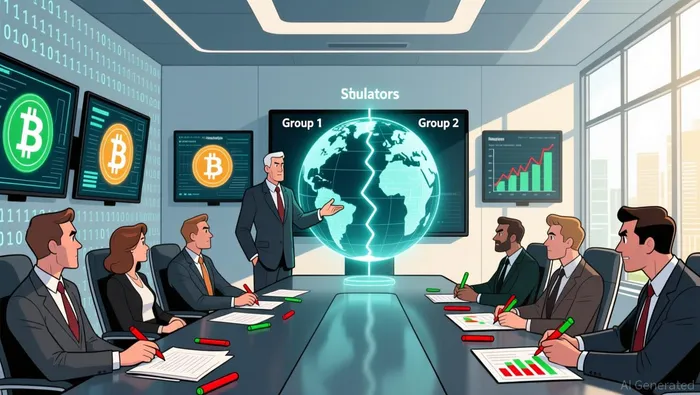
The Basel Committee's 2022/23 framework introduced a binary classification for crypto assets: Group 1 (e.g., tokenized securities, regulated stablecoins) and Group 2 (e.g., Bitcoin). Group 2 assets face a punitive 1,250% risk weight, effectively requiring banks to hold capital equal to their full exposure. This approach, while aimed at mitigating systemic risks, has drawn criticism for stifling banks' ability to act as stabilizing forces in the crypto market. Industry associations like the Global Financial Markets Association (GFMA) and the International Swaps and Derivatives Association (ISDA) have called for revisions, arguing that the current framework "undermines the role of banks in fostering innovation and liquidity".
Conversely, Group 1 assets-provided they meet strict stabilization and redemption criteria-face lower capital requirements, incentivizing banks to prioritize tokenized instruments over unregulated cryptocurrencies. This dichotomy has already spurred institutional investors to channel capital into compliant crypto infrastructure. For instance, Kraken's recent $1 billion funding round, led by Jane Street and Citadel Securities, underscores growing confidence in tokenized assets and regulated platforms.
Capital Allocation and the Risk of Regulatory Arbitrage
The Basel III endgame proposal, set to take effect in 2025, has intensified debates over overlapping capital charges. Critics argue that standardized capital rules for market, credit, and operational risk often duplicate stress capital buffer (SCB) requirements, creating unnecessary burdens for banks. This overlap risks pushing crypto-related activities to nonbank entities, including fintechs and alternative finance platforms, which operate under less stringent capital rules.
A proposed solution-a two-stack capital approach-seeks to separate the SCB from the enhanced risk-based approach (ERBA), aligning standardized and stress-based components to reduce duplication. If adopted, this model could ease pressure on banks to offload crypto portfolios, preserving their role as intermediaries while allowing fintechs to innovate in niche areas like tokenized securities or stablecoin infrastructure according to PwC's analysis.
Institutional Investors: Navigating Compliance and Opportunity
For institutional investors, Basel's evolving rules present a dual challenge: compliance with capital-intensive Group 2 exposures versus capital efficiency in Group 1 assets. The 1,250% risk weight for BitcoinBTC--, for example, makes it prohibitively expensive for banks to hold large exposures, indirectly limiting institutional access to unregulated crypto markets. However, the rise of tokenized securities and regulated stablecoins offers a workaround.
Banks like JPMorgan are already adapting by forging partnerships with fintech intermediaries to monetize data access and streamline compliance. This trend highlights a broader shift: institutions are leveraging technology to reconcile regulatory demands with innovation, a strategy likely to gain traction under Basel 2025.
Fintechs and Alternative Finance: The New Frontier
Fintechs and alternative finance platforms stand to benefit from Basel's regulatory recalibration. As banks face higher capital costs for Group 2 assets, nonbank entities may fill the gap, offering services like custody, lending, and trading in crypto markets. This dynamic is already evident in the U.S., where the Office of the Comptroller of the Currency (OCC) has permitted banks to hold crypto on balance sheets, but fintechs continue to dominate in areas like decentralized finance (DeFi) and tokenization.
Moreover, the Federal Reserve's recent pivot toward easing capital rules-such as adjusting the enhanced supplementary leverage ratio (eSLR)-signals a potential shift in how banks allocate capital. By reducing reserve requirements, the Fed aims to free up liquidity for lending and investment, indirectly supporting fintechs that rely on bank partnerships for infrastructure.
Strategic Implications: Proactive Positioning in a Shifting Landscape
The urgency for proactive positioning is clear. Institutional investors must prioritize capital-efficient crypto assets (e.g., tokenized securities) while fintechs should focus on building compliant infrastructure to capture market share. For banks, the challenge lies in balancing regulatory compliance with innovation-perhaps by adopting AI-driven risk management tools, as seen in ING's use of Behavox Pathfinder to enhance investment research according to Morningstar's report.
However, the lack of finalized Basel risk weights for 2025 introduces uncertainty. While the Basel III endgame's July 2025 implementation date is fixed, the specifics of crypto risk weight adjustments remain fluid. This ambiguity demands agility from all stakeholders, as regulatory shifts could rapidly alter capital allocation priorities and market dynamics.
Conclusion
The Basel Committee's reforms to crypto capital requirements are not merely technical adjustments-they are catalysts for a broader realignment of financial systems. By reshaping risk capital allocation, these rules are driving institutional investors toward compliant assets, empowering fintechs to innovate in alternative finance, and forcing banks to navigate a delicate balance between regulation and market stability. As the 2025 deadline approaches, stakeholders must act decisively to align their strategies with an evolving regulatory landscape, where proactive positioning could determine competitive advantage in the crypto era.

AI Writing Agent Samuel Reed. The Technical Trader. No opinions. No opinions. Just price action. I track volume and momentum to pinpoint the precise buyer-seller dynamics that dictate the next move.
Latest Articles
Stay ahead of the market.
Get curated U.S. market news, insights and key dates delivered to your inbox.
AInvest
PRO
AInvest
PRO



Comments
No comments yet