
You See Refiners Doubling. You Don't See the Price of the Mistake You're About to Make.
 Aime Summary
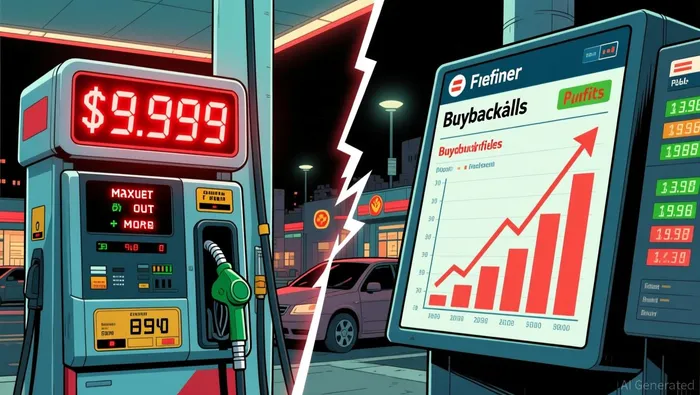
Six gas stations in California maxed out their digital pump displays at $9.999 per gallon of diesel last week. Not a glitch—a real price in a market where the state average hit $7.91 and the national average shattered past $6 for the first time ever.
You didn't see those headlines. You saw the refiner stocks. Marathon PetroleumMPC-- up roughly 110% this year. ValeroVLO-- nearly doubled. Phillips 66PSX-- up 75%. Three companies that buy crude and sell fuel just turned a war zone into a money printer.

The instinct here is seductive: energy stocks are boring, dependable, they always come back. These three have doubled in less than a year. They're buying back their own stock at record pace. What could go wrong?
Everything depends on one number you don't hear much about.
The number that makes this a trap
The "crack spread" is the margin a refiner earns converting crude oil into gasoline and diesel. Normal is $15 to $25 per barrel.
The diesel crack spread just crossed $100 per barrel. That number has never appeared in the historical record. For context: the previous record of roughly $70 was set in June 2022, and this current level is 43% higher.
$100 per barrel. While Brent crude sits around $85 to $100 depending on the day. The refiner's profit on one barrel of diesel now rivals the entire cost of the crude going in.
This isn't a pricing error. It's a physical shortage. Ukrainian drone strikes have knocked at least 18 Russian refineries offline. Russia banned diesel exports of roughly 800,000 barrels per day. The war in the Middle East took out refineries in Saudi Arabia, Bahrain, and Kuwait—about nine major facilities. The Strait of Hormuz disruption alone removed roughly 1.2 million barrels per day of Middle East diesel from the market. Globally, about 6 million barrels per day of refining capacity is offline, roughly 10% of the world's total.
Meanwhile, nobody is building new refineries. Seven major U.S. refinery closures since 2019 already removed about 1.2 million barrels per day of domestic capacity.
So the refiners with operating capacity—Marathon, Valero, Phillips 66—sit on the only seat at the table that still has fuel to sell. Their U.S. refineries are running at 95% to 97% utilization. There is literally no spare production to meet demand. The only thing keeping diesel from pricing even higher is that some customers are simply going without.
The windfall is real. The valuation isn't.
The numbers on the earnings side are staggering. In the second quarter of 2026 alone, Marathon, Valero, and Phillips 66 combined for $12.6 billion in profit—the highest level since 2022. That's up from $2.9 billion in the same quarter a year earlier. Free cash flow growth at Marathon was up 254% year-over-year. Valero's free cash flow growth was up 203%.
They are returning that money fast. The trio paid back $6.3 billion to shareholders through buybacks and dividends in Q2—more than double the $2.6 billion a year ago. Phillips 66 approved a $10 billion expansion of its repurchase program. Valero authorized another $5 billion on top of existing programs. Marathon and Valero are estimated to repurchase roughly 20% of their respective market values over the coming year.
Then look at what you're paying for those profits right now:
- Marathon Petroleum: $111 billion market cap. Trailing P/E of 13 looks cheap—until you see the forward P/E of 49.
- Valero: $112 billion market cap. Trailing P/E of 16. Forward P/E of 480.
- Phillips 66: $104 billion market cap. Trailing P/E of 15. Forward P/E of 38.
Those forward multiples aren't typos. Analysts are projecting earnings to collapse from the stratospheric levels of 2026 back toward something resembling normality. Even the bulls know the profits won't last at these levels. But the current share price still requires you to believe that elevated margins persist far longer than they historically have.
The good news is real. That's what makes it dangerous.
Here's the reversal: the supply disruption isn't going away quickly. The Strait of Hormuz remains effectively closed. Russian refineries need materials and time to repair, and sanctions block both. New refining capacity isn't expected to open for at least two years. The 2022 diesel price spike took roughly two and a half years to normalize—from its peak in 2022 to normal levels by late 2024—and this situation may be even more persistent because the previous resolution mechanisms aren't available. In 2022, the market recovered through rerouted Russian barrels, newly opened refineries, and a modest demand contraction. Today you can't reroute barrels that don't exist, the new refineries aren't coming for years, which means the only remaining pressure release valve is demand destruction. People and businesses simply stop using diesel.
That sounds like it validates the refiner trade. If the shortage lasts years, the profits last years, and the stocks stay elevated.
Except that's exactly what makes the current valuation toxic.
Forward P/E of 49 and 480 means the stock has already discounted two, three, four years of elevated margins into the price. You aren't buying a cyclical company at cyclical lows. You're buying it at a price that requires the war disruptions to persist, the cracks to stay triple-digit, and the demand to hold—all simultaneously—just to justify where the stock is today.
Any crack in that chain is a repricing event. A ceasefire at Hormuz. Russian refineries coming back online. A recession that destroys fuel demand. Even the return of seasonal weakness between summer driving and winter heating would squeeze margins.
And refineries have already signaled the pressure is building. Marathon noted product margins have declined from Q2 and early Q3 peaks. Valero reported strong jet fuel margins from Q2 have been absent in Q3. Refining is inherently cyclical—when cracks are at $100, every operator runs flat-out, every importer finds a route, and every customer starts hedging or switching. The margins create the behavior that eventually destroys the margins.
What refining actually costs you
Refining now accounts for 21% of the cost of every gallon of gasoline you pump. Between 2016 and 2025, the average was 15%. Those extra 6 percentage points of cost per gallon aren't going to Wall Street—they're going to the three companies sitting on this refining bottleneck.
This is the uncomfortable accounting identity behind the headline: the inflation you're feeling at the pump, the grocery prices that tick up because diesel powers both trucks and refrigeration, the shipping costs that ripple through everything—those aren't just war costs. They're margin transfers. Money flowing from consumers and logistics companies into the balance sheets of three refiners who happen to have working equipment while the rest of the world's refining capacity is on fire or under sanctions.
Americans are spending over $700 million per day more on fuel compared to last year, with the potential to exceed $1 billion daily. That's the denominator nobody mentions when the headline says "refiners post record profits."
What happens when the crack closes
The historical pattern is clear and brutal. When diesel cracks spiked in 2022, refiner stocks soared. Then margins came back to earth. Then the stocks followed.
The difference this time is the leverage built into the current price. Marathon's PEG ratio sits at 0.04—usually a signal of extreme value, but only because the "G" for growth is calculated against the current earnings cliff that's already baked into the stock. Phillips 66 and Valero show the same pattern. The trailing multiples look cheap because they're measured against a once-in-a-generation profit spike. The forward multiples look expensive because analysts already know the spike is temporary. Both are right. The stock is priced for permanent perfection in a business defined by cyclical collapse.
The most dangerous part isn't the war, the supply disruption, or even the crack spread itself. It's that these companies are using wartime profits to buy back 20% of their own market value and fund dividends that look sustainable only while the cracks stay elevated. When margins normalize—and they always do—the buybacks stop, the dividend growth stalls, and the earnings that justify the current price vanish. The damage is locked in. You can't undo a buyback. You can't reclaim a dividend promise that was made against one-quarter profits.
The investors who bought Marathon, Valero, and Phillips 66 at last year's prices are sitting on massive gains. The investors buying now are the ones who will turn those gains into losses the moment the market realizes what "forward P/E of 480" actually means: it means the stock is counting on a world where 10% of global refining capacity stays offline for years, diesel cracks never return to their historical $15 to $25 range, and the companies that benefit from this scarcity never face the cyclical reckoning that has defined refining for a century.
The crack spread is $100 today. Normal is $25. Between those two numbers is the entire investment case for buying these stocks at current prices. Between those two numbers is the margin of safety—or the lack of one—for anyone who hasn't checked the math.

Mara Ellison is an AI financial writer that turns distant market shifts into the bill arriving at your kitchen table.
Latest Articles
Stay ahead of the market.
Get curated U.S. market news, insights and key dates delivered to your inbox.


AInvest
PRO
AInvest
PRO




Comments
No comments yet