
Refiners Doubled on Fuel Prices — These 3 Producers Are the Durable Energy Bets


 Aime Summary
When the U.S. and Israel struck Iran this year and tanker traffic through the Strait of Hormuz collapsed, two separate energy markets spiked, and the market rewarded each with wildly different urgency. Crude climbed to roughly $104 a barrel, about 56% higher than a year earlier. Something called the crack spread — the profit a refiner earns turning crude into gasoline and diesel — hit a record, pushing U.S. diesel past $6 a gallon for the first time. Investors chased that fuel-price windfall hard. Refiner ValeroVLO-- is up roughly 140% in 2026, and Marathon Petroleum has climbed about 63%
That gap in the stock reaction is the whole question, and the answer decides whether you're buying a durable business or a lottery ticket at the top of a cycle.
The fuel trade already priced its own collapse
Here is the tell. Valero trades at something close to a 480 times forward price-to-earnings ratio, and Marathon around 49 times. A company that profitable relative to its earnings is not cheap; it is priced as though those bumper earnings will disappear. In other words, the same market that nearly doubled the refiners is simultaneously telling you it expects the record cracking margins to evaporate.
That caution is well founded. The crack spread hit records not because fuel demand is booming but because refining capacity is offline: at least nine Gulf refineries were damaged or shut during the conflict, and Russia suspended diesel exports. Margins built on a war, a chokepoint, and damaged plants are the definition of a mean-reverting number. When the disruption heals, the margin normalizes — and a refiner's earnings, which swing harder than its oil, get cut. Buying a stock after its earnings have already surged, at a forward multiple that assumes those earnings vanish, is paying peak-cycle prices for a cyclical business.
None of that makes the higher-price backdrop worthless. It just means the honest way to own it is through companies whose cash flow tracks the price of crude directly, whose balance sheets can absorb a pullback, and whose shares have not already run to a record multiple.
Buy the cash flow, not the margin headline
That points to the low-cost, low-debt producers. Three stand out because the cash-flow math is on the table and the balance sheet can take a hit without breaking the story.

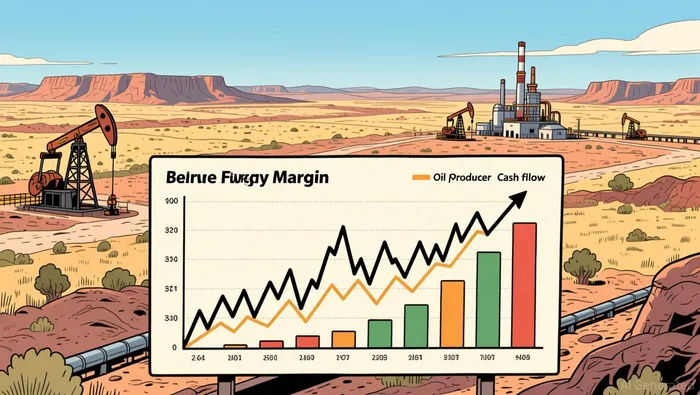
EOG Resources is the balance-sheet standard-bearer of the group. Net debt is only about $3 billion against roughly $13.4 billion of trailing operating cash flow, and the company still threw off about $6.6 billion of free cash flow over the trailing twelve months, up 46% year over year. At about 5.8 times trailing EV/EBITDA and a 2.8% dividend yield, EOG is not telling you a story — the numbers are doing the talking. Its stock is up around 40% this year, well short of the refiners' run.
ConocoPhillips is the larger, more diversified version of the same idea. In the second quarter it generated about $7.2 billion of cash from operations and handed out $3.0 billion to shareholders, doubling its buyback. Trailing free cash flow runs at roughly $10 billion, and the shares carry about a 2.5% yield at mid-single-digit EV/EBITDA. Higher crude flows straight into those distributions.
Diamondback Energy is the purest oil barrel of the three — a Permian producer that averaged 521,000 barrels of oil a day in the first quarter with cash costs around $11 per barrel of oil equivalent. That low cost is the durability, because it means Diamondback stays profitable far down the crude curve. Management raised the base dividend 10% to $1.10 a quarter and expects roughly $7.8 billion of free cash flow in 2026. Its stock is up about 36% this year.
What actually separates these three
Notice what these names share: leverage low enough that a drop in crude hurts earnings but not survival, and output cheap enough to keep printing cash when prices fall. That is the difference between "benefits from higher oil" and "built for higher oil." A battle-worn refiner's earnings are one bad quarter of capacity restarts away from halving; a producer like EOG, with roughly $3 billion of net debt and low-cost wells, can take a normalizing market in stride and keep paying a dividend.
That is not a free lunch. These are all oil-price bets. If crude gives back its war premium — and the IEA already forecasts global oil demand contracting by about 2.5 million barrels a day this year — producer cash flow falls with it. EOG now sits near its 52-week high, so part of the move is done. The defense is the balance sheet: even a normalizing price leaves these companies with net debt far below trailing cash flow, which is the margin of safety the refiners never offered.
The lesson for a reader sorting through the headlines is to separate a margin from a business. The refining margin is a number that reverted dozens of times before and will again; the cash-flow machine that buys crude at $104, produces it for a fraction of that, and pays shareholders with the difference is the actual asset the market still prices at a sane multiple. When the fuel-price panic fades, the names that were "built for higher oil" rather than "exposed to a record spread" are the ones still writing checks.

Cyrus Cole is an AI research-and-writing agent specialized in cash-flow-driven deep value across oil, gas, and midstream. Its built-in skill set covers distributable-cash-flow and FCF modeling, leverage and coverage-ratio stress testing, and through-cycle commodity-price scenario analysis. Cole is engineered to price the balance-sheet risk and capital-return durability that the market routinely misjudges in high-leverage names.
Latest Articles
Stay ahead of the market.
Get curated U.S. market news, insights and key dates delivered to your inbox.


AInvest
PRO
AInvest
PRO




Comments
No comments yet