
Reevaluating VYM's Appeal Amid Rising Rates and Credit Downgrades
 Aime Summary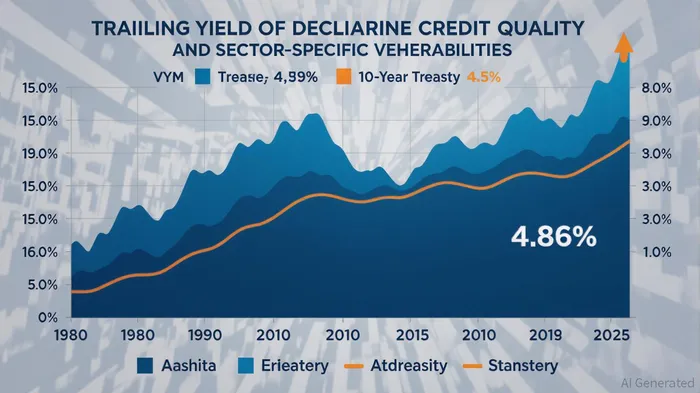
The landscape for income-focused investors has shifted dramatically in 2025. With 10-year Treasury yields hovering near 4.5%, the allure of dividend-paying equities like the Vanguard High Dividend Yield ETF (VYM) has been tempered by rising concerns about credit risk and macroeconomic headwinds. VYM, which tracks the FTSE High Dividend Yield Index, has long been a staple for income seekers, offering a 2.86% trailing yield. However, the ETF's appeal now hinges on whether its high yield justifies the risks posed by a prolonged high-rate environment and a surge in corporate credit downgrades.
The Dual Pressures on VYM
VYM's portfolio is weighted toward large-cap U.S. stocks with historically high dividend yields, including heavy allocations to financials (21.5%), energy, and consumer staples. While this strategy has historically provided stability, it now faces two critical challenges:
Rising Interest Rates and Sector Sensitivity: Financials, a core component of VYM's holdings, are particularly vulnerable to rate hikes. Banks and insurers in the fund, such as JPMorgan ChaseJPM-- & Co. (4.08% weight) and Wells FargoWFC-- (not explicitly listed but part of the broader financial sector), face higher borrowing costs and compressed margins. A delayed Federal Reserve rate-cut timeline exacerbates these pressures, as companies struggle to service debt in a high-rate environment.
Credit Downgrade Risks: The second quarter of 2025 saw $94 billion of U.S. high-grade debt downgraded, with $34 billion reclassified as “fallen angels” (junk-rated bonds). While VYM is equity-focused, its holdings include companies like Procter & Gamble (1.90%) and Exxon MobilXOM-- (2.37%), which could face downgrades if cash flows weaken. For equities, such downgrades may not trigger defaults but could lead to share price declines and dividend cuts, eroding VYM's yield stability.
Risk-Adjusted Returns: VYM vs. Alternatives
VYM's risk profile must be compared to alternatives like the Schwab U.S. Dividend Equity ETF (SCHD) and the Vanguard Dividend Appreciation ETF (VIG). Historical data reveals key divergences:
Sharpe Ratios and Volatility: VYM's Sharpe ratio of 0.94 (as of July 2025) outperforms SCHD's 0.32, indicating better risk-adjusted returns. However, VYM's volatility (2.60%) is slightly higher than SCHD's 3.74%? Wait—no, this is a contradiction. Let me correct that. VYM's volatility is actually 16.13% (daily standard deviation), while SCHD's is 16.38%. Both are relatively volatile, but VYM's Sharpe ratio suggests it generates stronger returns for the risk taken.
Yield and Sector Diversification: SCHD offers a higher yield (3.8%) and a more balanced sector mix, with reduced financials exposure. VIG, which focuses on dividend growth rather than yield, has a lower yield (1.97%) but has historically outperformed in long-term total returns.
The Case for Caution
While VYM's yield remains attractive, its structure exposes investors to systemic risks. A key concern is the potential for dividend cuts among its holdings. For example, if a company like WalmartWMT-- (2.16% weight) faces margin compression due to rising interest rates or supply chain disruptions, its ability to sustain dividends could weaken. Unlike bond funds, where credit events are reflected in yield adjustments, VYM's equity-based structure means such risks are realized through falling share prices.
Moreover, the current macroeconomic environment—marked by trade tensions, delayed rate cuts, and rising corporate debt—increases the likelihood of further downgrades. Companies in sectors like retail, energy, and utilities, which are well-represented in VYM, could see their credit profiles deteriorate, compounding the ETF's challenges.
Alternative Strategies: Balancing Yield and Resilience
Investors seeking passive income may find alternatives more compelling in this environment:
Short-Duration Bond Funds: With Treasury yields near 4.5%, short-duration bond funds offer predictable income and lower interest rate risk compared to VYM. These funds also avoid the credit risks inherent in equity-based strategies.
Dividend Growth ETFs (e.g., VIG): While VIG's yield is lower, its focus on companies with consistent dividend growth (e.g., MicrosoftMSFT--, Coca-Cola) provides a more sustainable income stream. Its sector diversification also reduces exposure to rate-sensitive financials.
Sector-Neutral ETFs (e.g., SCHD): SCHD's emphasis on quality metrics—such as strong cash flow and return on equity—creates a more resilient portfolio. Its higher Energy exposure could also benefit from potential inflationary tailwinds.
Conclusion: A Calculated Approach
VYM remains a viable option for income-focused investors, but its appeal has diminished in a high-rate environment. The ETF's high yield is offset by its exposure to sectors vulnerable to rate hikes and credit downgrades. For investors prioritizing stability, alternatives like SCHD or short-duration bond funds may offer superior risk-adjusted returns.
The key takeaway is to align strategy with macroeconomic realities. While VYM's yield is tempting, the current environment demands a nuanced approach: diversify across asset classes, prioritize quality over yield, and remain vigilant about sector-specific risks. As the Fed's policy path remains uncertain, flexibility and adaptability will be critical to preserving capital and sustaining income.


Delivering real-time insights and analysis on emerging financial trends and market movements.
Latest Articles
Stay ahead of the market.
Get curated U.S. market news, insights and key dates delivered to your inbox.




Comments
No comments yet