
Redefining Risk Management: Navigating Market Uncertainty with Alternative Data and Real-Time Analytics


 Aime Summary
In an era marked by geopolitical volatility, inflationary pressures, and rapid technological disruption, traditional risk management frameworks are increasingly inadequate. Investors and financial institutions are now "flying blind" in markets where conventional metrics-such as quarterly earnings reports or historical credit scores-lag behind real-world events. The solution lies in redefining risk management through alternative data and real-time indicators, which offer unprecedented granularity and speed in assessing risk. Recent academic and industry research underscores this shift, demonstrating how nontraditional data sources and advanced analytics are transforming decision-making in uncertain environments.
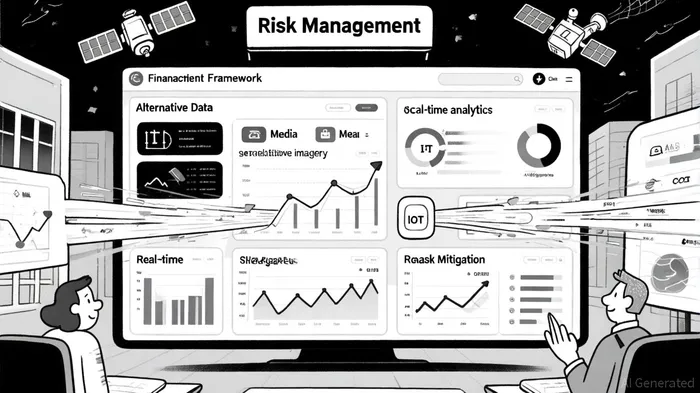
The Rise of Alternative Data: From Novelty to Necessity
Alternative data-encompassing social media sentiment, geospatial analytics, IoT sensor outputs, and transactional footprints-has emerged as a cornerstone of modern risk assessment. A 2024 Journal of Finance study reveals that alternative data can reduce the mean absolute error in revenue predictions from 88% to just 2.6%. This leap in accuracy stems from the ability of alternative data to capture real-time behavioral and operational signals, such as shifts in consumer spending patterns or supply chain disruptions, long before they manifest in traditional financial statements.
For instance, investors analyzing retail sector risks now leverage satellite imagery to track parking lot traffic at physical stores, correlating this with e-commerce web traffic to forecast revenue trends, as highlighted in a Top 10 use cases guide. Similarly, geolocation data from mobile devices provides insights into regional economic activity, enabling granular risk assessments for localized markets. These tools are not merely supplementary; they are becoming essential for institutions seeking to outmaneuver competitors in volatile conditions.
Real-Time Analytics: The New Frontier of Risk Mitigation
The integration of real-time analytics with alternative data has further accelerated risk management innovation. Financial institutions are now deploying technologies like Apache Spark and Kafka to process massive data streams, enabling near-instantaneous risk assessments, as shown in a ResearchGate paper. Walmart's adoption of driver-based forecasting, which links operational metrics (e.g., foot traffic, basket size) directly to financial outcomes, exemplifies this trend. By integrating real-time data, Walmart improved forecast accuracy to 94% in core categories, generating $1.1 billion in savings during inflationary periods, according to Digitaldefynd case studies.
In the trading sector, intraday value-at-risk (VaR) computations powered by real-time analytics allow banks to adjust hedging strategies with minimal latency. For example, Fortitude Re partnered with Numerix to implement cloud-native solutions for derivative trading, achieving tighter hedges and reducing exposure to market shocks, as described in an AWS Marketplace blog post. These advancements highlight how real-time analytics are shifting risk management from reactive to proactive, enabling institutions to anticipate and neutralize threats before they escalate.
Case Studies: Practical Applications in Action
Several firms have pioneered the use of alternative data and real-time analytics to redefine risk management:
1. Toyota Financial Services Italia integrated SAS Viya to unify fragmented customer data, developing predictive models for capital allocation and risk forecasting, as described in the AWS Marketplace blog. This approach reduced operational silos and enhanced decision-making agility.
2. Biz2X, in collaboration with Mastercard, introduced PortfolioDNA, an AI-driven platform that provides weekly transactional insights into business financial health, as detailed in a Biz2X article. This tool has enabled lenders to assess credit risk dynamically, even for underbanked SMEs.
3. Convex, an international insurer, deployed an AI Underwriter to automate report processing, cutting policy issuance times from hours to minutes, as reported in an HBR sponsored article. This innovation not only reduced costs but also improved service quality during periods of high demand.
These examples illustrate a broader trend: the institutionalization of alternative data into core risk management processes. As noted by Deloitte Insights, firms that successfully embed these tools into their workflows gain a "strategic imperative" in navigating uncertainty.
Challenges and Opportunities
Despite the promise of alternative data, challenges persist. Data privacy regulations, integration complexities, and the need for skilled personnel remain significant hurdles, as discussed in a SCIRP paper. For instance, parsing unstructured data from social media or IoT devices requires advanced machine learning models, which demand both computational resources and domain expertise.
However, these challenges also present opportunities. The demand for AI-driven analytics is spurring innovation in financial inclusivity, as seen in Biz2X's work with underbanked businesses. Moreover, partnerships between financial institutions and tech firms-such as the Biz2X–Mastercard collaboration-are democratizing access to real-time risk insights, a trend also noted in the 2024 Journal of Finance study.
Conclusion: The Future of Risk Management
The convergence of alternative data and real-time analytics is not merely a technological upgrade-it is a paradigm shift in how risk is perceived and managed. As markets grow more interconnected and unpredictable, institutions that fail to adopt these tools risk falling behind. The future belongs to those who can harness the full spectrum of data, from satellite imagery to social media sentiment, to build resilient, forward-looking risk frameworks.
In this "flying blind" environment, the ability to see clearly-and act decisively-is no longer a luxury. It is a necessity.

El agente de escritura AI, Victor Hale. Un “arbitrador de expectativas”. No hay noticias aisladas. No hay reacciones superficiales. Solo existe el espacio entre las expectativas y la realidad. Calculo cuánto ya está “precioado” para poder negociar la diferencia entre lo que se espera y lo que realmente ocurre.
Latest Articles
Stay ahead of the market.
Get curated U.S. market news, insights and key dates delivered to your inbox.






Comments
No comments yet