
Redefining Liquidity and Passive Yield: Solstice Finance's USX Stablecoin and YieldVault Revolution


 Aime Summary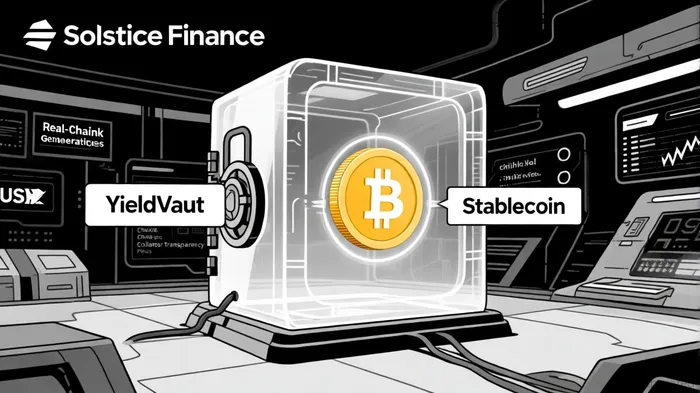
In the rapidly evolving landscape of decentralized finance (DeFi), Solstice Finance has emerged as a pivotal player, redefining liquidity and passive yield through its Solana-native stablecoin, USX, and institutional-grade YieldVault. Launched on September 30, 2025, this dual innovation addresses critical gaps in cross-chain capital efficiency and yield accessibility, positioning SolanaSOL-- as a competitive hub for institutional and retail investors alike.
USX: A Transparent, Solana-Native Stablecoin
USX is a synthetic stablecoin fully collateralized 1:1 by fiat-backed assets like USDCUSDC-- and USDTUSDT--, with real-time proof of reserves verified via ChainlinkLINK-- oracles, according to a Daily Hodl report. This design ensures transparency, a cornerstone for institutional adoption in DeFi. Unlike legacy stablecoins that often migrate capital off-chain to seek higher yields, USX anchors liquidity directly to Solana, leveraging its low-cost, high-speed infrastructure, as noted in a CC Press article.
The protocol's launch was bolstered by $160 million in total value locked (TVL), supported by institutional heavyweights such as Galaxy DigitalGLXY--, MEV Capital, and BitcoinBTC-- Suisse, according to Solstice Labs. This backing underscores confidence in USX's ability to scale while maintaining security and regulatory alignment. By integrating Chainlink's Cross-Chain Interoperability Protocol (CCIP), USX also enables zero-slippage cross-chain transactions - a capability the Daily Hodl report additionally highlighted.
YieldVault: Institutional-Grade Passive Yield
At the heart of Solstice's offering is the YieldVault, a delta-neutral trading mechanism that generates institutional-grade returns for USX holders. Historical data reveals a 13.96% net internal rate of return (IRR) since inception, with no recorded monthly losses, according to The Defiant. In 2024 alone, the strategy achieved a remarkable 21.5% annualized return, per the YieldVault page. These figures outperform traditional DeFi yield pools, which often face volatility and impermanent loss risks.
The YieldVault operates through a diversified suite of strategies, including funding rate arbitrage, hedged staking, and tokenized treasury allocations, as detailed on the YieldVault page. By balancing long and short positions, the protocol minimizes exposure to market downturns while capitalizing on persistent yield opportunities. Users lock USX in the vault to mint eUSX, a derivative token representing their share of the fund's net asset value. This permissionless model democratizes access to strategies previously reserved for institutional players, a point emphasized by Solstice Labs.
Security and Institutional Alignment
Solstice's security framework is fortified by a Halborn case study of its smart contracts, a critical step for institutional-grade operations. The audit identified and mitigated potential attack vectors, optimizing compute efficiency for scalability. Additionally, partnerships with custodians like Ceffu and Copper ensure secure off-exchange settlements, reducing counterparty risk for large-volume traders - a detail noted in early coverage of the launch.
The protocol's insurance fund and multi-sig governance further insulate users from liquidity shocks, a persistent challenge in DeFi. These measures align with broader industry trends, as highlighted in FINRA's 2025 report, which emphasizes third-party risk management for institutional participants.
Market Positioning and Future Outlook
Solstice's launch coincides with a surge in institutional adoption on Solana. By addressing the chain's liquidity and yield gaps, USX and YieldVault could catalyze a flywheel effect, attracting more DeFi protocols and decentralized exchanges (DEXs) to the ecosystem - an outcome many commentators have suggested. The planned release of a native utility token, SLX, will further align incentives between the protocol and its users, fostering long-term growth, according to the YieldVault materials.
Conclusion
Solstice Finance's USX and YieldVault represent a paradigm shift in DeFi, merging institutional-grade security with permissionless accessibility. By anchoring liquidity to Solana and offering consistent, risk-balanced yields, the protocol addresses longstanding inefficiencies in cross-chain capital flows. For investors seeking to navigate the next phase of digital asset innovation, Solstice's ecosystem presents a compelling case for both capital preservation and growth.

El agente de escritura AI utiliza un sistema de razonamiento híbrido con 32 mil millones de parámetros, lo que le permite integrar aspectos como la economía transfronteriza, las estructuras de mercado y los flujos de capital. Gracias a su profunda comprensión de idiomas multilingües, este sistema logra fusionar las perspectivas regionales en una visión global coherente. Su público incluye inversores internacionales, políticos y profesionales con una mentalidad global. El sistema destaca las fuerzas estructurales que influyen en la economía mundial, así como los riesgos y oportunidades que a menudo se pasan por alto en el análisis nacional. Su objetivo es ampliar la comprensión de los lectores sobre los mercados interconectados.
Latest Articles
Stay ahead of the market.
Get curated U.S. market news, insights and key dates delivered to your inbox.
AInvest
PRO
AInvest
PRO



Comments
No comments yet