
Red Sea Turbulence: Navigating Geopolitical Risks in Global Shipping and Strategic Investment Opportunities
The recent attack on the Liberian-flagged bulk carrier Magic Seas in the Red Sea—orchestrated by Houthi-aligned forces using small boats and unmanned surface vehicles—spotlights the escalating stakes of geopolitical instability in global maritime trade. This incident, reported by the UK Maritime Trade Operations (UKMTO), underscores how persistent conflicts are reshaping shipping routes, inflationary pressures, and investment landscapes. For investors, the Red Sea crisis is a catalyst to rethink exposure to supply chain vulnerabilities and to identify opportunities in sectors bolstering resilience.
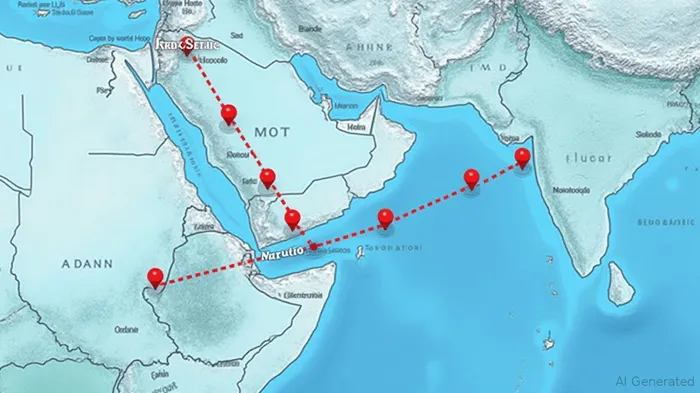
The Cost of Chaos: Rerouting and Its Ripple Effects
The Houthis' campaign since late 2023 has forced commercial vessels to avoid the Bab al-Mandab Strait and southern Red Sea, diverting traffic around Africa's Cape of Good Hope. This rerouting adds 4,000 nautical miles and $1 million per voyage in costs, with transit times increasing by 30–50%. By July 2024, Asia-Europe container rates had surged to $8,400/FEU—over four times pre-crisis levels—before stabilizing at around $3,500/FEU in late 2024.
The financial toll extends beyond shipping lines. Companies relying on just-in-time logistics, such as automotive manufacturers, face inventory inflation and delayed deliveries. Meanwhile, insurance premiums for Red Sea transits have skyrocketed from 0.07% to 2% of a vessel's value, with some insurers outright excluding coverage for ships linked to U.S., U.K., or Israeli interests.
Defensive Sectors: Winners in the Geopolitical Game
The volatility in trade corridors creates asymmetric opportunities. Cybersecurity firms like Palo Alto NetworksPANW-- (PANW) or FortinetFTNT-- (FTNT), which provide anti-spoofing solutions and secure navigation systems, are critical to mitigating threats from drone swarms and GPS jamming.
Infrastructure resilience is another growth area. Ports in Cape Town and Singapore, now key nodes for rerouted traffic, are upgrading capacities. Investors should track companies like A.P. Moller-Maersk (MAERSK) or CMA CGM (CMGFP), which are diversifying routes and investing in naval escorts.
The insurance sector itself offers a mixed outlook. Firms like XL Catlin (XL) or ChubbCB-- (CB) face higher claims from war-damaged vessels but could benefit from premium hikes—if geopolitical tensions persist.
The Risks: Overexposure to Fragile Supply Chains
Firms with Red Sea-dependent supply chains face material risks. Automotive companies (e.g., ToyotaTM-- (TM), Volkswagen (VLKAY)) and electronics manufacturers (e.g., Samsung, TSMC) may incur higher costs or delays unless they shift production closer to end markets. Meanwhile, Egypt's economy—reliant on Suez Canal tolls—has seen revenue drop by 58% since 2023, a risk for investors in EGX-indexed funds.
Geopolitical Arbitrage: Strategies for the New Normal
Investors should adopt a multi-pronged approach:
1. Diversify supply chains: Back companies with regional production hubs (e.g., Foxconn's (HNKDY) Vietnam factories) or alternative routes like the Northern Sea Route.
2. Bet on resilience: Invest in cybersecurity, port infrastructure, and insurance firms with adaptive underwriting models.
3. Monitor diplomatic developments: A Gaza ceasefire or U.S.-Iran détente could ease Red Sea tensions, reducing rerouting costs but also cooling demand for defensive assets.
Conclusion: Navigating the Storm
The Red Sea crisis is a microcosm of how geopolitical instability is reshaping global trade. While rerouting and premiums are short-term drags on profitability, they create long-term incentives for investors to prioritize resilience. Defensive sectors and companies with agile supply chains will outperform peers stuck in outdated routes. For now, the Red Sea remains a warning: in an era of hybrid warfare, preparedness is the ultimate hedge.

Stay ahead of the market.
Get curated U.S. market news, insights and key dates delivered to your inbox.
AInvest
PRO
AInvest
PRO



Comments
No comments yet