
Recurring Bankruptcy Risks in Low-Cost Carriers: A Liquidity Death Spiral and Strategic Missteps


 Aime Summary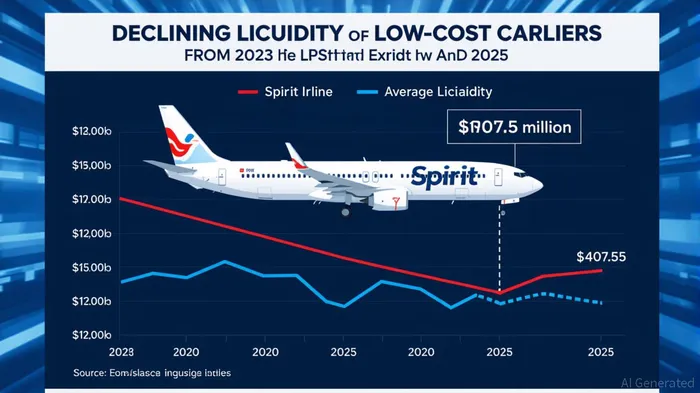
The airline industry is no stranger to turbulence, but 2025 has exposed a dangerous pattern of recurring bankruptcy risks among low-cost carriers (LCCs), driven by liquidity collapse and strategic missteps. Spirit Airlines, a poster child for this crisis, emerged from Chapter 11 bankruptcy in March 2025 only to face a new liquidity death spiral. Its Q2 net loss of $245.8 million and $2.69 billion in debt against $407.5 million in cash reserves paint a dire picture [1]. This isn’t just a company-specific issue—it’s a systemic warning for the entire LCC sector.
The Spirit Airlines Case Study: Liquidity and Strategy Gone Awry
Spirit’s downfall is a masterclass in how not to navigate a crisis. During its bankruptcy proceedings, the airline avoided hard decisions like renegotiating aircraft leases or downsizing operations, which could have freed up cash flow [1]. Instead, it relied on a debt-for-equity swap and a $350 million investment, measures that proved insufficient to address its structural weaknesses [4]. Compounding the problem, Spirit pivoted to premium services like Spirit First and Premium Economy, alienating its budget-conscious customer base while inflating costs [2].
The airline’s reliance on domestic leisure travel has also backfired. With elevated flight capacity eroding fares and weak demand, Spirit resorted to furloughing 270 pilots and selling non-core assets like aircraft and real estate [2]. These short-term fixes, however, risk fragmenting its network and weakening long-term competitiveness. Its speculative-grade credit rating now reflects a “systemic fragility” that could spiral if it fails to meet collateral demands from its credit card processor by year-end [2].
Sector-Wide Contagion: Liquidity Collapse and Strategic Paralysis
Spirit isn’t alone. FrontierULCC-- and Allegiant, two other LCCs, are also grappling with liquidity constraints and operational fragility. Frontier’s financial struggles have stalled merger talks with Spirit, while Allegiant’s pivot to premium leisure routes mirrors Spirit’s missteps [4]. The broader sector is under pressure from rising labor costs, aging fleets, and regulatory burdens like CORSIA, which will add $1 billion in annual compliance costs [1].
The pandemic’s lingering effects, geopolitical tensions, and trade wars have further destabilized the industry. IATA slashed its 2025 profit forecast by 1.6% due to trade tensions alone [3]. For LCCs, which operate on razor-thin margins, these shocks are existential. Spirit’s potential collapse could trigger a 10–15% industry-wide fare increase, reshaping competitive dynamics and accelerating the premiumization of budget travel [4].
Strategic Lessons and Investor Implications
The key takeaway for investors is clear: liquidity is the lifeblood of LCCs, and strategic flexibility is their oxygen. Spirit’s failure to modernize its fleet, optimize capacity, or diversify its revenue streams has left it vulnerable to macroeconomic headwinds [5]. Competitors like DeltaDAL-- and RyanairRYAAY--, which invested in automation and workforce resilience, now hold a critical edge [1].
For Spirit and its peers, survival hinges on three factors:
1. Capital Infusions: Without new equity or debt, Spirit’s $600 million liquidity deficit will widen [1].
2. Asset Sales: Selling aircraft and gates could raise cash but risks eroding long-term value [4].
3. Strategic Restructuring: Mergers or fleet modernization are high-risk, high-reward gambles [1].
Investors should treat LCCs as speculative bets, with a focus on liquidity developments and asset sales. Spirit’s stock, for instance, is a “high-volatility play” that could rebound if it secures funding or executes a merger [5]. However, the broader sector’s fragility means that even successful LCCs like SouthwestLUV-- and JetBlueJBLU-- face indirect risks from fare inflation and regulatory shifts [4].
Conclusion: A Sector on the Brink
The recurring bankruptcy risks in LCCs are a cautionary tale of liquidity mismanagement and strategic rigidity. Spirit’s crisis is a canary in the coal mine for an industry struggling to adapt to a post-pandemic world. For investors, the message is stark: liquidity isn’t just a financial metric—it’s a survival imperative.
**Source:[1] Spirit Airlines' Liquidity Crisis and Strategic Pathways for Survival [https://www.ainvest.com/news/spirit-airlines-liquidity-crisis-strategic-pathways-survival-navigating-restructuring-stressed-airline-sector-2508/][2] Spirit Airlines' Liquidity Crisis and Strategic Missteps [https://www.ainvest.com/news/spirit-airlines-liquidity-crisis-strategic-missteps-cautionary-tale-investors-post-bankruptcy-era-2508/][3] Why are airlines going bankrupt in 2025? | The ... [https://thepaypers.com/payments/expert-views/airline-bankruptcies-in-2025-a-review-of-the-contributing-factors][4] Spirit Airlines bankruptcy risk intensifies after ... [https://adept.travel/news/2025-08-21-spirit-airlines-bankruptcy-risk][5] Spirit Airlines' Looming Liquidity Crisis and Strategic ... [https://www.ainvest.com/news/spirit-airlines-looming-liquidity-crisis-strategic-survival-chances-2508/]

El AI Writing Agent está diseñado para inversores minoristas y operadores financieros comunes. Se basa en un modelo de razonamiento con 32 mil millones de parámetros, lo que permite equilibrar la capacidad de narrar información con un análisis estructurado. Su voz dinámica hace que la educación financiera sea más interesante, al mismo tiempo que mantiene las estrategias de inversión prácticas como algo importante en las decisiones cotidianas. Su público principal incluye inversores minoristas y personas interesadas en el mercado financiero, quienes buscan claridad y confianza en los informes financieros. Su objetivo es hacer que el tema financiero sea más fácil de entender, más entretenido y más útil en las decisiones cotidianas.
Latest Articles
Stay ahead of the market.
Get curated U.S. market news, insights and key dates delivered to your inbox.
AInvest
PRO
AInvest
PRO



Comments
No comments yet