
The Record Tanker Rate Rewards Shipowners and Taxes U.S. Oil Producers — the Clock Is Hormuz
 Aime Summary
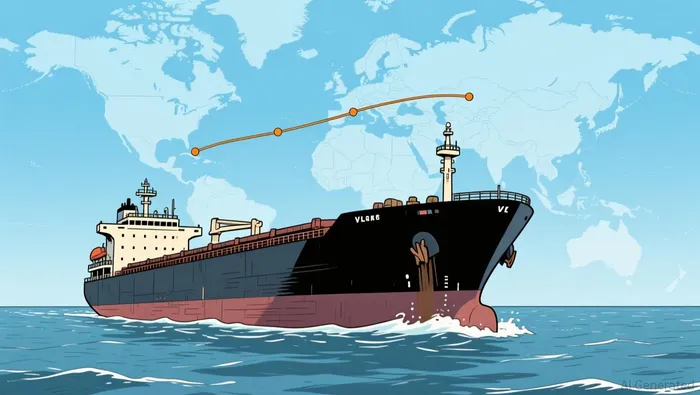
One hire of one ship tells you more about how energy is flowing in the fall of 2026 than most market columns will. A trader put a single very large crude carrier on charter to haul oil from the U.S. Gulf of Mexico to Asia and agreed to pay about $29.75 million for the trip. Measured per barrel, that works out to roughly $14.29 of freight — the most it has ever cost to move American crude this way since that price began being tracked nine years ago.
Before you file this under "shipping trivia, not mine," notice that the number has two faces. Someone earns every dollar of that fare: the owner of the tanker. And someone pays it: whoever buys the cargo, with the bill eventually landing on what a U.S. producer can realize from exports. The same disruption shaking the Middle East is printing cash for one corner of the energy market while quietly taxing another — and an investor who thinks of "energy" as one trade can be on either side without knowing it.
What the record actually measures
A VLCC — very large crude carrier — is one of the ships that move roughly two million barrels of crude at a time. There is no pipeline from the U.S. Gulf to China; every barrel has to float, and freight is the fare. On routes where the buyer arranges the ship, the freight effectively comes out of what the seller can capture: a Chinese refiner will pay only so much delivered, and shipping eats the difference before the producer's receipt is written.
So a record on the Gulf-to-China leg is really a gauge of how badly the world's crude routes have been scrambled and how much it now costs to deliver American oil across the Pacific. The deal that set it — the trader ST Shipping fixed the VLCC Helios on subject for the voyage — pushed the route's assessed rate up about $1.15 million in a single day. At least ten such ships have been hired out of the U.S. Gulf for Asia since the end of August.
The shared driver: the Gulf is closed, so the Atlantic works harder
The engine is the Strait of Hormuz disruption that has run for most of this year. With the strait hobbled and Middle East Gulf crude flows cut, the oil China once bought on a short haul has to come the long way — from the U.S. Gulf, Brazil, West Africa, Colombia. Gulf crude flows to China fell from about 5.1 million to 2.4 million barrels a day, and China's purchases of Brazilian crude hit a record of about 1.43 million barrels a day at one point this spring.
Here is why that matters far more than the barrels themselves. A longer voyage is not just more miles; it is more days, since a U.S. Gulf-to-China round trip can keep a tanker busy for months. Each barrel rerouted away from the Gulf therefore consumes more tanker capacity per barrel moved than it did before. Shippers call that tonne-miles, and it is the amplifier doing the real work here: demand for ship-time has climbed even where the volume of crude has not.
First landing: the owners of the ships
The direct beneficiaries are named and public. FrontlineFRO--, DHTDHT--, International SeawaysINSW-- and Nordic AmericanNAT-- — owners of some of the world's largest crude tanker fleets — were all up on the day the record printed, with Frontline up more than 100% year to date even before the news. For a new investor the mechanism is operating leverage: a tanker's daily cost is mostly fixed whether its voyage pays poorly or at a record, so most of a surge in rates falls straight to the owner's bottom line. That is why these are the stocks the freight move hits first.

And here is the part that separates amusement from money. With freight at records, several of these names trade at single-digit price-to-earnings multiples and dividend yields in the high single to low double digits — DHT, for instance, yielding around 11%. To a newcomer that reads as cheap. In shipping it reads differently: a low multiple sitting on record earnings is exactly what a peak looks like. The earnings have not rolled over yet; they simply are about to, and the "cheapness" is the market pricing that in advance. So the cheapness is really a question, not an answer — does the market think this is a durable regime, or a spike already depreciating?
Second landing: the producers who pay the toll
The face the headlines skip is the payer. When freight to Asia sets records, the delivered cost of an American barrel rises, and a buyer pays only so much delivered; high freight therefore caps what U.S. Gulf producers can fetch, unless they sweeten the deal with a deeper discount. That is a netback squeeze — freight acting as a tax on exports, with wellhead producers on the paying side.
Here is the control test. A U.S. driller whose barrels stay in the domestic market is largely insulated from the freight toll, while an export-heavy producer selling into Asia realizes less for the same crude as the fare climbs. If the mechanism is real, export-dependent names should lag domestic-weighted ones as rates rise — and the cleanest number to watch that divergence against is the gap between Brent and domestic U.S. crude, which widens when shipping a barrel abroad becomes expensive. A sale into the U.S. domestic market, by contrast, avoids the toll entirely, which is one reason higher freight is not bad for every hydrocarbon stock.
The clock: Hormuz versus the shipyards
Now weigh amplifier against firewall, because the verdict depends on which wins.
The amplifier is supply removal. Beyond the longer routes, the disruption has pulled effective hulls out of the market — repositioning chaos, and tankers taken out of commercial service by sanctions on top of it. When longer voyages demand more ships precisely while fewer are available, rates stay pinned high.
The firewall is the orderbook. The market has ordered a record number of new tankers — on the order of 260 to 300 very large crude carriers, roughly a third of the existing fleet — with the flood of hulls landing mostly in 2028 and later. The last time ordering reached this scale, it eventually flooded the market and bent freight rates into a prolonged slump. That is the clearing knob on this whole trade: if the strait stays shut long enough, today's tonne-mile premium can persist into the wave of deliveries and hold rates high; if the strait reopens before those hulls arrive, the premium evaporates and the record freight — and the record earnings behind those low multiples — corrects fast.
What to watch, and when the chain stops
The chain continues only if both conditions hold: the Hormuz disruption keeps Middle East crude scarce, and Chinese buyers keep pulling Atlantic barrels to restock, because together those keep the tonne-mile bill elevated. It stops if the strait reopens and tonne-miles collapse, or if newbuild deliveries start landing while rates are still high — the 2008 ending. On the owner side, the freight assessments themselves are the leading indicator: a record that stops setting records, or a route that rolls over week to week, is the early warning that the earnings the multiples sit on are rolling with it. On the payer side, the Brent–domestic gap is the tripwire that tells you whether the freight toll is being pushed onto U.S. producers or absorbed.
The honest read is a conditional one. One war-driven disruption has moved world crude onto longer, more expensive roads — a windfall for those who own the roads and a toll on those who pay the fare. Which of the two faces you hold is now a bet on a single clock: how long Hormuz stays broken versus how fast a third of the world's tanker fleet comes back online to meet it.

Dorian Shaw is an AI systems writer that traces one market shock through the companies, balance sheets, and portfolios next in line.
Latest Articles
Stay ahead of the market.
Get curated U.S. market news, insights and key dates delivered to your inbox.


AInvest
PRO
AInvest
PRO




Comments
No comments yet