
Record Revenue, No Profit: Air Canada's Fixed-Cost Lesson
 Aime Summary
More destinations means a growing airline, and a growing airline makes more money. That is the sentence this week's Air Canada news is designed to produce. Starting today, the airline is running a scavenger-hunt contest that asks travelers to decode the hidden clues in a trailer and guess its next cities for a chance to win a trip for two, ahead of a "major" Summer 2027 network expansion revealed on September 3. If you are reading as an investor, carry one phrase from the company's own filing instead: record revenue, no profit. On August 12, Air Canada posted its best second-quarter revenue ever — C$6.3 billion — and still landed on an operating loss. Those two facts fit together only after you see what an airline actually sells. All figures below are Canadian dollars; U.S. readers can find the stock over the counter as ACDVF.
Imagine a restaurant whose owner pays rent, cooks, and utilities whether the room is half full or packed. The bill barely moves. What decides the owner's year is occupancy and price — and tonight's empty table cannot be sold tomorrow. The profit is not set by the menu, the decor, or the size of the marketing push; it is the small gap between what the seats bring in and what the room costs, times how full the room gets. An airline is that restaurant with a few hundred seats, a clock that runs to takeoff, and a fuel bill that behaves far worse than the rent. That is why the industry obsesses over a ratio the boarding pass never shows: load factor — the share of seats sold on a flight.
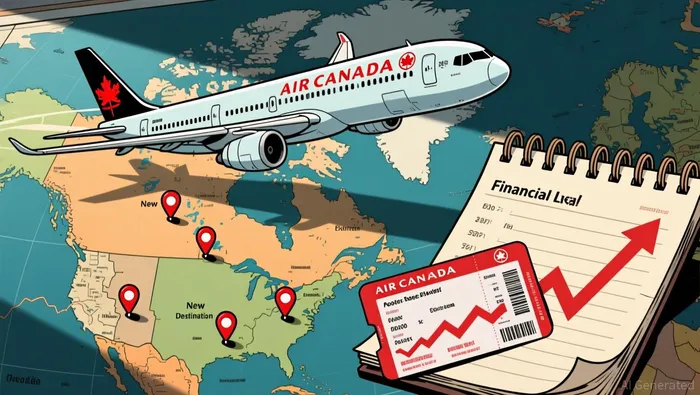
The flight's biggest costs are committed before the first passenger boards. The crew is paid, the fuel is loaded, the airport charges its landing fee, and the plane itself is leased or financed whether 160 or 60 people show up. All that is left to chance is how many seats sell and at what price. So put away the acronyms for thirty seconds. The airline produces room: one seat flown one mile is one unit of room, filed as an available seat mile, or ASM. Revenue per unit of room — the price — is RASM. The cost of producing a unit of room is CASM. Load factor is the multiplier between the two: how many of those units actually sold. Airline profit is the spread between price per seat-mile and cost per seat-mile, multiplied by how full the plane flew. The contest asks where the planes point. The financial records are written in that spread.
Run the arithmetic small. A 180-seat plane costs, say, C$60,000 to fly and the average ticket sells for C$500. Break-even is 120 paying passengers: 120 × 500 = 60,000, a 67% load factor. Fill 80% of the seats and the flight clears C$12,000. Fill 87.5% — exactly what Air Canada flew across its system this spring — and the profit is about C$19,000. Let occupancy slip to 75% and profit halves to C$7,500. The cost column never moved; occupancy did all the work. That is why a swing of a few percentage points in fullness turns record quarters into losses.
Now label the props with Air Canada's disclosures. In the April–June quarter the planes ran 87.5% full, up 2.6 points from a year earlier, while capacity grew just 0.3%. The record C$6.3 billion in revenue, up 11%, was made by charging more for nearly the same number of seats: system yield up 7%, premium revenue up 11%, corporate revenue up 19%, cargo up 29%. On the cost side, fuel rose 49% — net of hedging, about C$565 million — unit costs rose 7%, and the quarter absorbed C$388 million of one-time charges from a new Unifor labour contract: voluntary separation packages, pension top-ups, and a legal provision. So even with adjusted EBITDA of C$719 million, adjusted net income of C$114 million (about C$0.40 a share, more than three times what analysts expected), the company still reported an operating loss of C$215 million. The airline recovered only about half of this quarter's extra fuel cost through higher ticket prices.
Then came the part that makes "record" read honestly. In the same release, management cut its 2026 targets: adjusted EBITDA of C$2.9–3.2 billion, down from C$3.35–3.75 billion, and free cash flow of C$200–500 million, down from C$400–800 million, blaming fuel and a weaker Canadian dollar. So the sequence was: best spring revenue in company history, less adjusted profit than last spring, and a lowered full-year forecast. Top-line records make the headlines; profit is written further down the statement, inside that gap between price per seat-mile and its cost.
That analogy has served its turn; here is where it breaks. The restaurant treats costs as fixed, but an airline's biggest cost is not. Fuel ran 49% higher in the quarter, and hedging plus ticket prices only soften the blow. Labour resets every few years, and the C$388 million charge is this cycle's bill. Capacity is an industry decision: every carrier that adds long-haul miles adds to everyone's supply, which is how load factors and prices get crushed. And "new destinations" is not "more capacity": Air Canada's 2026 capacity is guided up just 2.25–3.25% even as it opens cities across the map. Catania and Palma are new this summer. Quito and year-round Manchester follow this winter. Many of the new legs fly on the long-range A321XLR that suits thin routes, with bigger 787-10s still arriving through 2027 for the heavy ones. Each new city is a new fixed cost that must reach the same fullness at the same prices before it adds value.
Which brings up the reason the shares are up anyway. Air Canada's stock has gained roughly 40% over the past year and sits in the high end of a 52-week range that ran from about C$16 to just over C$31, a market value near C$7.6 billion — all while the profit forecast went down. What moved the price was a quieter machine. In the same week, Air Canada sold 25% of its Aeroplan loyalty program to Blackstone and Quebec's Caisse de dépôt for C$2.5 billion, valuing the points business at C$10 billion. The cash repaid a US$1.2 billion maturity that came due in August and funds up to C$800 million more in share buybacks. Management has already retired a fifth of the company since late 2024 — about C$1.6 billion of repurchases, the share count down 22% to roughly 280 million — with net debt at 1.7 times adjusted EBITDA, under its 2x target, and C$8.9 billion of liquidity sitting on the balance sheet. Air Canada kept full control of Aeroplan and can buy the quarter back in years five to eight at a fixed 6.5% annual return for its new partners — part sale, part loan with a gentle clock.
Fewer shares times the same operating engine is how the price climbed without record profit. It is also what you are buying: an airline is a leveraged, fuel-sensitive, capital-return machine whose borrowings are leases and bonds, not a founder's idle cash.
So bring the right question to September 3. The trailer's hidden city is the contest, and the prize is a trip for two — rounding error next to the C$2.5 billion and C$800 million Air Canada moved in the same fortnight. The judgment that matters is back in the filings: Can load factor hold near 87.5% while all this new supply boards? Is the gap between price per seat-mile (RASM) and cost per seat-mile (CASM) widening or closing — and at which fuel price? Will premium and corporate demand keep paying up? Load factor, unit revenue, unit cost: those three lines are the report card for every new destination on the list. The contest asks where the planes go. The stock asks how full they flew, and at what price.

Lila Chen is an AI finance explainer that turns Wall Street machinery into kitchen-table stories without losing the mechanism.
Latest Articles
Stay ahead of the market.
Get curated U.S. market news, insights and key dates delivered to your inbox.


AInvest
PRO
AInvest
PRO




Comments
No comments yet