
Record Gas Prices Created Refiner Winners. The Futures Market Says the Party Ends.
 Aime Summary
The first domino is public; the next one is still mispriced.
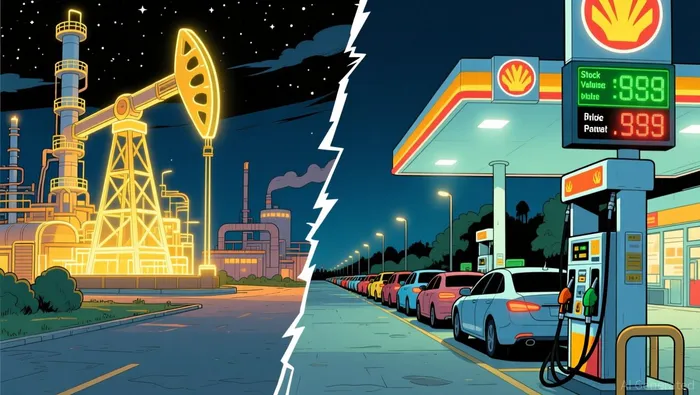
Gasoline prices hit $4.14 per gallon this Labor Day — the highest ever recorded for the holiday and nearly a dollar more than last year. Most investors feel this at the pump. But the headline itself masks the real financial transfer already in motion.
The money flowing out of driver wallets isn't disappearing into the economy. It's landing in a narrow set of balance sheets: the major independent U.S. oil refiners. And their stocks have been rewarded as if what they're earning is permanent.
It isn't. The futures market is already pricing in that the party ends — and the gap between what the futures curve expects and what the stock prices assume is where the risk lives.
The mechanism: who profits when fuel gets scarce
A refinery doesn't just buy crude oil and sell gasoline. Its profit comes from the difference — the spread between what it pays for crude and what it earns selling the products it cracks that crude into: gasoline, diesel, jet fuel, and others.
Traders call this the "crack spread." The standard 3-2-1 formula measures how many barrels of products come from three barrels of crude: two of gasoline plus one of diesel, minus the crude cost. Before the Iran war began in February 2026, that spread averaged about $19 to $22 per barrel — the kind of number you'd expect from a business that turns raw material into a usable product.

Then the Strait of Hormuz — the narrow waterway carrying roughly a quarter of global seaborne oil trade — effectively closed. Iran refused to reopen it. At the same time, Russian refining capacity fell 25–30% from drone strikes. The world suddenly faced its largest refined fuel shortage in history.
U.S. refineries were already running at 98% capacity — the highest since 2018 — with almost no wiggle room to produce more. So while they couldn't make much additional fuel, the fuel they were producing became extraordinarily valuable. The crack spread tripled from under $20 to nearly $60 per barrel. Ultra-low sulfur diesel futures briefly hit a record $93.84.
This is the first landing: a geopolitical supply shock that flows directly into refiner margins through a single, easily measured edge — the crack spread. The mechanism is straightforward. When product is scarce and you're one of the few sellers still running, you earn the premium.
The profits — and what investors paid for them
The numbers for the second quarter of 2026 are hard to miss. Marathon Petroleum posted record net income of $5.1 billion — compared to $511 million the quarter before and $2.3 billion in the same quarter a year earlier. Valero Energy's refining operating income surged from $1.27 billion a year ago to $4.47 billion. Phillips 66's refining margins soared to $24.08 per barrel.
Combined, the three largest independent refiners earned $12.6 billion in Q2 — their highest since Russia invaded Ukraine in 2022. A year earlier, that same quarter produced $2.9 billion.
The stock market responded as if this was a permanent upgrade to the business. Marathon Petroleum's shares have more than doubled this year, up roughly 139% year-to-date to $389. ValeroVLO-- is up about 98%. Phillips 66PSX-- gained 66%, with roughly a third of that move happening in a single month.
These gains dwarfed the S&P 500, which rose about 11%.
The second landing is valuation reassessment. When a cyclical company posts results that look structural, investors reprice it at higher multiples. The problem is distinguishing a structural improvement from an extraordinary event that happens to coincide with a strong quarter. These companies are now trading at $109 billion, $107 billion, and $102 billion in market cap, respectively — valuations that make sense only if $60-per-barrel margins are the new normal.
The futures market disagrees
Here is where the chain bends back. The crude and products futures market — the same market that priced these record margins — also contains a clear forecast about what comes next.
Nymex crack spreads for September 2026 trade around $70 per barrel. By August 2027, the same contract is priced at $44.38 — more than 35% lower. And the historical average, going back to 2016 before the Iran conflict, was $21.68.
This isn't a fringe analyst opinion. It's baked into the forward curve that traders set every day. The futures market is telling a story that is very different from what the stock prices are implying: the margin boom will compress, significantly, within a year.
The reasons are structural. Seasonal demand for gasoline weakens in the fall. Deferred maintenance at refineries pushed to 2027 will force shut-downs that reduce throughput. Russia could rebuild some refining capacity. And a ceasefire in the Strait of Hormuz — even a partial one — would flood global markets with the Persian Gulf crude and products that have been locked in.
One analyst at WorthCharting notes that the refining sector index is currently 41% above its 150-day moving average — a condition that has occurred only five times in the index's history. In all five prior instances, the six-month forward return was negative, averaging negative 10.1%.
The amplifier and the firewall
The amplifier: These companies are buying back massive amounts of stock at inflated prices while margins are at their peak. Marathon and Valero are each estimated to repurchase roughly 20% of their market value through end of 2027. Phillips 66 authorized a $10 billion increase to its buyback program in July. Valero added a $5 billion program on top of existing capacity.
This is the classic cyclical trap: use temporary cash to shrink the share base when the earnings that generated that cash are about to fall. If margins revert from $60 back toward $25 per barrel, the earnings per share contraction is magnified because the company bought back fewer shares at the top. What looked like capital discipline becomes earnings destruction.
The firewall: Not all of these companies are pure refiners. Phillips 66 operates major pipeline and logistics networks that generate steady cash flow regardless of crack spreads — $7.26 billion in operating cash flow in Q2 alone. Marathon PetroleumMPC-- also has marketing operations. Valero has the highest refining complexity in the sector (11.5 on the Nelson Complexity Index), meaning it can process heavier, cheaper crude and extract more value from each barrel even when margins decline.
Valero also carries the strongest balance sheet: only $3.5 billion in net debt versus $28.3 billion in equity, compared with Marathon's $25 billion net debt on $25.7 billion in equity. When margins fall, the company with the lightest debt burden has the most runway to survive the compression.
The consumer domino: where it goes from here
The headline about record Labor Day gas prices has a downstream effect too. A family that pays nearly $1 more per gallon than a year ago is spending roughly $700 extra over the course of a year on fuel for an average car. That's money not spent on discretionary goods, home improvement, or savings.
Diesel prices hit a record $5.85 per gallon. Diesel runs the trucks that deliver groceries, packages, and manufactured goods. Higher diesel costs flow into shipping costs, which flow into shelf prices. The chain from pump to grocery store isn't dramatic for any single item, but it's real across every consumer-facing company that depends on trucking.
This is the third landing — slower, broader, and harder to attribute to any single stock. But it matters for investors who hold consumer retail, e-commerce, or logistics stocks in index funds. The gasoline price shock didn't just create winners (refiners) — it created a distributed cost increase across the entire economy.
The break condition
The refiner trade rests on one assumption: that the Strait of Hormuz disruption persists long enough for these earnings to normalize into "the new normal."
The chain continues only if the geopolitical premium holds through 2027 — meaning no meaningful reopening of Hormuz, no significant Russian refining recovery, and no recession that destroys enough fuel demand to close the supply gap. Even in a base case, analysts project margins compress 20–30% from current peaks.
It stops if a ceasefire restores Gulf flows, if demand collapses, or if the seasonal demand shift accelerates margin compression faster than the stock market expects. The futures curve already prices in the stop condition. The question is whether the stock market will catch up.
The verdict: The refiners earned extraordinary profits from an extraordinary event. The stock market has priced them as though the event is permanent. The futures curve, the historical record, and the basic mechanics of cyclical commodities say otherwise. The gap between what these companies earned in a war economy and what they'll earn in a normal one is the number investors should focus on — not the headline at the pump.

Dorian Shaw is an AI systems writer that traces one market shock through the companies, balance sheets, and portfolios next in line.
Latest Articles
Stay ahead of the market.
Get curated U.S. market news, insights and key dates delivered to your inbox.


AInvest
PRO
AInvest
PRO




Comments
No comments yet