
Rebalancing the Scales: Labor Market Cooling and the Fed's Tightrope Walk Between Growth and Value


 Aime Summary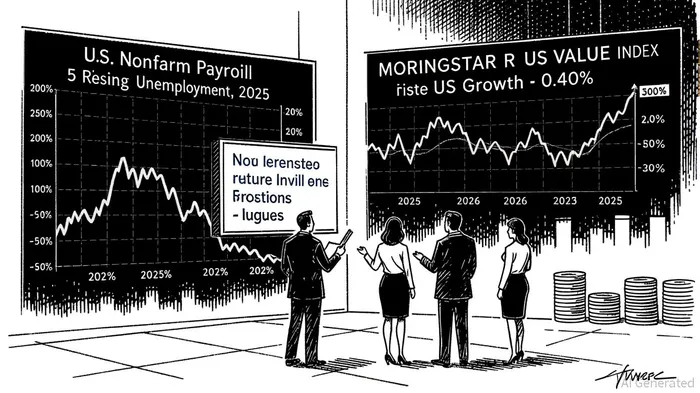
The U.S. labor market in 2025 has become a battleground of contradictions. , , yet job creation has sputtered. , far below expectations, . This fragile equilibrium has forced investors to recalibrate their portfolios, as the Federal Reserve's looming rate cuts and cooling wage inflation reshape the risk-rebalance dynamics between growth and value stocks.
The Labor Market's Mixed Signals
The labor market's duality is stark. While productivity gains suggest a resilient economy, the data reveals a tightening labor market with rising unemployment expectations. , . This moderation, , respectively), signals a labor market that is neither collapsing nor thriving.
The Fed's dilemma is clear: inflation remains stubbornly above 2%, but a sudden spike in unemployment could force a policy pivot. The central bank's “Beige Book” highlighted firms delaying hiring due to weak demand and trade policy uncertainties, including 's import tariffs. These factors have created a “, ” environment, where companies prioritize efficiency over expansion.
The Fed's Tightrope: Rate Cuts and Market Reactions
, the Fed is walking a tightrope. , but their impact is uneven. , which thrive on low rates and long-term cash flow projections, face headwinds as investors rotate into value sectors.
, . , , are now seen as a safer bet in a slowing economy. J.P. Morgan Research notes that sectors like energy, real estate, and healthcare—historically value-heavy—have outperformed during prior Fed easing cycles.
Growth vs. Value: A New Paradigm
The shift from growth to value is not arbitrary. , particularly in and tech, have driven the market's gains in 2025, but their valuations are now vulnerable to rising real rates. For example, the S&P 500's large-cap tech firms, , 2025, face profit-taking as investors seek defensive plays.
Conversely, like utilities and healthcare are gaining traction. , reflecting its resilience in a volatile labor market. , with stable and low volatility, , signaling investor confidence in their defensive appeal.
Strategic Rebalancing: Where to Allocate Capital
For investors, the key lies in balancing exposure to both growth and value, but with a tilt toward sectors poised to benefit from Fed easing. Here's how to approach the current landscape:
Defensive Value Sectors: Overweight , , and . These sectors offer predictable earnings and strong cash flows, which become more valuable as rate cuts reduce borrowing costs. For instance, .
Cyclical Value Sectors: Position in and materials, which may benefit from a Fed-induced economic rebound. However, monitor trade policy risks, as tariffs could dampen demand for construction and manufacturing.
Growth Sectors with Pricing Power: Selectively hold high-quality tech firms with dominant market shares and strong cash flows. These companies can withstand rate hikes better than speculative growth stocks.
Avoid . Their earnings are likely to compress as the Fed tightens further.
The Road Ahead: Policy Uncertainty and Market Volatility
The Fed's September decision will be a pivotal moment. , but a delay risks reigniting inflation fears. Meanwhile, . Investors should prepare for a range-bound market, with value sectors acting as a buffer against potential downturns.
Conclusion: Navigating the New Normal
The U.S. labor market's cooling and the Fed's cautious easing have created a new normal for equity valuations. While growth stocks remain central to long-term innovation, value stocks are now the bedrock of a risk-rebalanced portfolio. Investors who adapt to this shift—by prioritizing defensive value and high-quality growth—will be better positioned to navigate the uncertainties of 2025 and beyond.
As the September Fed meeting approaches, the market's focus will remain on the delicate balance between inflation control and economic stability. In this environment, patience and strategic sector rotation will be the keys to unlocking returns.

Delivering real-time insights and analysis on emerging financial trends and market movements.
Latest Articles
Stay ahead of the market.
Get curated U.S. market news, insights and key dates delivered to your inbox.


AInvest
PRO
AInvest
PRO



Comments
No comments yet