
Rebalancing Portfolios: Navigating U.S. Consumer Sentiment Shifts in 2025
 Aime Summary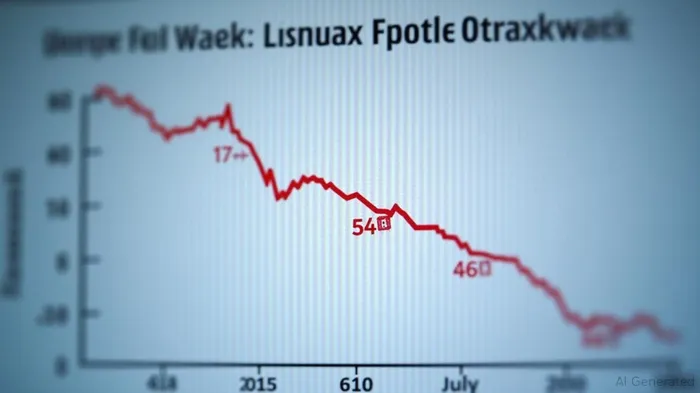
The U.S. economy in 2025 is caught in a tug-of-war between resilient fundamentals and fraying consumer confidence. The latest University of Michigan Consumer Sentiment Index, at 58.6 in August 2025, marks the first decline in four months, signaling a growing unease among households. This drop is not merely a statistical blip but a reflection of deepening concerns over inflation, tariffs, and labor market fragility. For investors, the implications are clear: portfolios must adapt to a shifting landscape where consumer behavior is increasingly cautious, and sector performance is diverging sharply.
The Drivers of Deteriorating Sentiment
Consumer expectations have soured as inflationary pressures persist. Year-ahead inflation expectations now stand at 4.9%, up from 4.5% in July, while long-run expectations have climbed to 3.9%. These figures, though below the peaks seen in early 2025, underscore a creeping anxiety about purchasing power. Meanwhile, the labor market, though officially robust (unemployment at 4.2%), is perceived as fragile. A staggering 62% of consumers expect unemployment to rise in the next year—a level not seen since the Great Recession.
The interplay of these factors is reshaping spending habits. Consumers are trading down, with 58% planning to reduce spending on cars, household goods, and dining out. The durable goods sector, already reeling from high prices and tariff-driven cost inflation, has seen its buying conditions index plummet to a one-year low. This is not just a short-term blip; the sector's 14% monthly decline in August 2025 reflects structural fragility.
Sector Rotation: From Industrial Struggles to Housing Resilience
The industrial sector, long a bellwether of economic health, is underperforming. July 2025 data shows U.S. industrial production edged down by 0.1%, with manufacturing capacity utilization at 76.8%—well below its long-run average. Tariff-related costs are eroding margins: Ford and General MotorsGM-- have each reported losses exceeding $2 billion due to trade barriers. Industrial ETFs like the Industrial Select Sector SPDR Fund (XLI) have underperformed, returning -1.85% year-to-date.
In stark contrast, the housing and consumer finance sectors are thriving. The iShares U.S. Home Construction ETF (ITB) has surged 57.13% year-to-date in 2025, while the SPDR S&P Homebuilders ETF (XHB) has returned 22.72% over three years. This outperformance is driven by two pillars: consumer resilience (wage growth and low delinquency rates among higher-income households) and favorable monetary conditions (wider net interest margins for banks). Financial institutionsFISI-- like Ally FinancialALLY-- and JPMorgan ChaseJPM-- are benefiting from stronger loan portfolios, as credit quality improves in the subprime and near-prime segments.
Strategic Implications for Investors
The divergence between industrial and consumer finance sectors demands a recalibration of portfolios. Here's how to position for the new reality:
Overweight Consumer Finance and Housing: ETFs like ITB and XHB offer exposure to sectors insulated from global trade shocks. These funds benefit from domestic demand and favorable interest rate environments. Pair them with defensive sectors like utilities or consumer staples to balance volatility.
Underweight Industrial and Durable Goods: Tariff-driven margin compression and underutilized capacity make industrials a high-risk bet. Reduce exposure to ETFs like XLI and sector-specific funds such as the U.S. Global Jets ETF (JETS).
Defensive Plays for Uncertainty: With inflation at 2.6% year-over-year in June 2025, consider inflation-hedging assets like real estate investment trusts (REITs) or commodities. Utilities and healthcare, with inelastic demand, also provide stability.
Monitor Labor Market Signals: The 60% of consumers expecting unemployment to worsen suggests a potential slowdown in 2026. Defensive allocations should increase as the year progresses.
The Road Ahead: Balancing Optimism and Caution
While the Federal Reserve's projected 50-basis-point rate cut in Q4 2025 may provide temporary relief, long-term interest rates remain elevated. This limits the effectiveness of monetary easing and constrains consumer spending. Meanwhile, the housing sector's strength—bolstered by low inventory and stable mortgage rates—offers a counterweight to industrial weakness.
Investors must also consider generational shifts. Gen Z and millennials are trading down to secondhand goods and essentials, while baby boomers maintain traditional spending patterns. This divergence suggests a nuanced approach: overweight value sectors for younger demographics and retain exposure to staples for older cohorts.
Conclusion
The U.S. economy in 2025 is a study in contrasts: a resilient retail sector coexists with a fragile industrial base, and consumer optimism clashes with inflationary fears. For investors, the path forward lies in sector rotation that prioritizes domestic demand and credit quality while hedging against trade policy risks. By reallocating capital to housing-linked durable goods and consumer finance, and balancing with defensive sectors, portfolios can navigate the uncertainties of 2025 and beyond.
As the Fed's annual revision of industrial production data in Q4 2025 provides further clarity, now is the time to act decisively. The market's next chapter will be written not by those who cling to old paradigms, but by those who adapt to the new economic reality.

Stay ahead of the market.
Get curated U.S. market news, insights and key dates delivered to your inbox.


AInvest
PRO
AInvest
PRO



Comments
No comments yet