
Rebalancing Portfolios: The Case for Consumer Staples Over Construction in a Rising Retail Sales Environment
 Aime Summary
The U.S. retail sales data for September 2025, , may seem unremarkable at first glance. Yet, beneath this muted headline lies a critical signal for investors: the persistent resilience of consumer demand. As the economy navigates a delicate balance between inflationary pressures and cautious spending, the interplay between retail sales trends and sector performance offers a roadmap for strategic portfolio rotation.
The Retail Sales Signal: A Barometer for Sector Rotation
U.S. retail sales have historically served as a leading indicator of economic health. From 2020 to 2025, , . These extremes underscore the sector's sensitivity to macroeconomic conditions. However, the broader implication for investors is that rising retail sales often signal a shift in consumer behavior—toward essentials and away from discretionary or cyclical spending.
Historical backtest data from 2000 to 2025 reveals a stark divergence between the S&P 500 Consumer Staples Index and the S&P 500 Industrials Index (a proxy for construction/engineering sectors). During periods of retail sales growth, such as the post-2009 recovery and the 2020–2021 post-pandemic surge, Consumer Staples delivered with lower volatility compared to Industrials' but higher risk. For example, in 2021, , , .
Defensive Strength of Consumer Staples
The Consumer Staples sector's appeal lies in its defensive characteristics. Over the past 40 years, it has outperformed the S&P 500 on a risk-adjusted basis, . This resilience stems from its focus on essential goods—food, household products, and personal care—whose demand remains stable even during downturns. For instance, during the 2020 pandemic, , , .
Cyclical Vulnerabilities in Construction/Engineering
In contrast, the construction and engineering sectors—represented by Industrials and Materials—exhibit pronounced . These sectors thrive during infrastructure booms and housing market expansions but falter when interest rates rise or demand wanes. For example, in 2025, , while nonresidential construction (e.g., . However, .
Strategic Implications for Investors
The data underscores a clear investment thesis: rotate toward Consumer Staples during retail sales growth and away from cyclical sectors like construction/engineering. Here's how to implement this strategy:
- Rebalance Toward Defensive Exposure: Allocate a larger portion of equity portfolios to Consumer Staples ETFs (e.g., XLP) during periods of rising retail sales. These funds offer exposure to companies like Procter & Gamble and Coca-Cola, which benefit from stable demand.
- Hedge Cyclical Bets: Reduce exposure to Industrials (XLI) and Materials (XLB) when retail sales growth slows, as these sectors are more susceptible to interest rate hikes and economic contractions.
- Monitor Retail Sales Trends: Use monthly retail sales reports to time . For example, , .
Conclusion: Balancing Stability and Growth
While construction and engineering sectors can deliver outsized returns during economic expansions, their vulnerability to macroeconomic shocks makes them a less attractive bet in a rising retail sales environment. Consumer Staples, with its low volatility and consistent returns, offers a safer harbor for capital preservation and long-term growth. As the U.S. economy continues to navigate a landscape of mixed signals—modest retail sales growth, inflationary pressures, and policy-driven infrastructure spending—investors who prioritize sector rotation based on retail trends will be better positioned to capitalize on market dynamics.
In the end, the key to navigating today's fragmented market lies not in chasing the next big thing, but in understanding the enduring power of essentials.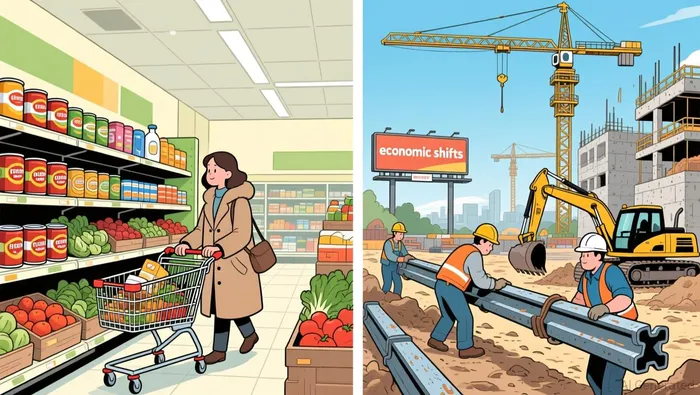

Stay ahead of the market.
Get curated U.S. market news, insights and key dates delivered to your inbox.


AInvest
PRO
AInvest
PRO



Comments
No comments yet