
Rebalancing the Portfolio: Navigating the U.S. Labor Market's Sector-Specific Shifts in 2025
 Aime Summary
The U.S. labor market in 2025 is undergoing a seismic transformation, marked by stark divergences between sectors. The Challenger Job Cuts report reveals a troubling trend: job reductions have surged to their highest levels since the 2008 financial crisis, driven by , , and . Yet, amid this turmoil, certain industries are bucking the trend, offering a roadmap for strategic . For investors, understanding these dynamics is critical to navigating a market increasingly defined by structural shifts rather than cyclical fluctuations.
The Pain Points: Sectors in Retreat
The Technology sector has emerged as the epicenter of labor market deterioration. In October 2025 alone, . This is not a temporary correction but a structural reordering. is automating roles from software development to customer service, while slowing demand for cloud infrastructure and enterprise software has forced companies to trim excess capacity. The Warehousing sector, , is similarly grappling with overcapacity and automation. Retail and Consumer Products are not far behind, , respectively, as shifting consumer habits and e-commerce consolidation reshape the landscape.
The ""—a term coined to describe the policy-driven uncertainty under the current administration—has further exacerbated these trends. While the phrase is often used pejoratively, it underscores how regulatory and fiscal policies are accelerating job cuts in sectors perceived as inefficient or politically sensitive.
The Bright Spots: Sectors on the Rise
Contrast this with the Health Care & Social Assistance industry, . Aging demographics, the expansion of telehealth, and a growing emphasis on are fueling demand for nurse practitioners, physician assistants, and home health aides. This sector's resilience is not merely demographic; it is also technological. AI is augmenting, rather than replacing, healthcare workers in diagnostics and patient management, creating a that is both human and machine.
The Transportation & Warehousing sector, despite its job cuts in warehousing, is expanding in logistics and delivery roles due to e-commerce's relentless growth. E-commerce sales hit $1.19 trillion in 2024, , . Meanwhile, Professional & Business Services and Construction are benefiting from infrastructure spending and the , .
Strategic Sector Rotation: A Framework for Investors
The data paints a clear picture: investors should tilt portfolios toward sectors with structural growth drivers and away from those facing automation-driven obsolescence. Here's how to act:
Shorten Exposure to Tech and Warehousing: The Technology sector's job cuts are a harbinger of broader earnings pressure. While AI is a long-term tailwind, its short-term impact is disruptive. Investors should reduce holdings in AI-dependent tech stocks and consider hedging with short positions in sector ETFs like XLK.
Overweight Healthcare and Transportation: The healthcare sector's growth is underpinned by demographic and technological tailwinds. ETFs like XLV (Health Care Select Sector) and IYT (Transportation) offer diversified access to these trends. For individual stocks, focus on companies integrating AI into healthcare delivery, such as Teladoc Health or UnitedHealth Group.
Monitor the Services Sector Cautiously: While the Services sector has seen job cuts, its role in supporting other industries (e.g., staffing for healthcare) means it is not a complete write-off. However, its volatility—driven by cost pressures and shifting demand—warrants a defensive stance.
- Factor in Geopolitical and Policy Risks: The "DOGE Impact" and potential rate cuts in November could spur a late-season hiring surge, particularly in Retail and Hospitality. Investors should remain agile, using options strategies to capitalize on short-term volatility.
The Long Game: Preparing for a Post-AI Labor Market
The labor market's transformation is not a temporary blip but a long-term realignment. AI is not just displacing jobs—it is redefining the skills required for the future. Investors should prioritize sectors where human capital remains irreplaceable (e.g., healthcare, education) and avoid those where is a direct substitute (e.g., administrative roles, customer service).
In the coming years, the winners will be industries that leverage AI as a tool for augmentation rather than replacement. For now, the data is clear: the U.S. labor market is diverging, and portfolios must follow suit.
By aligning investments with the forces reshaping the labor market, investors can not only mitigate risk but also position themselves to capitalize on the next phase of economic evolution. The key lies in recognizing that the future belongs to sectors where human ingenuity and technology converge—not where they compete.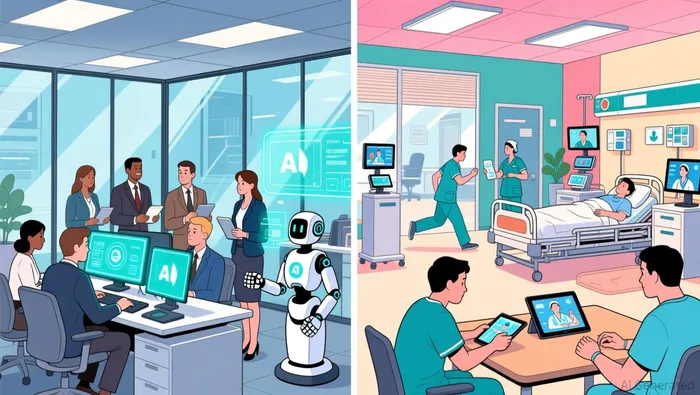

Stay ahead of the market.
Get curated U.S. market news, insights and key dates delivered to your inbox.


AInvest
PRO
AInvest
PRO



Comments
No comments yet