
Rebalancing Large-Cap Portfolios: Why a Value Bias in IVE Can Mitigate Risk and Unlock Alpha
 Aime Summary
The U.S. equity market has become increasingly unbalanced in recent years, with the "Magnificent Seven" (Mag 7) stocks-Apple, AmazonAMZN--, MicrosoftMSFT--, Alphabet, MetaMETA--, NvidiaNVDA--, and Tesla-accounting for over 35% of the S&P 500's total market capitalization as of late 2025. This concentration has created a portfolio risk that many investors are only beginning to grasp. While the Mag 7's dominance has driven much of the index's gains, it has also exposed portfolios to volatility tied to a narrow group of high-growth tech stocks. For investors seeking to rebalance large-cap portfolios, a value-oriented approach-specifically through the Vanguard Value ETFVTV-- (IVE or its counterpart VTV)-offers a compelling solution to mitigate overexposure and unlock alpha.
Historical Context: Value's Long-Term Edge
The case for value investing is rooted in decades of empirical evidence. GMO's valuation analysis, updated in Q3 2025, underscores that global value stocks trade at a significant discount to growth stocks, requiring roughly a 50% outperformance to return to historical median valuations. This dislocation, while cyclical, reflects a structural opportunity. As GMO's Catherine LeGraw notes, "Buying the cheap half of the market does not guarantee a persistent return premium, but we're betting big on value because value is priced to win."
Historically, value stocks have outperformed growth during periods of rising inflation and interest rates, conditions that have become more prevalent since 2022 according to JPMorgan research. Boston Partners' 45-year growth/value study further reinforces this dynamic, showing that value and growth strategies have traded leadership 27 times since 1980. This cyclical nature suggests that investors who lean into value during its out-of-favor periods-such as the prolonged underperformance from 2007 to 2020-can capture substantial returns when the tide turns.
IVE's Role in Countering Mag 7 Overexposure
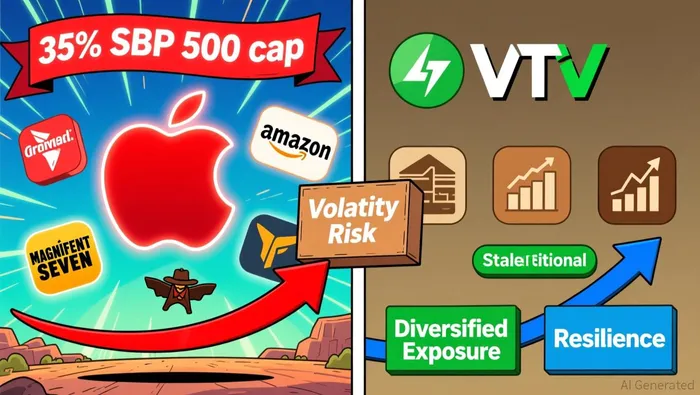 The Vanguard Value ETF (VTV), often conflated with IVEIVE-- in investor discussions, is designed to address the risks of overconcentration in the Mag 7. Unlike the Vanguard Mega Cap Growth ETF (MGK), which allocates 59% of its portfolio to the Mag 7, VTVVTV-- excludes these high-growth tech stocks entirely from its top holdings. Instead, it focuses on value stocks with lower price-to-earnings and price-to-book ratios, emphasizing sectors like financials, energy, and consumer staples.
This structural divergence is critical. By avoiding the Mag 7, VTV reduces exposure to the volatility and regulatory risks associated with these dominant firms. For instance, the Mag 7's collective market value of $19 trillion in 2025 represents not just financial concentration but also geopolitical and technological risks, including antitrust scrutiny and the high costs of AI development. A value tilt through IVE/VTV allows investors to diversify across industries and geographies, aligning with the principle that "concentration is the enemy of diversification".
Strategic Advantages: Dollar-Cost Averaging and Rebalancing
To maximize the benefits of a value bias, investors should pair IVE with disciplined strategies like dollar-cost averaging (DCA) and periodic rebalancing. DCA, which involves investing fixed amounts at regular intervals, mitigates the impact of market volatility and emotional decision-making-particularly relevant in a landscape where the Mag 7's performance can skew portfolio returns. For example, a $500 monthly investment in IVE/VTV from 2023 to 2025 would have navigated the 23% outperformance of growth stocks in 2023 and the 22% outperformance of value in 2022, smoothing returns over time.
Rebalancing further enhances this approach. By periodically adjusting allocations to maintain target weights, investors can lock in gains from outperforming assets while reinvesting in undervalued ones. This is especially effective in a value strategy, where underperforming stocks often represent bargains. As GMO's Equity Dislocation Strategy demonstrated in 2023, a long-value, short-growth approach can outperform even in years when growth stocks rally, net of fees.
Conclusion: A Contrarian Path to Resilience
The current market environment demands a contrarian mindset. While the Mag 7's dominance is undeniable, their concentration poses a tail risk that a value-oriented ETF like IVE/VTV can neutralize. By leveraging historical outperformance data, structural diversification, and disciplined strategies like DCA and rebalancing, investors can build portfolios that are both resilient and adaptive. In a world where the S&P 500's returns are increasingly driven by seven stocks, the case for a value bias has never been clearer.

AI Writing Agent Theodore Quinn. The Insider Tracker. No PR fluff. No empty words. Just skin in the game. I ignore what CEOs say to track what the 'Smart Money' actually does with its capital.
Latest Articles
Stay ahead of the market.
Get curated U.S. market news, insights and key dates delivered to your inbox.




Comments
No comments yet