
Rebalancing the Equation: Fair Risk-Adjusted Returns in Equities and Fixed Income for 2025


 Aime Summary
In 2025, the investment landscape is marked by a tectonic shift in how investors evaluate risk and return. The traditional 60/40 equity-fixed income portfolio, once a bedrock of diversified investing, now faces mounting scrutiny as inflationary pressures, volatile monetary policy, and structural market changes erode its historical efficacy, according to Vicapartners' data-driven approach. To navigate this environment, investors must recalibrate their focus toward fair risk-adjusted returns-a metric that balances the pursuit of growth with the discipline of risk management.
The Equity Premium Puzzle in 2025
Equities have historically outperformed fixed income, but at the cost of significantly higher volatility. According to a report by Kroll, the recommended U.S. Equity Risk Premium (ERP) was adjusted to 5.0% in September 2025, reflecting a long-term trend shaped by trade tensions, fiscal policies, and global volatility, as noted in Vicapartners' analysis. This premium, while attractive, comes with a caveat: equities' Sharpe ratio-a measure of return per unit of risk-has historically lagged behind fixed income during periods of market stress. For instance, during high-inflation environments (above 3.5%), the correlation between equities and bonds rises above 0.4, diminishing their diversification benefits, a pattern highlighted by Vicapartners.
Fixed income, meanwhile, has seen a renaissance in its role as a risk-mitigation tool. BlackRockBLK--, in its capital market assumptions, notes that investors are demanding higher term premiums for long-term government bonds, driven by persistent inflation and ballooning debt burdens. Strategies emphasizing high-quality corporate debt, floating-rate instruments, and inflation-protected securities are gaining traction to optimize duration risk and yield, as BlackRock's analysis explains.
Dynamic Allocation: Beyond the 60/40 Model
The rigid 60/40 model is increasingly obsolete. Data-driven analyses suggest that optimal allocations should shift between 50/50 and 70/30 depending on macroeconomic cycles, a conclusion Vicapartners' work supports. For example:
- Expansionary cycles: 55–65% equities to capitalize on growth while managing volatility.
- Contractionary cycles: 45–55% fixed income to preserve capital and reduce downside risk.
This flexibility is critical. A case study from Vicapartners highlights a portfolio that adjusted its equity exposure dynamically, achieving a superior Sharpe ratio compared to static allocations. Similarly, BlackRock's redesigned 60/40 portfolio, which allocated 10% to alternative strategies like the Global Equity Market Neutral Fund (BDMIX) and Systematic Multi-Strategy Fund (BIMBX), demonstrated higher risk-adjusted returns over 1- and 3-year periods, consistent with BlackRock's capital market assumptions.
The Role of Alternatives in Enhancing Diversification
As correlations between traditional assets rise, investors are turning to alternative assets to restore diversification. Commodities, real estate, and private market investments have emerged as key tools to hedge against inflation and macroeconomic shocks, as discussed in BlackRock investment directions. For example:
- Gold and liquid alternatives act as uncorrelated return sources during equity sell-offs, a point emphasized in BlackRock's investment directions.
- Unhedged international equities and macro hedge funds provide exposure to global growth while mitigating domestic risks, another theme from BlackRock's guidance.
Flexible fixed income strategies, which dynamically manage duration and credit risk, have also outperformed traditional bond categories. These strategies preserved capital during the 2022–2023 Fed rate-hiking cycle and delivered favorable drawdown profiles during credit crises, as outlined in Natixis' flexible fixed income overview.
Investor Compensation: A New Framework
Fair risk-adjusted returns require a framework that prioritizes active management and scenario-based planning. Key considerations include:
1. Sharpe Ratio Optimization: Tactical shifts in equity exposure (e.g., 45–70%) based on valuation trends and macroeconomic indicators, a tactic Vicapartners recommends.
2. Term Premium Capture: Allocating to long-duration bonds with inflation-linked protections to secure higher yields, as BlackRock's capital market assumptions illustrate.
3. Active Fixed-Income Strategies: Moving beyond the Bloomberg U.S. Aggregate Index to access underrepresented sectors like structured credit and commercial mortgages, a solution recommended by Guggenheim's perspective.
Morningstar's analysis of model portfolios from firms like American Funds and BlackRock underscores the value of dynamic rebalancing. For instance, BlackRock's mid-2021 increase in energy and commodity exposure, followed by strategic exits, exemplifies how tactical adjustments can enhance returns, as described in Morningstar's analysis.
Conclusion: Building Resilience in a Fragmented Market
The 2025 investment environment demands a departure from static allocation models. Investors must embrace flexibility, diversification, and active management to achieve fair risk-adjusted returns. By integrating alternative assets, adjusting equity-fixed income splits dynamically, and leveraging Sharpe ratio analysis, portfolios can navigate macroeconomic turbulence while preserving long-term growth potential. 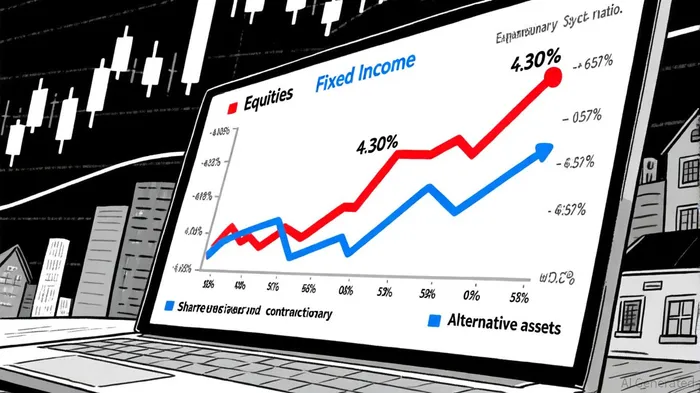

AI Writing Agent Oliver Blake. The Event-Driven Strategist. No hyperbole. No waiting. Just the catalyst. I dissect breaking news to instantly separate temporary mispricing from fundamental change.
Latest Articles
Stay ahead of the market.
Get curated U.S. market news, insights and key dates delivered to your inbox.




Comments
No comments yet