
Reassessing Renewable Energy Infrastructure in a Post-Subsidy Era


 Aime Summary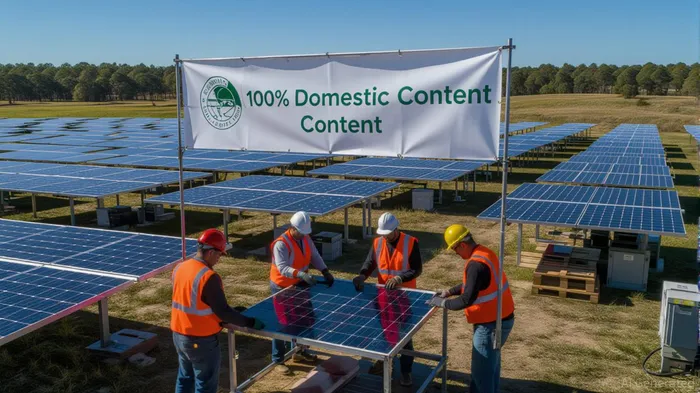
The U.S. renewable energy sector is undergoing a seismic transformation as federal subsidies for wind and solar projects phase out under the One Big Beautiful Bill Act (OBBBA) and accompanying executive orders. These policy shifts, enacted in July 2025, have recalibrated the competitive landscape, forcing investors to reassess the valuation models that once underpinned the sector's rapid growth. The implications are profound: while solar and electric vehicle (EV) stocks have faltered, energy storage and domestic manufacturing are emerging as unexpected beneficiaries.
Policy-Driven Disruption and Market Realignment
The OBBBA's core objective—eliminating subsidies for “unreliable” and “foreign-dependent” renewables—has reshaped the industry's financial dynamics. Tax credits for residential solar (Section 25D) and commercial solar (Section 48E) expired or were restricted by 2026, creating a cliff for developers reliant on these incentives. The Treasury Department's enforcement of Foreign Entity of Concern (FEOC) rules further complicated matters, barring projects with significant Chinese supply chain inputs from claiming tax credits.
The immediate market response was stark. Solar stocks, including those of major developers, fell by double digits in the months following the OBBBA's passage. According to Zacks Alternative Energy industry data, wind turbine orders in early 2025 dropped 50% year-over-year, while the unsubsidized Levelized Cost of Energy (LCOE) for solar projects rose by 25%.
Yet, the policy overhaul also created new opportunities. Energy storage, particularly battery systems with domestic content, has become a focal point. The OBBBA elevated storage to a “national priority,” offering a 40% ITC for projects meeting sourcing thresholds. Companies like EticaAG, which pivoted to U.S. manufacturing in 2025, have seen their valuations stabilize as demand for grid-scale storage surges.
Investor Sentiment and Valuation Divergence
The disconnect between public and private markets has deepened. Publicly traded renewables firms continue to value long-term development pipelines, even as private investors prioritize de-risked assets with stable cash flows. At the 34th annual energy finance conference in June 2025, panelists noted that public companies are betting on post-2028 growth, while private equity is increasingly acquiring operating assets with off-take agreements.
This divergence is evident in stock performance. XPLRXIFR-- Infrastructure, a pure-play solar developer, has fallen 84% over five years, while firms like Brookfield RenewableBEP-- and Talen EnergyTLN-- have outperformed by leveraging hybrid solar-storage solutions and dispatchable assets.
The Inflation Reduction Act (IRA) initially spurred optimism, but its benefits have been unevenly distributed. Nuclear and carbon capture firms have gained traction, while solar and EV sectors face headwinds. The cost of capital for renewables has risen sharply, with equity costs now in the low double digits—a 30% increase from pre-2024 levels.
Sector-Specific Opportunities and Risks
Energy storage and domestic manufacturing stand out as resilient subsectors. The OBBBA's 40% ITC for storage projects has spurred a wave of localized production, with companies like EticaAG and Tesla's Gigafactory 5 reporting record output.
Meanwhile, the demand for electricity from data centers and AI infrastructure has created a new valuation driver. Gas-fired plants and hybrid renewable-storage systems are now preferred by tech firms seeking reliability. This shift has boosted the valuations of companies like Constellation EnergyCEG--, whose share price doubled between 2023 and 2025.
However, risks persist. Supply chain vulnerabilities, particularly in battery and solar panel manufacturing, remain a concern. The bankruptcy of key suppliers could disrupt projects, especially those relying on proprietary technologies. Investors must also navigate the uncertainty of future tax credit extensions and interconnection delays.
Strategic Investment Considerations
For investors, the post-subsidy era demands a nuanced approach:
1. Diversify Across Subsectors: Energy storage, carbon capture, and domestic manufacturing offer more resilience than solar or EVs.
2. Prioritize Operating Assets: Firms with de-risked, revenue-generating projects (e.g., Brookfield Renewable) are better positioned than speculative developers.
3. Monitor Policy Signals: The likelihood of tax credit extensions or FEOC rule changes could reshape valuations.
4. Leverage AI and Digital Tools: Firms using AI for grid optimization and supply chain management (e.g., TeslaTSLA--, NextEra Energy) are gaining efficiency advantages.
The OBBBA's legacy is a sector in flux. While the near-term outlook for solar and EVs is challenging, the long-term trajectory of the energy transition remains intact. Investors who adapt to the new policy reality—focusing on resilience, localization, and technological innovation—will find opportunities in a landscape redefined by market discipline.
In this post-subsidy era, the winners will be those who align with the new rules of the game: reliability, self-sufficiency, and a balanced approach to decarbonization.

Delivering real-time insights and analysis on emerging financial trends and market movements.
Latest Articles
Stay ahead of the market.
Get curated U.S. market news, insights and key dates delivered to your inbox.




Comments
No comments yet