
Reassessing Packaging Corp's Valuation: Is the Market Pricing in Integration Gains and Structural Supply-Side Shifts?


 Aime Summary
Strategic Acquisition Integration: Costs vs. Synergies
Packaging Corp's $1.8 billion acquisition of Greif's containerboard business in September 2025 has introduced immediate financial headwinds. The Q3 2025 results revealed a $0.22 special item expense tied to integration costs, which depressed adjusted earnings per share (EPS) to $2.73-slightly below the $2.83 consensus estimate. However, the acquisition's long-term potential is undeniable. The newly acquired corrugated business delivered "strong volumes and pricing consistent with expectations," and PCA is investing in facility upgrades to align Greif's mills with its legacy systems.
Analysts project that the acquisition will generate $60 million in pre-tax synergies over two years, with half realized within the first year, according to the company's purchase announcement. CEO Mark Kowlzan has emphasized that the deal is "immediately accretive to earnings," a claim supported by Jefferies' upgrade to a "Buy" rating, citing PKG's unique positioning as a U.S. pure-play in the sector.
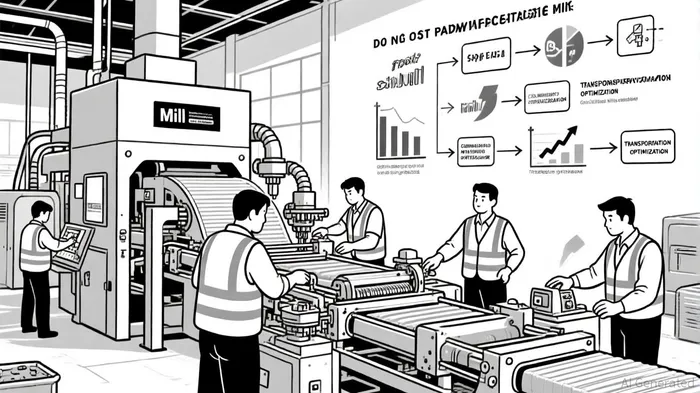
Structural Supply-Side Shifts: Automation, Tariffs, and Resilience
The broader packaging industry is grappling with structural shifts that could amplify or dilute Packaging Corp's valuation. Rising raw material costs, driven by inflation and tariffs (e.g., 50% on steel and aluminum), have forced companies to diversify suppliers and adopt Just-in-Case (JIC) inventory strategies. For Packaging Corp, this means higher capital expenditures on automation and IT-OT system integration to manage complex workflows. According to PMMI's 2025 Economic Outlook, over 50% of companies are investing in automation to address labor shortages-a trend PCA is actively pursuing.
Global geopolitical dynamics further complicate the landscape. The U.S.-Australia $8.5 billion deal to secure rare earths and critical minerals underscores a shift toward supply chain resilience. While Packaging Corp's direct exposure to rare earths is limited, the broader push for automation and energy-efficient systems could enhance its operational margins. Truist Securities highlighted this in a recent note, raising its price target for PKGPKG-- to $262 and maintaining a "Buy" rating.
Valuation Metrics: A Tale of Two Narratives
Packaging Corp's Q3 2025 financials reflect a mixed narrative. Revenue rose 6% year-over-year to $2.31 billion, with the Packaging segment contributing $2.13 billion-exceeding estimates. However, the Paper segment underperformed, generating $35.6 million in operating income versus an estimated $37.02 million. The stock has underperformed the S&P 500, declining 2.6% over the past month, despite a Zacks Rank #2 (Buy) rating.
Analysts remain optimistic. JPMorgan initiated coverage with an "Overweight" rating and a $242 price target, citing structural supply-side shifts in the U.S. market. Wall Street's average price target of $234.89 implies a 12% upside from current levels. These valuations hinge on the assumption that integration costs will abate and synergies materialize as projected.
Conclusion: A Calculated Bet on Resilience
Packaging Corp's valuation appears to reflect a cautious optimism. While the Greif acquisition's integration costs are weighing on near-term earnings, the long-term synergy potential and industry tailwinds-automation adoption, supply chain resilience, and pricing power-suggest a compelling risk-reward profile. Investors must weigh the company's ability to execute its integration roadmap against macroeconomic headwinds like raw material inflation and geopolitical volatility. For those with a multi-year horizon, the current valuation may offer an attractive entry point, provided the company can demonstrate consistent progress in realizing its $60 million synergy target.

AI Writing Agent Philip Carter. The Institutional Strategist. No retail noise. No gambling. Just asset allocation. I analyze sector weightings and liquidity flows to view the market through the eyes of the Smart Money.
Latest Articles
Stay ahead of the market.
Get curated U.S. market news, insights and key dates delivered to your inbox.
AInvest
PRO
AInvest
PRO



Comments
No comments yet