
Reassessing Netflix's 95,000% Post-IPO Surge: A New Era of Accessibility and Strategic Reinvention


 Aime Summary
A Stock Split for the Masses
On November 17, 2025, NetflixNFLX-- executed a 1-for-10 stock split, according to Financial Modeling Prep. This move, the first in a decade, was not merely a cosmetic adjustment but a strategic recalibration aimed at broadening ownership. By lowering the price barrier, Netflix has made its shares more accessible to individual investors and employees, a demographic that might otherwise be priced out of a stock trading in the "four-figure" range. According to Forbes, the split also aligned the company with major indices like the Dow Jones Industrial Average (DJIA), potentially paving the way for inclusion in blue-chip benchmarks.
The timing of the split coincided with Netflix's inclusion in the S&P 500 on the same date, a milestone that reflects its solidified status as a market leader. Analysts suggest that this dual event could catalyze institutional demand, as index funds and passive investors are compelled to add Netflix to their portfolios. As stated by a Forbes contributor, the split and S&P 500 inclusion "send a clear signal of confidence in Netflix's long-term value proposition."
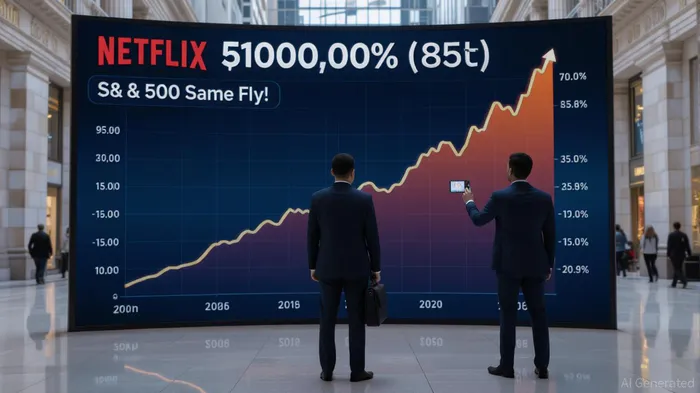
Historical Performance: A Tale of Two Timeframes
Netflix's historical performance paints a nuanced picture. Over the past decade, , . This outperformance is a testament to the company's ability to reinvent itself-from a DVD rental service to a content creation powerhouse. However, , . This divergence raises questions about the sustainability of its growth model in an era of rising content costs and intensifying competition from platforms like Disney+ and Amazon Prime Video.
The recent volatility underscores the challenges of scaling a streaming business. While Netflix's library of original content remains a cornerstone of its appeal, the company must now contend with a saturated market and evolving consumer preferences. As one analyst noted, "The streaming wars are no longer about differentiation but endurance."
Strategic Diversification: Short-Form Content and Live Programming
To address these challenges, Netflix has embarked on a dual strategy: embracing short-form content and expanding its live programming. Wall Street analysts are divided on the merits of these moves. of Wells Fargo has argued that short-form content-akin to TikTok or Instagram Reels-could attract younger audiences and complement Netflix's existing library according to Business Insider. Cahall also suggested that upfront payments to creators could provide a competitive edge over YouTube's ad-dependent model.
Conversely, of Argus Research has cautioned against overextending into short-form video, advocating instead for improvements to Netflix's ad-tier offerings. Meanwhile, the company's partnership with NASA to stream live rocket launches and spacewalks represents a bold foray into real-time content, a domain previously unexplored by streaming giants according to Seeking Alpha. These initiatives, if successful, could diversify Netflix's revenue streams and enhance user engagement.
The Road Ahead: Balancing Accessibility and Innovation
For retail investors, the stock split and S&P 500 inclusion mark a pivotal moment. The reduced share price has democratized access to a company that once seemed reserved for institutional portfolios. Yet, the recent underperformance against the S&P 500 serves as a reminder that Netflix's growth cannot rely solely on its past success. The company must continue to innovate while managing costs-a delicate balancing act in an industry where content budgets are rising faster than subscriber growth.
Looking ahead, the inclusion in the S&P 500 could provide a tailwind for Netflix's stock, as index inclusion often drives liquidity and long-term stability. However, the true test of its long-term potential lies in its ability to adapt to a rapidly changing media landscape. Whether through short-form content, live programming, or other uncharted territories, Netflix's next chapter will be defined by its capacity to stay ahead of the curve.
As the streaming wars enter their next phase, investors must weigh the company's historical resilience against the uncertainties of the future. For now, .

Delivering real-time insights and analysis on emerging financial trends and market movements.
Latest Articles
Stay ahead of the market.
Get curated U.S. market news, insights and key dates delivered to your inbox.
AInvest
PRO
AInvest
PRO



Comments
No comments yet