
Reassessing Inflation Drivers in a Post-Tariff Environment: The Impact of Tariff Rollbacks on U.S. Inflation and Consumer Prices


 Aime Summary
Sector-Specific Impacts: Tariffs as a Double-Edged Sword
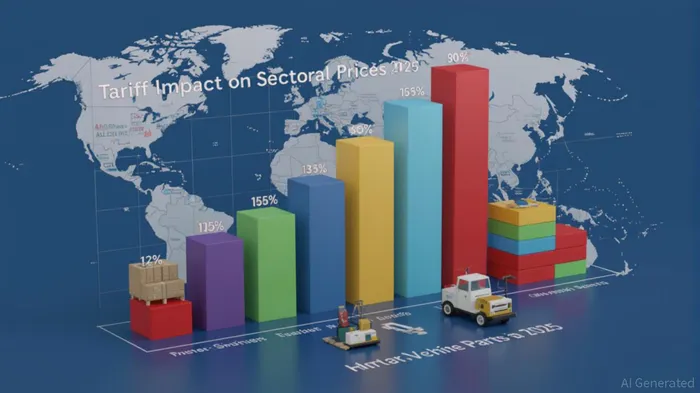 Tariffs have historically acted as a mixed force for inflation, with sector-specific effects dominating the narrative. According to a model-based analysis by the St. Louis Fed, the PCE-weighted average effect of tariffs on prices in 2025 is estimated at 0.87%, with durable goods-such as furniture, motor vehicle parts, and electronics-experiencing the largest predicted price increases. By August 2025, approximately 35% of these model-predicted effects had materialized in the data, contributing 0.5 percentage points to headline PCE annualized inflation and 0.4 percentage points to core PCE inflation.
The Budget Lab's research further underscores this trend, noting that core goods prices were 1.9% above pre-2025 trends as of June 2025, with 61-80% of new tariffs passed through to consumer prices in that period. Sectors like household furnishings, appliances, and textiles-reliant on imported inputs-have borne the brunt of these pressures, as two-thirds of U.S. furniture and a significant share of other household goods are imported.
However, the San Francisco Fed's findings complicate this picture. Researchers Régis Barnichon and Aayush Singh argue that tariffs, while raising input costs, also act as aggregate demand shocks, reducing economic activity and inflation in the short term. Historical data from the pre-World War II era supports this, showing that a 4-percentage-point tariff increase could lower inflation by 2 percentage points while raising unemployment by 1 percentage point. This duality-tariffs as both inflationary and deflationary forces-highlights the need for sector-specific analysis in investment decisions.
Short-Term Inflation Dynamics: The Role of Economic Activity
The Federal Reserve's June 2025 CPI report reveals a weakening U.S. dollar, down over 7% since December 2024, despite higher tariffs. This divergence from theoretical expectations suggests that broader economic factors-such as deteriorating demand and expectations of lower interest rates-are overshadowing the inflationary effects of tariffs. Treasury Secretary Scott Bessent's recent testimony noted that inflation had eased, albeit marginally, with tariff rollbacks contributing to this cooling.
Yet, the political calculus of tariffs introduces volatility. For instance, President Trump's 50% tariff on Brazilian imports-imposed due to legal issues involving former President Jair Bolsonaro-risks reintroducing inflationary pressures in sectors like coffee, orange juice, and beef. Conversely, deeper tariff cuts on Brazilian food products, announced in November 2025, aim to alleviate grocery costs. These contradictory policies underscore the unpredictable nature of trade-driven inflation in a post-tariff environment.
Rebate Programs and Fiscal Policy: A New Inflationary Vector
The proposed $2,000 tariff-funded rebate checks for 2026, championed by President Trump and his economic advisor Kevin Hassett, introduce a novel inflationary risk. While tariff revenues surged to $27 billion in June 2025, many Republicans argue that these funds should prioritize deficit reduction over direct consumer payments. Critics warn that such stimulus-style cheques could replicate the inflationary pressures seen during the pandemic, when similar measures fueled demand-side inflation.
This tension between fiscal responsibility and consumer relief reflects broader ideological divides. Senator Ron Johnson and Rick Scott have emphasized the need to address the $38 trillion national debt, while others view rebates as a tool to offset the regressive effects of tariffs on low-income households. For investors, the political trajectory of these proposals will be a key determinant of inflationary expectations and market volatility.
Broader Economic Implications: Supply Chains and Consumer Demand
The ripple effects of tariff adjustments extend beyond price trends. The U.S. Consumer and Professional Products (CPP) segment, for example, reported a 10% revenue decline in 2025 due to disrupted ordering patterns and weak demand linked to tariffs. While EBITDA margins improved, this was attributed to cost-cutting and global sourcing rather than demand recovery. Such sectoral fragility highlights the risks of prolonged trade uncertainty for supply chains and corporate profitability.
Meanwhile, the ISM's June 2025 data reveals a Prices Index of 69.7, signaling persistent input cost pressures, while the New Orders Index has contracted for five consecutive months. This combination of rising costs and falling demand suggests a fragile equilibrium, where tariffs may exacerbate inflation in some sectors while stifling growth in others.
Conclusion: Navigating the Post-Tariff Landscape
The 2025 tariff adjustments have created a multifaceted inflationary environment, where sector-specific impacts, fiscal policy debates, and global trade dynamics intersect. For investors, the key lies in distinguishing between short-term volatility and long-term structural trends. Sectors with high import exposure-such as durable goods and consumer staples-remain vulnerable to price shocks, while those benefiting from domestic sourcing or asset-light models may see improved margins.
As policymakers weigh the merits of rebate programs against fiscal prudence, the inflationary trajectory will hinge on the interplay of trade policy, consumer behavior, and monetary responses. In this evolving landscape, a granular understanding of tariff-driven inflation is essential for crafting resilient investment strategies.

Delivering real-time insights and analysis on emerging financial trends and market movements.
Latest Articles
Stay ahead of the market.
Get curated U.S. market news, insights and key dates delivered to your inbox.






Comments
No comments yet