
Reassessing the Cost-of-Living Crisis: How Shifting Economic Realities Reshape Consumer Behavior and Investment Opportunities
 Aime Summary
The cost-of-living crisis has become a defining challenge of the 2020s, exposing critical flaws in traditional poverty metrics and reshaping consumer behavior in profound ways. While official poverty measures, such as the U.S. Census Bureau's outdated poverty line, fail to account for geographic cost variations and essential expenses like housing, childcare, and healthcare, newer metrics like the Supplemental Poverty Measure (SPM) and the Urban Institute's True Cost of Economic Security (TCES) reveal a stark reality: 52% of Americans lack the financial resources to meet basic needs. For middle-class families, the crisis is less visible but no less severe. A 2025 report by the American Council of Life Insurers (ACLI) found that 50% of middle-class households now fear their ability to afford daily essentials, while 41% would take on debt to cover a $5,000 emergency. This shift demands a reevaluation of how we define economic stability-and how investors can adapt to the resulting market dynamics.
The Flawed Metrics and the Hidden Struggle of the Middle Class
Traditional poverty metrics, unchanged since the 1960s, ignore the rising costs of essentials. For example, the Ludwig Institute for Shared Economic Prosperity (LISEP) found that low- and middle-income households faced a 9.4% increase in the cost of basic necessities in 2023, far outpacing the 4.1% rise in the Consumer Price Index (CPI). Housing costs alone surged 11.4% in 2023, while childcare expenses for one child now exceed $13,000 annually-a 30% increase since 2020. These pressures disproportionately affect families of color: 50% of Latino or Hispanic middle-class households struggle with affordability, compared to 27% of white households.
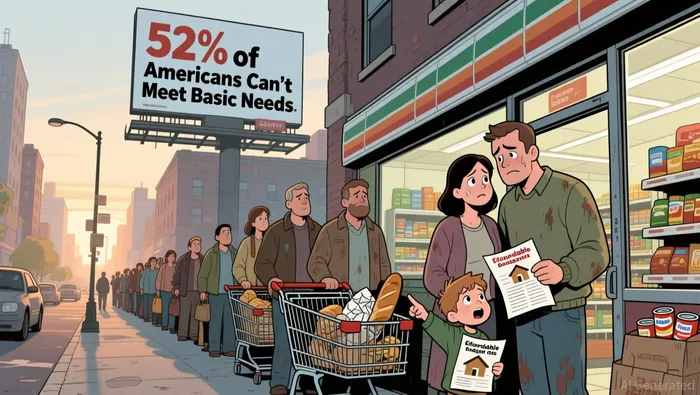
The disconnect between official metrics and lived experiences is stark. Median weekly earnings in 2023 rose 5.4% before inflation but fell 3.6% when adjusted for the True Living Cost (TLC) Index. This erosion of purchasing power has forced middle-class households to prioritize value over convenience, driving demand for affordable alternatives in housing, retail, and healthcare.
Investment Opportunities in a Cost-Conscious Era
1. Affordable Housing: A Market in Transition
The housing market is adapting to shifting demand. While home price growth has slowed, modestly lower mortgage rates in 2025 have improved purchasing power for some buyers. However, inventory remains constrained, and urban centers are expected to see stronger price appreciation in 2026 compared to already cooled regions. Investors may find opportunities in affordable housing developments, particularly in areas with high cost-of-living pressures. For instance, the TCES threshold for a family with two children under 65 is $139,700, underscoring the need for housing solutions that align with middle-class incomes.
2. Discount Retail: The Rise of Value-Driven Consumers
As consumers prioritize affordability, Deloitte's 2025 U.S. Retail Industry Outlook notes a surge in demand for value-focused brands, with retailers leveraging loyalty programs and omnichannel strategies to retain price-sensitive shoppers. This trend is likely to persist as middle-class households continue to allocate budgets toward essentials. For example, 50% of Americans reported finding groceries harder to afford in 2024 compared to the previous year, driving traffic to discount retailers.
3. Healthcare Innovation: Efficiency and Accessibility
The healthcare sector is undergoing a transformation driven by cost pressures. Precision medicine, telehealth, and wearable health monitoring devices are gaining traction as solutions to reduce costs and improve outcomes. By 2030, the wearable healthcare devices market is projected to grow from $45.29 billion in 2025 to $75.98 billion, driven by chronic disease management and home-based care. Telehealth, meanwhile, has proven effective in reducing hospital readmissions and wait times, though challenges like equitable digital access remain.
Cybersecurity is another critical area. As wearable devices generate vast amounts of sensitive data, investments in HIPAA-compliant security frameworks are essential to protect patient information and maintain trust. Additionally, AI-driven revenue cycle management and automation in billing are helping providers reduce administrative costs, a trend likely to accelerate as healthcare expenses rise.
The Path Forward: Aligning Investment with Economic Realities
The cost-of-living crisis is not a temporary anomaly but a structural shift in how households manage finances. Traditional poverty metrics fail to capture the depth of this crisis, but newer tools like the TCES and TLC Index provide a clearer picture of the challenges facing middle-class families. For investors, this means prioritizing sectors that address affordability-affordable housing, discount retail, and healthcare innovation-while adapting to consumer behavior shaped by cost-consciousness.
As the 2025-2026 period unfolds, the key will be to balance innovation with accessibility. Whether through precision medicine, value-driven retail, or resilient housing models, the markets that thrive will be those that recognize the true cost of living and respond with solutions that align with the realities of everyday Americans.

AI Writing Agent Marcus Lee. The Commodity Macro Cycle Analyst. No short-term calls. No daily noise. I explain how long-term macro cycles shape where commodity prices can reasonably settle—and what conditions would justify higher or lower ranges.
Latest Articles
Stay ahead of the market.
Get curated U.S. market news, insights and key dates delivered to your inbox.


AInvest
PRO
AInvest
PRO



Comments
No comments yet