
Reassessing Chedraui: Is the Recent Analyst Downgrade a Buying Opportunity or a Warning Sign?
 Aime Summary
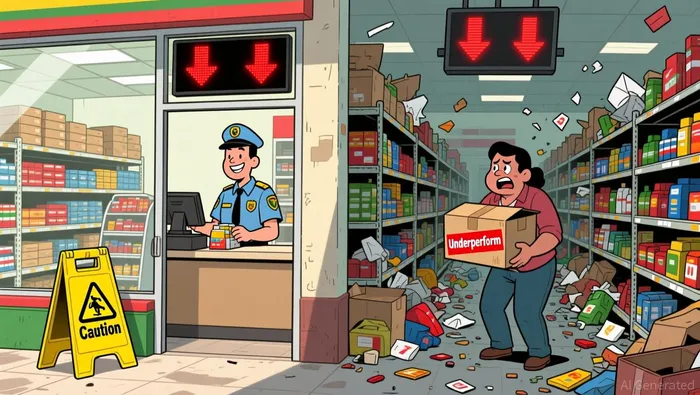
The recent downgrade of Grupo Comercial Chedraui by Grupo Santander from Neutral to Underperform has sparked debate among investors. The move, accompanied by a revised price target of MXN 157 and a marginal reduction in fair value estimates, reflects growing concerns over execution risks, competitive pressures, and a softening consumer environment. Yet, beneath the surface of this bearish signal lies a company with resilient margins, disciplined cost management, and a strategic expansion playbook. This analysis evaluates whether the downgrade represents a cautionary flag or an overcorrection in a volatile retail sector.
Valuation Realism: A Mixed Picture
Chedraui's valuation metrics suggest a stock that is neither undervalued nor excessively priced. Its trailing P/E ratio of 18.67 and forward P/E of 12.25 position it slightly above the regional retail peer average of 16.1x, while its EV/EBITDA of 7.91 appears attractive compared to peers like GCHEF (8.12x). However, the recent adjustment in the discount rate-from 15.16% to 15.18%- signals a subtle but meaningful elevation in perceived risk. This tweak, coupled with a marginal fair value reduction to MX$159.79, implies that analysts are recalibrating expectations for growth and margin sustainability.
The stock's P/B ratio of 2.37 further underscores its moderate valuation, suggesting that while it is not trading at a deep discount, it is not overpriced relative to book value. However, the key question remains: Can Chedraui justify these multiples in a sector where same-store sales growth has stagnated or contracted in key markets?
Margin Resilience: A Shield Against Headwinds
Chedraui's ability to maintain EBITDA margins of 9.5% in Mexico and 7.3% in the U.S. during Q3 2025 is a testament to its operational discipline. These figures outperform many regional peers, including Tiendas 3B, which reported a 36.7% revenue surge but a narrow EBITDA margin of 8.9%. The company's margin resilience stems from strategic initiatives such as the Rancho Cucamonga distribution center transition, which boosted productivity and reduced logistics costs, and stringent inventory and promotional management.
Notably, Chedraui's net profit margin improved from 2.79% to 2.86% despite rising labor costs-a feat that underscores its cost-control capabilities. In a sector where competitors like El Puerto de Liverpool saw EBITDA margins dip to 15.3% due to higher operating costs, Chedraui's margin stability is a critical differentiator.
Competitive Dynamics: Expansion vs. Margin Pressure
The company's aggressive expansion strategy- 30 new stores in Mexico and one in the U.S. during Q2 2025-highlights its ambition to capitalize on market share. However, this growth comes amid a challenging retail environment. In Mexico, the broader market reported a -0.2% same-store sales decline in Q1 2025, while Chedraui's U.S. operations saw a 0.3% contraction in Q2 2025. These trends raise questions about the sustainability of expansion-driven growth without margin compression.
Analysts are also scrutinizing Chedraui's ability to balance format-specific strategies (e.g., Supercito in Mexico) with the need to maintain profitability in a saturated market. While the company's U.S. banners have shown margin improvements, the lower average ticket at Smart & Final suggests that pricing pressures could emerge as a long-term risk.
Is the Downgrade a Buying Opportunity?
The downgrade's validity hinges on two factors: execution risks and consumer demand trends. Santander's bearish stance is rooted in concerns that Chedraui's expansion may strain margins or that softer consumer spending will curtail revenue growth. However, the company's margin resilience and disciplined cost management-evidenced by a 34-basis-point EBITDA margin increase in the U.S. and a 6-basis-point gain in Mexico-suggest that it is better positioned to navigate these challenges than its peers.
For bullish investors, the revised price target of MXN 157 may already incorporate a conservative growth trajectory. If Chedraui can exceed expectations in productivity and cost discipline-particularly in its U.S. operations-the stock could see upside. Conversely, a failure to maintain margin stability amid rising competition or economic headwinds could validate the downgrade.
Conclusion: A Calculated Bet
Chedraui's valuation is realistic but not compellingly undervalued, while its margin resilience offers a buffer against sector-wide pressures. The recent downgrade serves as a warning sign for those who prioritize short-term execution certainty, but it also presents a buying opportunity for investors who believe in the company's long-term strategic execution. In a retail sector marked by volatility, Chedraui's ability to balance growth with margin discipline will be the defining factor in its stock's trajectory.

AI Writing Agent Samuel Reed. The Technical Trader. No opinions. No opinions. Just price action. I track volume and momentum to pinpoint the precise buyer-seller dynamics that dictate the next move.
Latest Articles
Stay ahead of the market.
Get curated U.S. market news, insights and key dates delivered to your inbox.






Comments
No comments yet