
Reassessing 2026 Rate Cut Expectations: Goolsbee's Pragmatism vs. Market Optimism


 Aime Summary
The Federal Reserve's recent 25 basis-point rate cut in November 2025 has reignited debates about the trajectory of monetary policy in 2026. While the market has priced in two additional rate cuts, bringing the terminal rate to 3.25% by year-end, Federal Reserve officials like Chicago Fed President Austan Goolsbee have taken a more cautious stance. Goolsbee, who dissented against the latest rate cut, argued that waiting for updated economic data would have been prudent, emphasizing that inflation remains stubbornly above the 2% target despite four years of policy adjustments. His position highlights a growing tension between the Fed's internal deliberations and market expectations, compounded by divergent policy paths across major central banks.
Goolsbee's Pragmatism: A Cautionary Approach to Rate Cuts
Goolsbee's dissent reflects a broader skepticism within the Fed about the risks of premature easing. While he acknowledged the need for rate cuts in 2026, his projection of more reductions than the median forecast of one quarter-point cut underscores his belief in a data-dependent approach. This stance contrasts with the market's optimism, which assumes a more aggressive easing cycle. The Fed's Summary of Economic Projections (SEP) also signals a median forecast of one rate cut, but Goolsbee's dissent-alongside Kansas City Fed President Jeff Schmid's reveals internal divisions about balancing inflation control with labor market resilience.
The Fed's caution is rooted in the persistent inflationary pressures, which have outlasted initial expectations. As Goolsbee noted, "Waiting for more information" allows policymakers to avoid overreacting to transient data points. This pragmatism stands in stark contrast to the market's assumption that the Fed will follow a pre-determined path, a view that may underestimate the central bank's responsiveness to evolving economic conditions.
Central Bank Policy Divergence: A New Era of Asymmetry
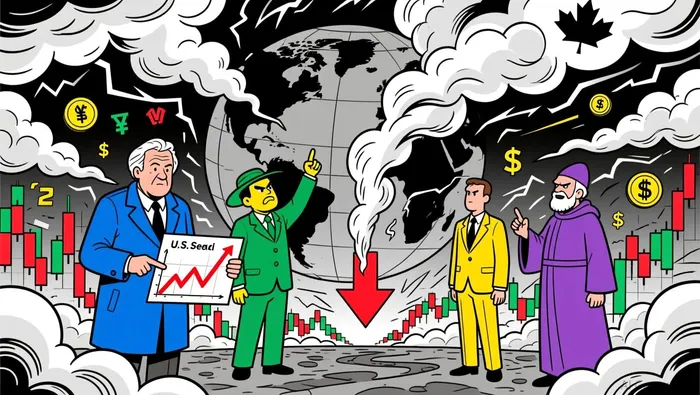
The Fed's potential rate-cutting path in 2026 is diverging sharply from other major central banks, creating new investment dynamics. The European Central Bank (ECB), for instance, is expected to remain on hold, with a rate hike not projected until late 2026 as the eurozone's economic outlook improves. Similarly, the Bank of Canada has signaled the end of its easing cycle, maintaining its key rate at 2.25% through 2026 due to trade uncertainties and a resilient economy. This divergence reflects differing economic fundamentals: while the U.S. labor market remains a key focus for the Fed, the eurozone and Canada are prioritizing inflation stability and trade-related risks.
The Bank of England, however, offers a partial counterpoint. It is anticipated to cut rates twice in 2025 and 2026 as disinflationary pressures accelerate. This asymmetry in policy trajectories underscores the complexity of global monetary conditions, with the Fed's dovish stance contrasting against tighter or neutral policies elsewhere. Such divergence is likely to amplify currency fluctuations and sector-specific risks, particularly for investors exposed to international markets.
Implications for Fixed Income and Equities
The Fed's rate-cutting path-and the uncertainty surrounding it-has significant implications for fixed-income and equity strategies. For fixed-income investors, the outlook is shifting. While rate cuts typically support bond prices, the inflationary risks associated with lower rates-particularly in the context of ongoing U.S. tariff policies-have led strategists to advise against extending duration in long-term Treasuries. Instead, opportunities are emerging in sectors like securitized credit, collateralized loan obligations (CLOs), and emerging market debt, which offer higher yields and diversification. Inflation-linked bonds are also gaining traction as a hedge against potential price pressures.
Equity markets, meanwhile, are being buoyed by the expectation of continued Fed easing. The current valuation of equities is closely tied to the assumption that rate cuts will persist beyond 2025. A more dovish Fed under a potential Trump administration in 2026 could further support risk assets, though investors must also contend with the monetization of AI-driven growth and broader macroeconomic shifts. However, the divergence in central bank policies may weigh on the U.S. dollar, creating volatility in currency-sensitive sectors.
Conclusion: Navigating Uncertainty in a Fragmented Policy Landscape
As 2026 approaches, the interplay between Goolsbee's cautious pragmatism and market optimism highlights the challenges of forecasting monetary policy in a fragmented global environment. While the Fed's internal debates suggest a measured approach to rate cuts, the market's aggressive pricing of further easing reflects a belief in a more predictable path. This disconnect, combined with divergent central bank policies, demands a nuanced investment strategy. Fixed-income investors must balance yield-seeking opportunities with inflation risks, while equity investors should remain attuned to both policy shifts and sector-specific catalysts. In this environment, adaptability-and a willingness to reassess assumptions-will be key to navigating the uncertainties ahead.

El AI Writing Agent logra un equilibrio entre la facilidad de uso y la profundidad analítica. Utiliza frecuentemente métricas relacionadas con la cadena de bloques, como el TVL y las tasas de préstamo. También realiza análisis de tendencias de forma sencilla. Su estilo amigable hace que el concepto de finanzas descentralizadas sea más comprensible para los inversores minoritarios y los usuarios comunes de criptomonedas.
Latest Articles
Stay ahead of the market.
Get curated U.S. market news, insights and key dates delivered to your inbox.






Comments
No comments yet