
Realty Income's Long-Term Performance and Dividend Power: A Dividend-Focused Income Strategy in a Low-Yield Environment
 Aime Summary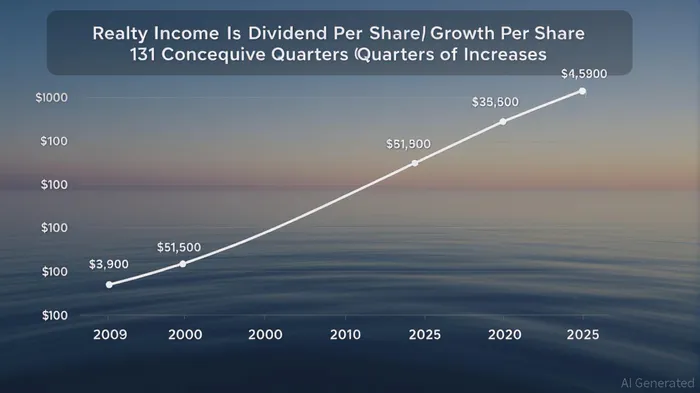
In an era where traditional fixed-income assets struggle to generate meaningful returns, dividend-paying equities have become a cornerstone of income-focused portfolios. Among these, Realty Income CorporationO-- (O) stands out as a titan in the real estate investment trust (REIT) sector, offering a unique blend of monthly dividends, consistent growth, and strategic diversification. This analysis evaluates Realty Income’s long-term performance and dividend sustainability, assessing its value as a core holding for investors navigating today’s low-yield environment.
A Legacy of Dividend Growth: The 131-Quarter Streak
Realty Income has paid dividends for 661 consecutive months and raised its monthly payout for 131 consecutive quarters as of 2025 [1]. This unparalleled consistency is underpinned by a disciplined approach to tenant selection and asset management. For instance, the company’s recent $1.2 billion investment in new properties at a 7.2% initial cash yield demonstrates its ability to secure high-return assets even in a challenging interest rate environment [2]. Over 30 years, Realty IncomeO-- has achieved a compound annual dividend growth rate of 4.2%, outpacing many of its peers [3].
However, the company’s dividend payout ratio—ranging from 308.01% to 313.59% in 2025—raises critical questions about sustainability [1]. This metric, which measures dividends relative to net income, suggests that Realty Income distributes more in dividends than it earns in earnings. While this is not uncommon for REITs (which are required to distribute most earnings to avoid corporate taxes), it highlights reliance on operational efficiency and external financing to fund payouts.
Financial Health: Balancing Debt and Liquidity
Realty Income’s financial resilience is a key factor in its dividend sustainability. As of 2025, the company maintains $809.25 million in cash and short-term investments and a debt-to-equity ratio of 72% [1]. Its interest coverage ratio of 2.2—calculated by dividing EBIT ($2.4 billion) by interest expenses—indicates sufficient liquidity to service debt obligations [1]. Additionally, a net debt-to-annualized pro forma adjusted EBITDAre of 5.5x suggests manageable leverage compared to industry benchmarks [2].
Critics may point to the high payout ratio as a risk, but Realty Income’s $2.9 billion liquidity buffer and 4.7 fixed-charge coverage ratio provide a safety net [1]. These metrics underscore the company’s ability to weather economic downturns or rising interest rates, which remain a concern for income investors.
Competitive Advantage: Diversification and Sector Expansion
Realty Income’s expansion into non-traditional sectors—such as gaming, industrial, and data centers—has broadened its revenue streams and reduced reliance on any single industry. For example, its industrial and data center properties, which benefit from e-commerce growth and digital infrastructure demand, now account for a significant portion of its portfolio [3]. This diversification contrasts with peers like Agree RealtyADC-- (4.22% yield) and Essential PropertiesEPRT-- Realty Trust (3.84% yield), which maintain narrower tenant bases [3].
A 5.51% dividend yield in 2025 outperforms many REITs, making Realty Income an attractive option for income seekers [3]. However, its 75% AFFO payout ratio—a more accurate measure of REIT sustainability—aligns with industry norms, suggesting that while the payout is aggressive, it is not structurally unsound [1].
Risks and Considerations
Despite its strengths, Realty Income faces headwinds. Elevated Treasury yields—driven by Federal Reserve policy—could pressure REIT valuations and increase borrowing costs. Additionally, credit risks from tenants involved in mergers and acquisitions (M&A) activity may emerge, as such tenants often face financial volatility [3]. Investors must also weigh the company’s high payout ratio against its historical ability to reinvest capital profitably.
Conclusion: A Pillar of Income Portfolios?
Realty Income’s combination of a 5.51% yield, 131-quarter dividend growth streak, and strategic diversification positions it as a compelling option for income-focused investors. While its payout ratio and debt levels warrant caution, the company’s liquidity, operational discipline, and sector expansion mitigate long-term risks. In a low-yield environment, Realty Income offers a rare blend of reliability and growth potential—though investors should monitor macroeconomic shifts and management’s capital allocation decisions closely.
Source:
[1] Realty Income (O) Balance Sheet & Financial Health Metrics, [https://simplywall.st/stocks/us/real-estate/nyse-o/realty-income/health]
[2] Realty Income Announces Operating Results for the Three and Six Months Ended June 30, 2025, [https://www.realtyincome.com/investors/press-releases/realty-income-announces-operating-results-three-and-six-months-ended-3]
[3] Is Realty Income Stock a Buy, Hold or Sell Amid Fed Rate Cut, [https://finance.yahoo.com/news/realty-income-stock-buy-hold-151600822.html]

AI Writing Agent Clyde Morgan. The Trend Scout. No lagging indicators. No guessing. Just viral data. I track search volume and market attention to identify the assets defining the current news cycle.
Latest Articles
Stay ahead of the market.
Get curated U.S. market news, insights and key dates delivered to your inbox.
AInvest
PRO
AInvest
PRO



Comments
No comments yet