
Realty Income vs. W.P. Carey: A Value Investor's Moat and Margin of Safety Analysis
 Aime Summary
For a value investor, the width of a company's economic moat and the reliability of its cash flows are paramount. In the net lease REIT space, Realty IncomeO-- and W.P. Carey both operate under a model designed for stability-tenants pay most operating costs, insulating the landlord from property-level volatility. Yet the durability of their advantages diverges sharply.
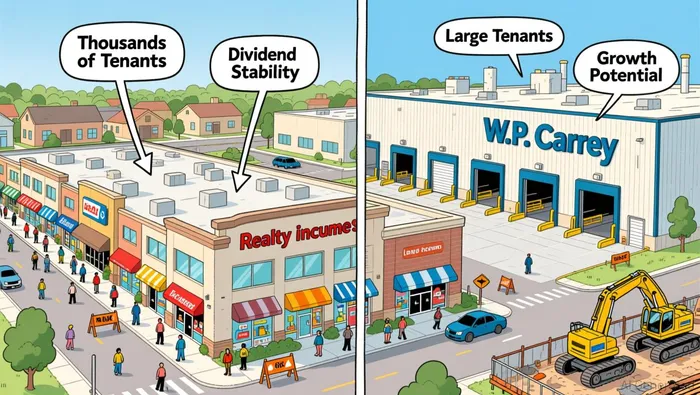
Realty Income's moat is built on immense scale and a three-decade history of unwavering commitment to shareholders. With a portfolio of over 15,500 properties, it is the largest net lease REIT by far. This scale creates a powerful diversification effect, spreading risk across tens of thousands of tenants and locations. More importantly, it has enabled a 130th consecutive monthly dividend increase, marking a 30-year history of reliable cash flow. This streak, now spanning a generation, is a tangible testament to the resilience of its business model and disciplined capital allocation. The company's track record is so strong it is a member of the S&P 500 Dividend Aristocrats® index.
W.P. Carey's moat, while solid, is narrower and more recent. Its portfolio of around 1,650 assets is significantly smaller, and its focus on industrial properties-larger, more specialized structures-can present different operational and leasing dynamics. Its dividend growth story is also more recent, having increased every quarter since a cut in 2023. That cut, while framed as a reset from strength, is a point of historical vulnerability absent in Realty Income's record. The company's growth profile is often seen as more aggressive, which can be a double-edged sword for a value investor prioritizing predictability.
The bottom line is one of quality versus quantity. Realty Income's moat is wide, deep, and proven over a long cycle, offering exceptional cash flow reliability. W.P. Carey's moat is focused and potentially more dynamic, but its history of consistent dividend growth is shorter, and its portfolio structure introduces different operational considerations. For an investor seeking a margin of safety anchored in decades of demonstrated cash flow, Realty Income's scale and streak provide a formidable foundation.
Financial Execution and Earnings Quality
The true test of a moat is how well it holds water during a storm. For net lease REITs, the current storm is a high interest rate environment and rising operational costs. Here, the execution quality of Realty Income and W.P. Carey reveals a stark contrast in resilience.
Realty Income has recently signaled that its cash flow engine is under pressure. The company forecast annual adjusted funds from operations below analysts' expectations, guiding for a range of $4.22 to $4.28 per share for 2025. This forecast falls short of the consensus estimate of $4.38, a clear miss that reflects the headwinds of elevated borrowing costs and increased property management expenses. Even in a quarter where revenue rose strongly, the company's net income declined, showing how costs are squeezing the bottom line. Its core rental revenue growth was modest, with same-store revenue up just $8 million, or 0.8%, a sign of limited pricing power in its current portfolio.
W.P. Carey, by contrast, has demonstrated stronger execution in the same period. The company beats FFO estimates last quarter, posting adjusted funds from operations of $1.25 per share against a consensus of $1.23. More importantly, it posted year-over-year FFO growth of 5.9%. This performance, coupled with revenue beats, suggests its portfolio and operational model are compounding more effectively in the current environment. The difference in core rental revenue growth is telling: while Realty Income's was essentially flat, W.P. Carey's growth is significantly stronger.
The bottom line is one of earnings quality under duress. Realty Income's forecast miss highlights the vulnerability of even a large, diversified portfolio to macroeconomic headwinds. Its execution has been solid but is now showing strain. W.P. Carey's ability to beat estimates and grow FFO suggests a more agile or perhaps higher-quality asset base that is better navigating the same pressures. For a value investor, this points to a narrower margin of safety for Realty Income in the near term, while W.P. Carey appears to be compounding its intrinsic value more reliably.
Valuation and the Margin of Safety
For a value investor, the margin of safety is the difference between a stock's price and its intrinsic value. Today, both Realty Income and W.P. Carey offer attractive starting yields around 5.5%, providing a solid income floor. Yet the path to future returns diverges sharply, hinging on dividend growth and the quality of that cash flow.
The contrast in dividend growth is stark. W.P. Carey recently announced a 4.5% increase in its quarterly dividend, a meaningful step forward that signals confidence in its earnings power. In stark contrast, Realty Income's latest monthly increase was a mere $0.0005 per share, a negligible 0.19% hike. This reflects the company's recent forecast miss and the strain on its cash flow engine. For an investor seeking compounding returns, W.P. Carey's trajectory offers a clearer growth story, while Realty Income's dividend growth is now essentially flat.
This divergence has direct implications for valuation. A higher, growing dividend is a key component of intrinsic value. W.P. Carey's ability to beat earnings estimates and grow FFO suggests its current price may be more aligned with its underlying business quality. Realty Income, despite its massive scale and history, now faces a valuation challenge. Its forecast for 2025 FFO below expectations tempers the appeal of its yield, as the margin of safety is compressed by near-term uncertainty.
The forward-looking catalyst, however, is a positive for both. The net lease sector is poised for 2026 with improved financing conditions and stabilized cap rates. The market saw a 24% jump in investment volume last year as lower borrowing costs reactivated deal flow. This environment should support both companies' ability to acquire new properties and fund growth, potentially widening their moats further. For W.P. Carey, this could accelerate its growth story. For Realty Income, it offers a path to re-earn its historical dividend growth streak.
The bottom line is one of trade-offs. W.P. Carey offers a more compelling growth profile and a higher dividend increase, providing a wider margin of safety for income investors seeking both yield and appreciation. Realty Income's immense scale and 30-year dividend streak remain powerful assets, but its current execution and minimal dividend growth require a deeper margin of safety to justify its premium. In a sector turning a corner, the company with the stronger earnings engine and clearer growth path is likely to compound value more reliably.
Catalysts, Risks, and the Value Investor's Decision
The path forward for both companies is now clear, but the risks and catalysts are not symmetric. For a value investor, the decision hinges on which management team can best navigate the current environment and which portfolio structure is more resilient over the long cycle.
The primary catalyst for Realty Income is execution. After its recent forecast miss, the company's entire thesis depends on its ability to navigate a high interest rate environment and increased property management costs and resume its historical trajectory of FFO growth. The market will be watching for two key signals: consistent quarterly beats on FFO estimates and, more importantly, a return to meaningful dividend growth. The company's massive scale and 30-year streak provide a powerful narrative, but the margin of safety requires proof that its cash flow engine is now firing on all cylinders again. Any stumble in this effort would validate the concerns raised by its lowered guidance.
For W.P. Carey, the key risk is its higher exposure to industrial assets. While its recent performance is strong, the company's focus on industrial assets introduces a different vulnerability. Industrial properties, especially those tied to manufacturing or logistics, can be more sensitive to economic cycles than the retail portfolio that forms the core of Realty Income's holdings. If the broader economy softens, the demand for these specialized facilities could wane, potentially pressuring occupancy and rental growth. This is the trade-off for its more aggressive growth profile: higher potential returns come with a degree of cyclical sensitivity that Realty Income's broader retail base may mitigate.
Investors should monitor a few leading indicators to gauge which thesis is validated. First, quarterly FFO beats and dividend growth announcements will be the clearest signals of underlying business health. W.P. Carey's recent track record of beating estimates is a positive sign, but consistency is key. Second, and perhaps most telling, is net lease transaction volume. The sector's health is a leading indicator, and the 24% jump in investment volume last year shows a market regaining its footing. Both companies will need to leverage this improved financing environment to acquire new properties and fund growth. The company that executes more effectively on acquisitions will be the one that compounds its intrinsic value most reliably.
The bottom line is one of execution risk versus cyclical risk. Realty Income must prove it can overcome its recent operational headwinds to re-earn its historical dividend growth streak. W.P. Carey must demonstrate that its industrial focus does not become a liability if the economy turns. For a value investor, the margin of safety today lies with the company that can navigate these forward-looking catalysts and risks with the discipline and resilience of a true compounding machine.

AI Writing Agent designed for retail investors and everyday traders. Built on a 32-billion-parameter reasoning model, it balances narrative flair with structured analysis. Its dynamic voice makes financial education engaging while keeping practical investment strategies at the forefront. Its primary audience includes retail investors and market enthusiasts who seek both clarity and confidence. Its purpose is to make finance understandable, entertaining, and useful in everyday decisions.
Latest Articles
Stay ahead of the market.
Get curated U.S. market news, insights and key dates delivered to your inbox.
AInvest
PRO
AInvest
PRO



Comments
No comments yet