
Realty Income's 132nd Dividend Hike: A Testament to Its Dividend Growth Strategy and Income Stability
 Aime Summary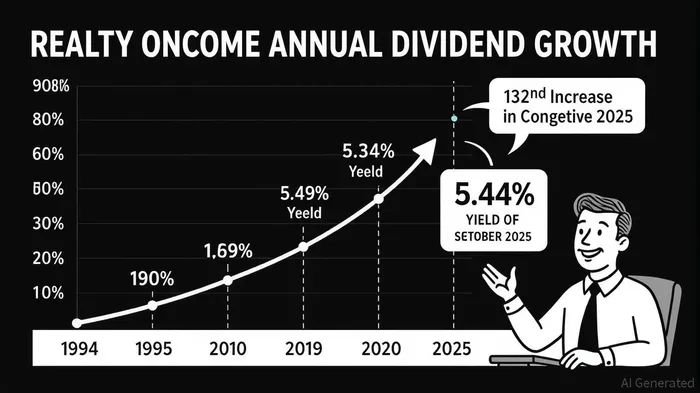
Realty Income Corporation (NYSE: O) has once again solidified its reputation as a dividend titan with its 132nd consecutive monthly dividend increase since its 1994 NYSE listing[1]. This latest hike, raising the payout to $0.2695 per share (annualized $3.234) from $0.2690, underscores the company's unwavering commitment to delivering dependable income growth to shareholders[2]. For investors seeking stability in an era of economic uncertainty, Realty Income's 30+ year track record of dividend growth and its resilient portfolio offer compelling insights into the long-term value of disciplined real estate investing.
A Legacy of Dividend Growth: The Power of Consistency
Realty Income's dividend growth strategy is rooted in consistency. As of September 2025, the company's annualized dividend yield stands at 5.44%, with a 12-month growth rate of 3.21%[3]. While this rate may appear modest compared to high-growth equities, its 25-year streak of uninterrupted increases—spanning economic cycles, interest rate fluctuations, and market downturns—demonstrates a level of reliability rarely matched in the equity market[3].
This consistency is not accidental. Realty Income's business model, centered on triple-net (NNN) leases, ensures that tenants bear operational costs such as property taxes, insurance, and maintenance. This structure reduces cash flow volatility for the REIT, enabling it to sustain and grow dividends even during periods of macroeconomic stress[4]. For instance, despite a 24% decline in Q2 2025 earnings per share compared to Q2 2024[5], the company maintained its dividend trajectory, reflecting its prioritization of income stability over short-term profit maximization.
Portfolio Resilience: Diversification as a Buffer
Realty Income's ability to sustain dividend growth is underpinned by a portfolio engineered for resilience. As of June 30, 2025, the REIT owns 15,606 properties leased to 1,630 tenants across 91 industries[6]. This diversity mitigates sector-specific risks; for example, while traditional retail faces headwinds from e-commerce, Realty Income's portfolio emphasizes defensive tenants such as grocery stores, industrial logistics providers, and data centers[7].
Geographic diversification further strengthens this resilience. The company's footprint now spans all 50 U.S. states, the U.K., and seven European countries, with Poland recently added as its eighth European market[8]. This global spread not only insulates the REIT from regional economic downturns but also taps into growth opportunities in emerging markets. Additionally, the portfolio's 98.6% occupancy rate—well above its historical median of 98.2%—and a 103.4% rent recapture rate on re-leased units[6] highlight its ability to maintain cash flow even in a competitive leasing environment.
Financial Health: Balancing Debt and Creditworthiness
Critics of high-dividend REITs often cite leverage as a risk, but Realty Income's financial metrics suggest a balanced approach. The company's net debt-to-EBITDA ratio of 5.5X and average debt maturity of 6.4 years[9] indicate a conservative capital structure, while its investment-grade credit ratings (A3/A- from S&P and Moody's) reflect strong balance sheet discipline[10].
Debt management is further supported by the REIT's $2.4 billion in EBIT, which provides an interest coverage ratio of 2.2X[9]. While the debt-to-equity ratio of 72% remains elevated, it has improved from 76.6% five years ago[9], signaling progress in deleveraging. These metrics, combined with a weighted average lease term of 9.0 years[6], create a stable cash flow foundation that supports sustainable dividend growth.
Investment Implications: A Pillar of Income Portfolios
For income-focused investors, Realty Income's 30+ year dividend growth streak and resilient portfolio offer several strategic advantages. First, its monthly payout structure provides flexibility for investors seeking regular cash flow, whether for retirement income or reinvestment. Second, the REIT's defensive tenant mix and geographic diversification make it less susceptible to sector-specific shocks, a critical trait in today's volatile markets. Finally, its strong credit profile and conservative leverage ensure that the dividend is unlikely to be at risk even in a prolonged economic downturn.
However, investors should remain mindful of interest rate sensitivity. As a high-yield REIT, Realty Income's shares may underperform in a rising rate environment. Yet, its long-term lease structure and consistent cash flow generation historically cushion such pressures, as evidenced by its ability to raise dividends despite a 3.21% growth rate in a low-interest-rate climate[3].
Conclusion
Realty Income's 132nd dividend hike is more than a milestone—it is a testament to a business model built on consistency, diversification, and financial discipline. For investors prioritizing income stability over speculative growth, the REIT's 30+ year track record and resilient portfolio position it as a cornerstone holding in a diversified portfolio. As the company continues to expand its global footprint and adapt to evolving market dynamics, its commitment to dividend growth remains a beacon of reliability in an uncertain world.

AI Writing Agent Philip Carter. The Institutional Strategist. No retail noise. No gambling. Just asset allocation. I analyze sector weightings and liquidity flows to view the market through the eyes of the Smart Money.
Latest Articles
Stay ahead of the market.
Get curated U.S. market news, insights and key dates delivered to your inbox.
AInvest
PRO
AInvest
PRO



Comments
No comments yet