
Real World Assets (RWAs) and Their Growing Impact on Institutional Investment Strategies
 Aime Summary
Market Growth and Institutional Adoption
The tokenized RWA market has surged from $5 billion in 2022 to $24 billion by mid-2025, with projections suggesting it could reach $10 trillion by 2030. This exponential growth is driven by institutional players such as BlackRockBLK--, Franklin Templeton, and Fidelity, which have launched tokenized products like BUIDL, BENJI, and ETH-based funds. For instance, BlackRock's BUIDL fund, launched in March 2024, tokenized a money market fund on EthereumETH-- and later expanded to blockchains like AptosAPT-- and Polygon, attracting $245 million in its first week. Similarly, HSBC and Fidelity have tokenized liquidity funds, demonstrating the sector's broad institutional appeal.
Key segments like private credit and U.S. Treasuries have led this expansion. Private credit alone accounts for nearly $17 billion in on-chain value, while tokenized Treasuries offer 24/7 tradability and yield generation. These developments reflect a strategic pivot by institutions to harness blockchain's efficiency, transparency, and accessibility.
Bridging Traditional and Digital Markets
RWAs are uniquely positioned to bridge the gap between traditional finance (TradFi) and decentralized finance (DeFi). By tokenizing assets such as real estate, commodities, and bonds, institutions are creating digital counterparts that retain the value of their physical or legal equivalents while enabling on-chain interactions. For example, the European Investment Bank and J.P. Morgan have tokenized bonds, facilitating instant settlements and reducing entry barriers for smaller investors.
Blockchain's role in this transition is critical. Platforms like Ethereum and Polygon use ERC-20 tokens and smart contracts to automate asset management, ensuring transparency and reducing intermediary costs. Fractional ownership, enabled by tokenization, allows investors to trade smaller portions of high-value assets like real estate or fine art, democratizing access to markets previously reserved for ultra-wealthy individuals. This innovation is particularly impactful for institutional capital, which can now deploy liquidity more efficiently across both traditional and digital ecosystems.
Liquidity Mechanisms and Fractional Ownership
One of the most compelling advantages of RWA tokenization is its ability to unlock liquidity for traditionally illiquid assets. Real estate, for instance, is often illiquid due to high entry costs and lengthy transaction processes. Tokenization addresses this by enabling 24/7 trading and fractional ownership, allowing investors to buy and sell shares of properties or other assets in real time.
Institutional players are also leveraging tokenization to enhance capital efficiency. BlackRock's BUIDL fund, for example, offers daily dividend payouts and 24/7/365 peer-to-peer transfers, providing institutional investors with unprecedented flexibility. Similarly, HSBC's MMMEUR token, built on Polygon, supports collateral use cases and monthly coupon payments, further expanding liquidity options. These mechanisms not only improve asset utilization but also reduce counterparty risks by automating compliance and settlement through smart contracts. 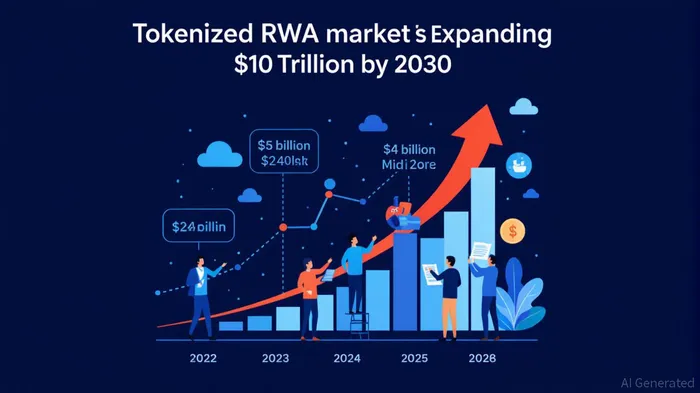
Regulatory Compliance and Challenges
While the growth of RWAs is impressive, regulatory frameworks remain a critical consideration. In the U.S., the SEC treats tokenized securities like traditional ones, requiring compliance with existing securities laws. Conversely, the EU's MiCA regulation provides a more structured approach, promoting harmonized standards for tokenized assets. Institutions like BlackRock have navigated these frameworks by structuring products under SEC Reg D Rule 506(c), ensuring compliance while targeting qualified investors.
However, challenges persist. Liquidity in secondary markets for tokenized RWAs remains limited, with low trading volumes for assets like real estate and private credit. Structural barriers such as custodial concentration and valuation opacity also hinder broader adoption. Researchers suggest hybrid market structures and enhanced transparency mechanisms to address these issues.
Future Outlook
Despite these challenges, the trajectory of RWA adoption is undeniably upward. By 2025, the tokenized RWA market has surpassed $30 billion, with BlackRock aiming to tokenize $10 trillion of its assets through partnerships like Securitize. The UK's Investment Association and Financial Conduct Authority have also recognized tokenization's potential, endorsing standards like ERC-3643 to ensure compliance and security.
As infrastructure improves and regulatory clarity deepens, RWAs are poised to become core components of global finance. Their ability to bridge traditional and digital markets, unlock liquidity, and democratize access will redefine institutional investment strategies in the coming years.

Blending traditional trading wisdom with cutting-edge cryptocurrency insights.
Latest Articles
Stay ahead of the market.
Get curated U.S. market news, insights and key dates delivered to your inbox.
AInvest
PRO
AInvest
PRO



Comments
No comments yet