
Real-Time Aviation Data: A New Frontier for Geopolitical and Economic Risk Analysis in Investment Strategies


 Aime Summary
In an era where geopolitical tensions and supply chain vulnerabilities dominate global economic discourse, real-time aviation data platforms like Flightradar24 are emerging as indispensable tools for investors. These platforms offer granular insights into air traffic patterns, military movements, and infrastructure disruptions, enabling investors to navigate the complex interplay between geopolitics and market volatility. As recent events and expert analyses demonstrate, the ability to monitor and interpret such data is no longer a luxury but a necessity for risk-aware investment strategies.
The Delhi Airport GPS Spoofing Incident: A Case Study in Cyber-Geopolitical Risk
The November 2025 GPS spoofing attacks on Delhi's Indira Gandhi International Airport serve as a stark example of how digital warfare can destabilize critical infrastructure. Over seven days, the attacks disrupted 800 flights, forcing reliance on manual navigation systems after the airport's Instrument Landing System (ILS) was temporarily offline for upgrades
according to reports. 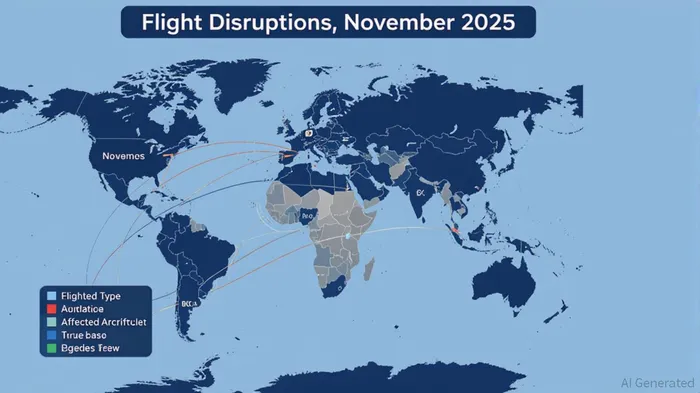 Flightradar24's real-time tracking data highlighted the scale of the disruptions, revealing Delhi as the second-most-affected airport globally during the incident
according to data.
This event underscored the vulnerabilities of GPS-dependent systems in aviation and logistics. According to a report by Breached, the spoofing attacks were not random but strategically timed to exploit gaps in infrastructure resilience, raising concerns about state-sponsored cyber warfare
according to the report. For investors, the incident highlighted the need to reassess exposure to regions reliant on single-point navigation technologies. The National Security Advisor's subsequent investigation into the attack's origins further emphasized the geopolitical stakes, as nations grapple with the weaponization of digital tools
according to findings.
Flightradar24 and the Evolution of Supply Chain Risk Monitoring
Platforms like Flightradar24 are increasingly integrated into supply chain risk management frameworks. By tracking air and maritime traffic in real time, these tools allow investors to visualize trade route disruptions caused by geopolitical events. For instance, during the 2025 Houthi attacks in the Red Sea, Flightradar24 data enabled logistics firms to reroute cargo and mitigate delays, demonstrating the platform's utility in crisis response
according to analysis.
The rise of AI-powered geopolitical risk monitoring has amplified this capability. As noted in a 2025 analysis by Debales.ai, AI agents now process data from 1,000+ sources-including Flightradar24-to predict disruptions such as tariff changes or sanctions. For example, a 60% tariff on Chinese EVs was flagged by AI systems, enabling firms to adjust pricing and logistics strategies preemptively
according to AI monitoring. Such tools are critical for investors, as geopolitical events now account for 45% of supply chain disruptions, up from 25% pre-2020
according to the report.
Military Movements and the Passive Radar Market
The growing demand for advanced surveillance technologies further illustrates the intersection of aviation data and geopolitical risk. The military and civil aviation passive radar market, projected to grow at a 7.5% CAGR from 2026 to 2033, is driven by the need to monitor military movements and secure supply chains amid trade restrictions
according to market analysis. Passive radar systems, which rely on existing signals rather than active emissions, are increasingly adopted by nations seeking to avoid detection while tracking adversarial activity.
Investors are taking note. A LinkedIn analysis highlights how major players are investing in AI-enabled data analytics and software-defined radio (SDR) modules to enhance passive radar capabilities
according to the analysis. This trend reflects a broader shift toward localized, resilient infrastructure-a response to the structural risks posed by global supply chain dependencies
according to industry trends.
Investor Strategy Adjustments: From Reactive to Proactive
The Delhi incident and similar events have prompted investors to adopt proactive risk management strategies. According to a 2025 Solvency II Wire report, insurers are leveraging Flightradar24 data to map trade routes and assess exposure in politically unstable regions
according to the report. This includes developing modular insurance programs that adapt to emerging threats, such as cyberattacks on navigation systems.
Moreover, the fiscal consequences of extreme cybersecurity incidents are reshaping investment portfolios. A study by ResearchGate found that companies experiencing major breaches face long-term financial repercussions, with market valuations declining by up to 30% post-incident
according to economic analysis. In response, investors are prioritizing firms with robust cybersecurity infrastructure and diversified supply chains. For example, following a ransomware attack on Collins Aerospace in September 2025, European airports accelerated investments in cyber insurance and supply chain redundancies
according to findings.
The Future of Geopolitical Risk Analysis
As digital warfare and geopolitical tensions escalate, the role of real-time aviation data in investment decision-making will only expand. Platforms like Flightradar24 are not merely observational tools but strategic assets for anticipating disruptions. For instance, predictive analytics now estimate a 65% probability of renewed U.S.-Israeli operations against Iran in late 2025-a scenario that could ripple through global markets
according to research. Investors integrating such insights into their strategies are better positioned to navigate volatility and safeguard returns.
In conclusion, the convergence of aviation data, AI, and geopolitical risk analysis is redefining modern investment practices. By leveraging platforms like Flightradar24, investors can transform unpredictable threats into actionable intelligence, ensuring resilience in an increasingly fragmented world.

Stay ahead of the market.
Get curated U.S. market news, insights and key dates delivered to your inbox.


AInvest
PRO
AInvest
PRO



Comments
No comments yet