
The Real Epicenter of the March 2026 U.S. Stock Plunge
 Aime Summary
The Korean Crash, Its Hidden Logic, and Actionable Lessons for Retail Traders
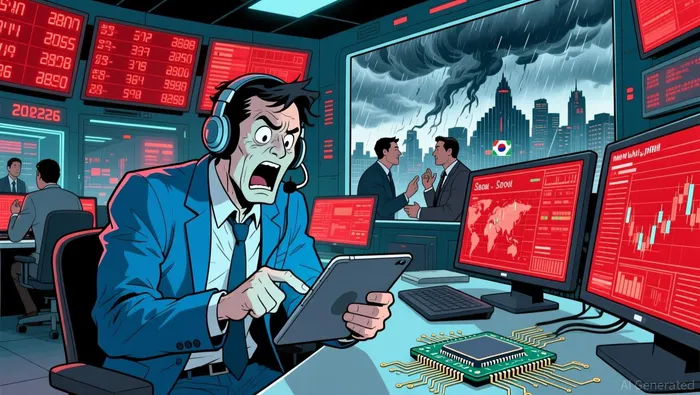
As a trader who's navigated a few market cycles, I've learned that financial crises rarely unfold in a straight line. Sometimes, a storm brewed in one corner of the world makes landfall in another with shocking ferocity. That's precisely the chaotic, non-linear script that played out in early March 2026. While the initial spark flew in the Middle East, the financial tsunami it triggered took a counterintuitive path: its real epicenter wasn't Wall Street, but the Korean stock market. The shockwaves then raced through the global semiconductor supply chain before hammering U.S. tech stocks.
This analysis pieces together the events from the perspective of an individual trader. We'll strip back the headlines to expose the micro-mechanics of the crash, examine the deadly combo of derivative blow-ups and physical supply chain breaks, draw lessons from similar liquidity crises, and outline a concrete, data-backed strategy for navigating what comes next.
{"type":"image","url":"https://cdn.ainvest.com/aigc/hxcmp/images/compress-qwen_generated_1772626688875.jpg.png","prompt":"As a trader who's navigated a few market cycles, I've
learned that financial crises rarely unfold in a straight line. Sometimes, a
storm brewed in one corner of the world makes landfall in another with shocking
ferocity. That's precisely the chaotic, non-linear script that played out in
early March 2026. While the initial spark flew in the Middle East, the
financial tsunami it triggered took a counterintuitive path: its real
epicenter wasn't Wall Street, but the Korean stock market. The shockwaves
then raced through the global semiconductor supply chain before hammering U.S.
tech stocks.
This analysis pieces together the events from the
perspective of an individual trader. We'll strip back the headlines to expose
the micro-mechanics of the crash, examine the deadly combo of derivative
blow-ups and physical supply chain breaks, draw lessons from similar liquidity
crises, and outline a concrete, data-backed strategy for navigating what comes
next.
"}
Part I: The Avalanche Begins in Seoul: Geopolitics and the Sudden Shift in Market Sentiment
To grasp the current U.S. market turmoil, we must start at the beginning. Over the weekend of February 28, 2026, the geopolitical landscape violently reset. A U.S.-Israel joint military strike on Iran, involving operations "Epic Fury" and "Roaring Lion," resulted in significant escalation, including the blockade of the Strait of Hormuz.
A Chokehold on Energy, A Shock to Global Supply Chains
The Strait of Hormuz, a 21-mile wide channel, is the artery for about 20% of the world's daily oil consumption and a major LNG export route. Its effective closure by Iranian forces triggered an instant paralysis in global shipping. Major carriers like Maersk and MSC suspended transit, forcing a 3,500-mile detour around Africa, adding roughly $1 million in fuel costs per voyage.
The energy market's reaction was brutal. WTI crude spiked 8.76% to $77.47/bbl, with Brent following suit, quickly pushing toward $85. Goldman Sachs warned that a full, month-long blockade could send European and Asian spot gas prices soaring by 130%.
Korea's Market Meltdown and the Tech-Wide U.S. Selloff
As an economy critically dependent on energy imports, South Korea's market bore the immediate brunt. On March 3-4, the KOSPI index went into freefall, plunging 7.24% initially before losses deepened to 11% intraday, triggering market-wide circuit breakers and halting program trading. Foreign investors dumped a net $4.7 billion in Korean stocks in just two days.
The panic didn't stay in Seoul. As the epicenter of global memory chip manufacturing, Korea's pain became Wall Street's problem. Samsung Electronics (SSNLF) cratered ~10%, and SK Hynix (HXSC.F) plunged 11.5%. The selling virus jumped the Pacific.
While the S&P 500 and Dow managed relatively contained single-day drops (0.9% and 0.8% respectively), thanks partly to U.S. energy production, the damage in tech was severe. The Nasdaq fell 1%, and semiconductor ETFs bore the worst of it: * VanEck Semiconductor ETF (SMH) & iShares Semiconductor ETF (SOXX): Down over 3.5% each. * Tech Select Sector SPDR Fund (XLK): Down 3%. Individual giants like NVIDIA (NVDA) fell 3%, AMD (AMD) dropped ~4%, and memory-exposed Micron (MU) tanked 6.6%. In 48 hours, global equities shed over $3.2 trillion in value. The VIX fear gauge spiked 21% to 25.97—panic had officially arrived.
The Macro Pivot: From "Soft Landing" to "Stagflation" Fears
This event flipped the script on the 2026 macro narrative. The prevailing "soft landing" and Fed rate-cut story evaporated overnight. With oil and gas prices surging, the inflation fight was back on.
Banks like JPMorgan warned that sustained high oil prices ($85-$90+) would not only crush the odds of a March Fed rate cut (from ~80% to near-zero) but also sharply raise recession risks in Europe and East Asia. If oil breached $100, a global recession within two quarters was on the table. The market theme shifted abruptly from "valuation expansion on easing hopes" to "defensive contraction on re-inflation and earnings risk."
Part II: Why Was Korea the Epicenter? The Fascinating, Hidden Drivers
Why did a Middle East conflict hammer a Northeast Asian stock market more than almost anywhere else? This counterintuitive outcome reveals critical blind spots in the global financial system.
1. A Fragile Energy Lifeline Meets the AI Supply Chain's Achilles' Heel Korea's industrial model is built on an incredibly fragile energy import system. A staggering 70.7% of its crude oil and 20.4% of its LNG comes through the Strait of Hormuz. For Korea, a blockade isn't just an inflation shock—it's a physical supply break. As the OECD nation with the highest oil consumption-to-GDP ratio, it's hyper-sensitive to this exact crisis.
Furthermore, its crown jewel industry—semiconductors—is intensely energy-hungry. Producing AI chips (like NVIDIA's GPUs and SK Hynix's HBM memory) consumes vast amounts of power. Soaring energy costs directly eat into chipmaker margins. Logistics delays compound the problem, stretching delivery times globally. Reports even surfaced that Samsung's massive Texas fab expansion could be delayed to 2027. Korea isn't just an oil importer; it's the linchpin of the global AI hardware supply chain. When it chokes, Wall Street's "infinite AI capacity" valuation model cracks.
2. The "Ant" Army: Retail Mania and Concentrated Bets Backfire Before the crash, Korea's market was a global standout. Fueled by AI mania, the KOSPI had skyrocketed 130% in 12 months, breaching 6000 for the first time. The U.S.-listed Korea ETF (EWY) was up 92% in 2025 and another 28% YTD in 2026.
But this was a house of cards. A historic retail frenzy—Korea's individual investors, nicknamed "ants"—had opened over 100 million stock accounts (nearly double the population). Leveraged ETFs and mega-cap tech stocks saw massive inflows, with liquidity hyper-concentrated in names like Samsung and SK Hynix. SK Hynix, as a ~70% supplier of HBM to NVIDIANVDA--, saw its price wildly disconnected from fundamentals.
Former JPMorgan strategist Marko Kolanovic had warned this looked like a classic "blow-off top," with retail buying masking stealthy institutional selling. When the external shock hit, this over-leveraged, narrow "inverted pyramid" was destined for a catastrophic collapse.
3. The Hidden Trigger: Volatility-Selling and the "Autocallables" Bomb Beyond fundamentals, a key hidden accelerant was the widespread use of "Autocallable" structured products in Korea. These complex notes, popular in a low-rate world, allowed investors to earn high yields by effectively selling volatility.
Here’s the killer setup: These products were often linked not just to the KOSPI, but also to the S&P 500 and volatile U.S. tech stocks like Tesla (TSLA). They paid out handsomely as long as markets were calm. But if the underlying assets moved violently outside a set range, the notes would "knock out," forcing massive, simultaneous unwinding.
Throughout the KOSPI's relentless rally in early 2026, these volatility-shorting products kept getting "knocked out," draining volatility supply from the market. This created a bizarre anomaly: even as stocks hit record highs, Korea's version of the VIX doubled to over 50. This "high stocks, high vol" distortion sent weird signals to global quant funds.
When the Middle East crisis hit and Korean stocks plunged through the Autocallables' lower barriers, a tidal wave of these products triggered at once. Dealers, forced to hedge, frantically sold the underlying assets—including those U.S. tech stocks. What started as a local Korean selloff morphed into a global, derivatives-driven liquidity crunch centered on the very tech names everyone owned.
Part III: Beneath the Surface: The Ominous Signal in Korea's $70 Billion Rescue
In response, Korean authorities moved with crisis-level speed, announcing a "100 trillion Won+" (roughly $70 billion) market stabilization fund. Major financial groups pledged tens of billions more in liquidity support for businesses.
This overwhelming response is the critical signal for global traders: The perceived damage goes far beyond a normal valuation correction. It hints at systemic financial and real economy risks.
1. A Debt Crisis Extended To understand the scale, you must look back. In 2022, Korea faced a credit crisis (the "Legoland" developer default) and launched a 50 trillion Won liquidity fund. That tool was never fully retired and was recently extended into 2026. The new "100 trillion Won" plan is essentially an escalation and continuation of past debt bailouts.
Korea's fiscal position in 2026 is stretched thin, with a record budget and massive bond issuance planned. With global rates likely to stay high (or rise) due to the new inflation shock, financing costs are soaring. This rescue isn't just about propping up the KOSPI; it's a desperate attempt to prevent a stock crash from triggering a "wealth effect" collapse, a corporate debt default wave, and a full-blown banking crisis. They are using national credit to backstop an over-leveraged economy.
2. Pressure on the AI National Strategy Korea's ambitious plan to become a "top 3 AI power" involves a five-year, 100+ trillion Won national fund. The 2026 budget alone tripled AI spending to about $7.5 billion. These plans rely on smooth capital markets and easy fiscal financing. With stocks crashing, foreign capital fleeing (pushing the won to ~1478/USD), and emergency funds being diverted, Korea's AI infrastructure investments face severe headwinds. A slowdown here directly threatens the iteration speed of the global AI supply chain—a core fundamental reason why U.S. AI leaders like NVDANVDA-- and AMDAMD-- sold off in tandem.
Part IV: History's Reflection: The 2026 Korea Crash vs. The 2024 Yen Unwind
Smart traders look for historical rhymes. The closest recent parallel is the August 2024 "Yen Carry Trade Unwind." Comparing the two is essential for mapping the potential path ahead.
The Key Takeaway: The 2024 event taught us that derivative/leverage blow-ups can create short-term, deep "oversold" conditions in quality assets. However, 2026's defining feature is the return of an "inflationary backdrop." With oil prices structurally higher, the Fed cannot easily ride to the rescue with liquidity. The old playbook of relying on the "Fed Put" to save tech valuations is broken. We are in a higher-for-longer reality.
Part V. A Retail Trader's Survival Guide: Mindset Reset and Defensive Positioning
In this complex environment, what should an individual trader do? As Fidelity's portfolio team noted in a 2026 piece: "If 2025 taught us anything, it’s that markets react to headlines, but portfolio victories are won with discipline. In 2026, resilience isn’t about predicting the next shoe to drop, but being positioned for any outcome."
1. Trading Psychology: Ditch Panic, Ditch "High-Beta" Dependency * Don't sell into a VIX spike (>25). History shows selling at peak fear often means selling low to institutional buyers. * Break the "tech only goes up" mentality. The era of easy multiple expansion on AI hype is over, at least for now. Your portfolio is likely overexposed. Blindly averaging down into high-beta semis (MU, etc.) is a dangerous game.
2. The Strategic Pivot: Rotate into "Defensive Assets" & Havens When growth is shocked, capital flows to quality: strong balance sheets, stable cash flows, pricing power, and recession resistance.
3. Build a "Barbell" Portfolio for All Weathers Abandon single bets. Adopt a barbell strategy for balance:
Final Thought
The March 2026 storm started with missiles in the Middle East, found its financial trigger in Seoul's derivatives market, and delivered a chill to every tech-heavy portfolio on Wall Street. It was a brutal lesson in modern interconnectedness: Korea's oil dependence, retail speculation in AI chips, and complex structured products combined to create a perfect storm.
Korea's frantic $70 billion rescue is more than a local lifeline. It's a blaring siren for global investors. The "Goldilocks" era of low volatility and perpetual AI gains is being challenged by the return of geopolitical risk premiums and supply-chain-driven inflation.
As a retail trader, your task isn't to panic-trade or try to catch a falling knife. It's to understand the fragile supply chain logic, strip away leverage-driven illusions, and rotate capital into assets with real pricing power, robust cash flows, and physical defensive attributes. Discipline, deep diversification, and a defensive posture are your keys to not just surviving this storm, but positioning to thrive when the fear finally clears.

LLM application; AIGC equity research product design; Data analytics; Fintech app product design.
Latest Articles
Stay ahead of the market.
Get curated U.S. market news, insights and key dates delivered to your inbox.
AInvest
PRO
AInvest
PRO



Comments
No comments yet