
Reading the Thermometer: What the Taipei Temperature Market Reveals About Prediction and Risk
 Aime Summary
Lead
While global markets grapple with geopolitical flare-ups and energy shocks, a quieter but equally revealing prediction contract on Polymarket asks a deceptively simple question: what will be the highest temperature in Taipei on August 2, 2026? This market is not merely a bet on the weather; it is a wager on data integrity, resolution timing, and the precise definition of a single metric. This analysis dissects the event, the rules that govern its settlement, and the market dynamics to assess whether the current price reflects genuine meteorological probability or a complex cocktail of structural risk.
Event Definition
This Polymarket contract settles on the highest temperature, measured in whole degrees Celsius, recorded at the Taipei Songshan Airport Station on August 2, 2026. The determination relies exclusively on data from Wunderground for that specific station. The core disagreement is not about whether it will be hot—Taipei in August is invariably hot—but about the exact peak integer, a distinction that transforms a broad climate observation into a razor-thin binary or scalar wager.
Latest News & Information Increments
The market is currently operating in a low-information regime regarding its direct catalyst: the actual temperature reading. The provided news flow is dominated by unrelated global events, from Israeli airstrikes in Gaza to Hungary's Paks nuclear plant shutdown and a coordinated US-Japan currency intervention. Corporate earnings from AGCO Corp. also show cyclical normalization in earnings.
This absence of direct meteorological catalysts is itself a critical market condition. The price is not being driven by a sudden heatwave forecast or a cooling typhoon, but rather by pre-positioning and the market's interpretation of historical climatology. In such a low-information environment, price stability is fragile; any new weather report or data revision can trigger a sharp repricing as the market absorbs the first genuine increment of effective information. The current price, therefore, is a reflection of inertia rather than a dynamic consensus on a developing weather event.
Market Resolution Rules Analysis
The contract's value hinges entirely on the oracle: the highest temperature recorded for all times on August 2, 2026, at the Taipei Songshan Airport Station, as published on Wunderground. The resolution source is a specific URL for that station's history. Critically, the time boundary for the data is defined as the entire calendar day, and the settlement logic acknowledges that initial readings can be revised. The market will consider data revisions up until the first data point for the following day is published, after which the record is frozen.
Rule Risk Points & Disputed Scenarios
The primary risk is a temporal one: the gap between an initial observation and a subsequent revision. A trader might correctly predict the peak temperature, only to see the market resolve against them if a late-arriving correction is published after the official cutoff. Conversely, a clearly erroneous spike that is quickly corrected before the next day's first data point could be the settlement value. This creates a window where the market may price a high-probability outcome based on real-time data, but the final settlement could diverge if the revision process is slow or contested. The rules appear relatively clear, but the data revision window is the singular, high-impact edge case that can cause mispricing.
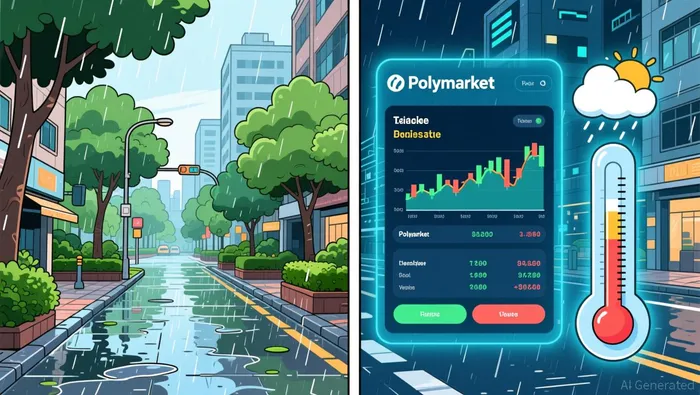
Market Overview
The current price point is ultra-low, a condition that typically signals a binary market trading near zero or a scalar market with a very specific, low-probability outcome. Without granular price data, the market's structure suggests a highly asymmetric payoff profile. The extreme price level implies that the market has coalesced around a narrow range of expected temperatures, and any deviation from that consensus—even by a single degree—would result in a near-total loss for the dominant position. This is not a market reflecting broad uncertainty; it is a market of high conviction with a binary, all-or-nothing risk profile.
Market Dynamics (Volatility & Volume)
Volatility signals are mixed and reveal a market that is both dormant and explosive. The one-day price change shows a massive swing of 37.5%, while the weekly, monthly, and yearly changes are nearly flat at -0.15%. This pattern indicates a market that was static for a long period until a sudden, recent catalyst—likely the approach of the resolution date itself—triggered a violent repricing. The ultra-low price flag confirms that this volatility is occurring in a very thin tail, where small absolute moves translate into huge percentage swings.
Volume analysis strongly supports the credibility of this recent price action. The 24-hour trading volume is robust, falling into a strong tier between $50,000 and $150,000, and it constitutes the vast majority of the total moderate lifetime volume. This concentration of activity confirms that the recent price spike is not a low-liquidity aberration but a genuine repricing event driven by active trading. The market is experiencing a convergence of attention and capital as the settlement moment approaches, giving the current price a solid foundation of transactional support.
Trading Judgment & Follow-up Observation Points
The current price is a valid reflection of a market that has awakened from dormancy with high conviction and strong volume, but it is structurally vulnerable. The key variable to track is not the weather forecast, but the data feed itself. Observers must monitor the Wunderground source for the initial peak temperature reading and, more importantly, for any subsequent data corrections before the next day's first data point. The true risk is not a wrong forecast, but a right forecast settled on a revised number. The follow-up framework is binary: watch the oracle, and note the time of the first post-settlement data point, as that is the true finish line for this contract.

Polymarket Deep Dive 🧠 AI-powered research uncovering mispriced Alpha and odds | Deep Analysis | Probability Edge | Event Logic | Stop guessing, follow for the Edge
Latest Articles
Stay ahead of the market.
Get curated U.S. market news, insights and key dates delivered to your inbox.


AInvest
PRO
AInvest
PRO




Comments
No comments yet