
RBI Holds CRR at 3%, Signaling Liquidity Stability
 Aime Summary
- The Reserve Bank of India (RBI) maintained the Cash Reserve Ratio (CRR) at 3%, confirming no change in liquidity parameters for scheduled commercial banks861045--.
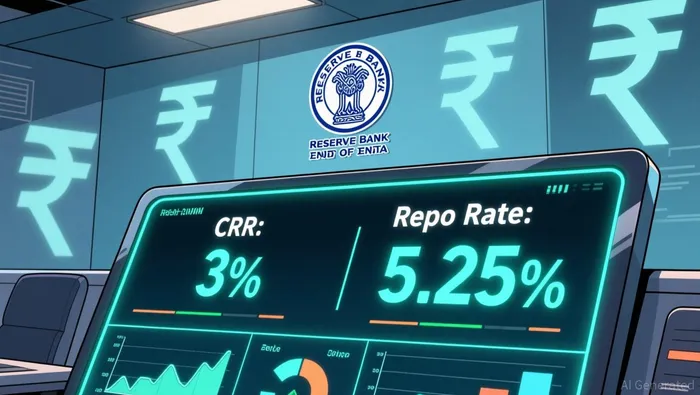
- This static liquidity metric coincides with the RBI MPC's decision to hold the repo rate at 5.25% and adopt a neutral policy stance for the August 2026 meeting.
- The unchanged CRR helps manage systemic liquidity as the government raises ₹32,000 crore through dated securities, ensuring banks have adequate funds to participate in sovereign auctions.
- Investors view the stable CRR as a signal that the RBI prioritizes liquidity stability over aggressive tightening, even as it intervenes in forex markets to mitigate excessive rupee volatility.
The Reserve Bank of India (RBI) kept the Cash Reserve Ratio (CRR) unchanged at 3% on August 5, 2026, publishing the data at 12:30 alongside the Monetary Policy Committee (MPC) meeting outcomes. This static liquidity parameter underscores the central bank's cautious approach to monetary policy, balancing the need to support economic growth against the risks of persistent inflation. The decision to maintain the CRR aligns with the broader macroeconomic environment, where underlying inflation remains under control, and growth projections have been revised upward.
How Does the Unchanged CRR Fit Into the RBI's Broader Policy Framework?
The Cash Reserve Ratio (CRR) is a critical tool for the RBI to manage liquidity in the banking system. By keeping the CRR at 3%, the central bank ensures that commercial banks maintain a steady portion of their deposits as reserves, which supports credit availability without injecting excessive liquidity that could fuel inflation. This decision is consistent with the MPC's neutral stance on monetary policy, which was adopted following the August 2026 meeting.
The MPC maintained the benchmark repo rate at 5.25%, citing controlled underlying inflation and strong domestic demand as key drivers of economic resilience. Governor Sanjay Malhotra highlighted that headline inflation volatility is largely supply-driven, particularly from food861035-- and fuel prices, rather than broad-based demand pressures. This distinction allows the RBI to remain data-dependent, waiting for greater clarity on the growth-inflation dynamic before considering any policy shifts. The unchanged CRR complements this approach by providing a stable liquidity backdrop, enabling banks to manage their balance sheets effectively amid global uncertainties.
Why Is Liquidity Stability Crucial Amid Sovereign Borrowing and Forex Interventions?
The static CRR takes on added significance in the context of the government's borrowing requirements and the RBI's forex market interventions. The Government of India announced the sale of two dated securities, totaling ₹32,000 crore, to manage sovereign borrowing. The auction, conducted via the e-Kuber system on August 7, 2026, includes 6.36% GS 2031 and 7.71% GS 2066, with the government retaining option to retain additional subscription up to ₹2,000 crore against each security.
The unchanged CRR ensures that the banking system has sufficient liquidity to absorb this sovereign issuance, preventing potential liquidity crunches that could arise from large-scale government borrowing. Concurrently, the RBI has been active in the forex market, conducting net sale of USD 14.9 billion between January and May 2026 to curb excessive rupee volatility. While the INR is market-determined, the RBI's interventions aim to stabilize the currency during periods of excessive swings. The stable CRR supports this by maintaining a robust liquidity position in the banking system, which is essential for managing both domestic borrowing needs and external sector stability.
Looking ahead, investors will watch for any shifts in the RBI's liquidity management strategy, particularly as global risks such as geopolitical tensions and the US Federal Reserve's policy trajectory continue to evolve. The RBI's emphasis on core inflation and data-dependent guidance suggests that policy adjustments will be gradual and targeted, with the CRR serving as a key indicator of the central bank's liquidity stance. As the economy navigates these complexities, the static CRR reflects a measured approach to supporting growth while safeguarding financial stability.

Stay ahead of the market.
Get curated U.S. market news, insights and key dates delivered to your inbox.


AInvest
PRO
AInvest
PRO




Comments
No comments yet