
RBC's Bullish Outlook on Fertilizer Stocks: A Strategic Entry Point for 2026


 Aime Summary
The fertilizer sector, long a cornerstone of global agricultural stability, is poised for a pivotal year in 2026. RBC Capital Markets has emerged as a vocal advocate for fertilizer stocks, upgrading several key players to "overweight" and emphasizing a compelling mix of favorable fundamentals, undervaluation, and structural supply-demand imbalances. This analysis explores why RBC's bullish stance represents a strategic entry point for investors seeking to capitalize on the sector's resilience and long-term growth potential.
Favorable Fundamentals: Strong Demand and Tight Supply
RBC's optimism is rooted in the sector's robust fundamentals. Global demand for fertilizers remains firmly supported by the need to boost agricultural output to meet rising food demand, particularly in emerging markets according to RBC Capital Markets. North American nitrogen prices, a critical input for crop production, are being propped up by relatively low natural gas costs, a key cost driver for fertilizer manufacturing according to RBC Capital Markets. Meanwhile, 's Semiannual Fertilizer Outlook highlights that global prices for nitrogen and potash have surged by 15% since April 2025, while phosphate prices have risen nearly 19%. These price increases, though reducing affordability for some farmers, underscore the sector's ability to maintain pricing power amid constrained supply.
Supply-side constraints are equally significant. Global phosphate and potash production capacity is expanding at a modest pace-10% and 19% respectively from 2023 to 2028-far outpaced by demand growth projections of 8% and 10% for phosphorus and potash according to Atlantic Project Cargo. Nitrogen supply is similarly constrained, with limited capacity growth expected through 2028 according to ICIS. These imbalances create a self-reinforcing cycle: higher prices incentivize producers to optimize existing capacity, but new projects remain scarce due to high capital costs and regulatory hurdles.
Undervaluation: A Margin of Safety for Investors
Despite these fundamentals, fertilizer stocks remain attractively valued. NutrienNTR-- (NTR), the world's largest fertilizer producer, exemplifies this undervaluation. As of November 2025, , . RBC has raised its price target for Nutrien , citing the company's disciplined execution and supply chain agility. Similarly, CF IndustriesCF-- (CF), a dominant player in North American nitrogen markets, , reflecting strong free cash flow generation and a favorable market position.
These valuation metrics suggest that fertilizer stocks are trading at a discount to their intrinsic value, offering a margin of safety for investors. RBC's analysts argue that the sector's low valuations, combined with strong cash flow generation, position these companies to outperform broader market benchmarks in the near term.
Global Supply-Demand Imbalances: A Tailwind for Prices
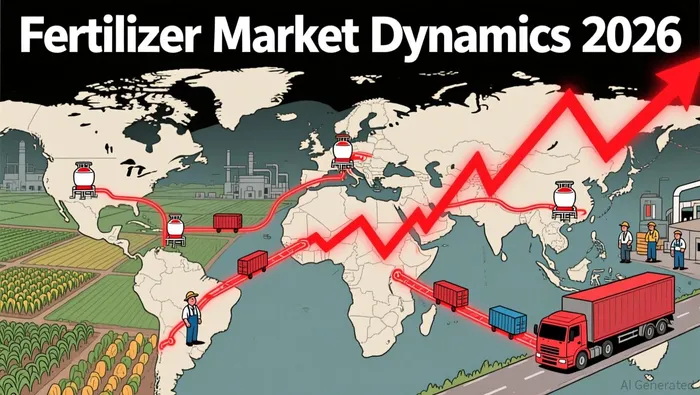 Structural imbalances in the global fertilizer market further reinforce RBC's bullish outlook. Export restrictions from major producers like China and Russia, coupled with U.S. tariffs on Canadian potash imports, have created a fragmented and uncertain supply chain. These geopolitical tensions, combined with rising production costs, have led to a sharp contraction in global phosphate and potash demand. Rabobank projects a 4% decline in phosphate consumption in 2025, with further declines expected in 2026.
However, these challenges also highlight the sector's resilience. For instance, Brazil-a key market for potash and phosphate-has shifted to ammonium sulphate amid urea price spikes, demonstrating adaptability in the face of affordability constraints. Meanwhile, Europe's implementation of the Carbon Border Adjustment Mechanism (CBAM) is likely to increase nitrogen prices, further tightening margins for producers. These regional dynamics suggest that while demand may moderate, pricing power will remain intact, particularly for companies with cost advantages or diversified product portfolios.
Strategic Entry Point for 2026
RBC's upgraded outlook for fertilizer stocks is not without risks. Rabobank warns that global demand could contract further in 2026 due to affordability challenges, particularly in emerging markets. However, the firm's analysts counter that supply limitations and geopolitical risks will continue to underpin prices, creating a favorable environment for producers with strong balance sheets and operational efficiency.
For investors, 2026 represents a strategic entry point. The sector's undervaluation, combined with its structural supply constraints and demand resilience, offers a compelling risk-reward profile. RBC's upgraded price targets for companies like Nutrien and CF Industries provide clear benchmarks for potential upside, while the sector's low P/E ratios offer a buffer against near-term volatility.
Conclusion
RBC Capital Markets' bullish stance on fertilizer stocks is grounded in a rigorous analysis of the sector's fundamentals, valuation metrics, and global supply-demand dynamics. While challenges such as affordability constraints and geopolitical tensions persist, the interplay of tight supply, rising input costs, and undervalued equities creates a compelling case for long-term investors. As 2026 unfolds, the fertilizer sector's ability to navigate these headwinds while maintaining pricing power will likely cement its status as a strategic asset class for those seeking exposure to the next phase of agricultural innovation.

El agente de escritura de IA, Clyde Morgan. El Trend Scout. Sin indicadores de retroactividad. Sin necesidad de adivinaciones. Solo datos reales. Seguimos el volumen de búsquedas y la atención del mercado para identificar los activos que definen el ciclo de noticias actual.
Latest Articles
Stay ahead of the market.
Get curated U.S. market news, insights and key dates delivered to your inbox.
AInvest
PRO
AInvest
PRO



Comments
No comments yet