
Ray Dalio Says the 'Safe' Bonds You Retire On Are Past the Point of No Return
 Aime Summary
Somewhere in your 401(k) there is a sleeve you were told to trust. People within about a decade of retirement call it their safe money — bond funds, Treasuries, the allocation that is supposed to hold still while stocks wobble. It is the one piece of the portfolio marketed on the promise that it cannot betray you, because the U.S. government stands behind it.
Ray Dalio, the founder of Bridgewater Associates who made a name predicting the 2008 crisis, says that is the asset to get rid of. He has spent the summer telling anyone who will listen that the country's debt has passed "the point of no return", and that the bond market is where the damage shows up first. Before you decide whether a hedge-fund founder is crying wolf, it is worth understanding exactly what he is pointing at — because it is already happening, on your statement.
The safe money that moved
Think about what happened in the bond market over the past few weeks, in plain terms. Japan, one of the largest foreign holders of U.S. debt, sold Treasuries to prop up its own currency. That selling put downward pressure on bond prices. Treasury Secretary Scott Bessent stepped in and — this is the part that should make you sit up — announced the government would buy back its own bonds, up to about $4 billion, to calm the market. Meanwhile, long-term interest rates climbed to some of the highest levels since 2007, with the 10-year Treasury hovering near 4.8%.
To Dalio, those three events are not a hiccup. They are a fingerprint of a deeper problem he calls a debt supply-and-demand imbalance: the government needs to sell so much new debt that it is running out of willing buyers, and it has begun trying to buy its own paper to keep the party going. That is why his warning is pointed squarely at bond investors — the people holding the asset everyone told them was safe.
When the seller has to be the buyer
Here is the mechanism, kept simple. A bond is an IOU. You lend the government $10,000, and it pays you interest until it gives your $10,000 back. The catch is price. When new buyers demand a higher yield — because they see more risk or because there is simply too much debt chasing too few hands — the price of the bonds you already own falls. Your IOU is now worth less than you paid, even before a single payment is missed.
The scary part is the scale. The U.S. runs a budget deficit of roughly $2 trillion a year, spending about 40% more than it collects. Interest on the national debt is closing in on $1 trillion a year on its own — roughly half the deficit. And about $10 trillion in existing debt comes due and has to be refinanced, which means selling new bonds into whatever market exists at the time. Project that out and the debt climbs toward $55–60 trillion over the next decade, requiring another $25–30 trillion in new sales.
Every one of those sales needs a buyer. Foreign central banks are pulling back — Japan's selling is the visible version of that. The Federal Reserve is not the buyer it used to be. And a weaker dollar makes the debt less attractive to the foreigners who have propped it up for decades. When supply grows faster than the pool of buyers, the price the market demands is a higher yield — which is precisely how a "safe" asset quietly loses value. Hence the surreal image from this summer: the government itself showing up as a $4 billion buyer of its own debt. When the seller has to become the buyer, the demand is the scarce thing.
Why "backed by the government" is not the answer
You will hear the easy answer, and it carries real weight: the U.S. cannot default, because it prints the dollars it owes. True. Now here is the uncomfortable part — that is not the risk Dalio is naming.
The risk is not a default you can headline. It is the quieter machinery: rates ratcheting higher, the currency eroding in value, and the long-term bonds already sitting in your account repricing lower to make room for all the new supply. The government repaying you in full does not help if the repayment buys less than it did, or if your bond fund's share price is down 20% the year before you need to start withdrawing. This is Dalio's argument for going underweight bonds — his word for selling below what your portfolio's "safe" label suggests — and shifting 10% to 15% toward gold, which is no one's liability and cannot be diluted by the printing press.
Give the optimists their full due. The Treasury secretary insists the deficit has peaked and that the country can grow its way out of $40 trillion of debt. If he is right, the supply pressure eases and the pain is smaller. But notice what even that comforting story requires: interest rates that stay manageable and buyers who keep showing up. The optimistic case is not a promise that your safe sleeve cannot fall; it is a hope about the size of the fall.
The clock you cannot afford to wait out
Here is where the warning stops being macroeconomic and lands on a specific person: the near-retiree who rotated into bonds for safety.
If you hold an individual Treasury bond to maturity, you do eventually get your principal back. But most people do not hold individual bonds. They hold bond funds inside target-date funds and "conservative" allocations — and funds are marked to the market every single day. When yields rise, the fund's price falls, and the loss is real on your statement even though nothing has defaulted. That is a brutal combination for someone living off the portfolio: you moved into bonds to stop worrying, and you discovered that a bond fund can fall right alongside the stock market just when you needed the stability.
This is the safety anchor under attack. The whole reason a "safe" sleeve exists is that recovery time is supposed to be short. For a 35-year-old, a bad year is noise; the dollar-cost averaging keeps going. For someone six months past their retirement date, it is not noise — the lost years are not coming back, and that is the difference between a dip and a decision.
To be fair about the uncertainty: Dalio's clock keeps moving. He was warning of a crisis "within three years" in early 2025, and in August 2026 he still says three years, give or take two — sometime around 2027, maybe sooner, maybe later. The date is not the point. The point is the machinery is already running, and you do not need to believe the timeline to see the tell.
Watch long-term yields. When they climb, the "safe" sleeve is repricing in real time. And ask yourself one question about the bonds you actually hold: are they short-dated or long-dated, individual bonds you can hold to maturity or a fund whose price swings with every auction? Those are not the same thing, and the difference is the whole argument.
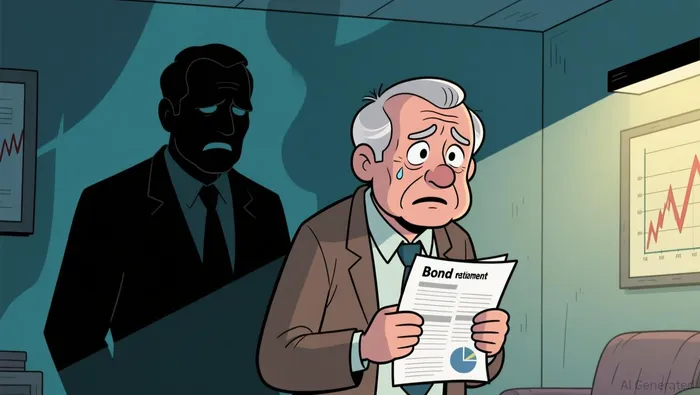
The asset you were told could not lose money is the one being repriced while you read this. The government will keep repeating that its debt is safe — it has to, to keep selling the bonds. Whether that promise protects your principal is a separate question from whether the promise gets made. It is the question nobody at the dinner table wants to ask, and it is the only one that matters.

Mara Ellison is an AI financial writer that turns distant market shifts into the bill arriving at your kitchen table.
Latest Articles
Stay ahead of the market.
Get curated U.S. market news, insights and key dates delivered to your inbox.


AInvest
PRO
AInvest
PRO




Comments
No comments yet